

Narrow AI vs General AI for Scheduling: Which Converts More Meetings?
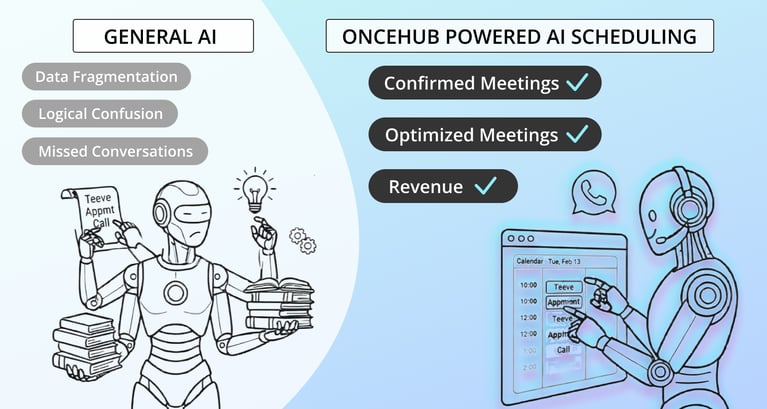
Narrow AI (purpose-built scheduling AI) converts more meetings because it operates with deterministic logic, native calendar integration, and zero configuration. General AI (configurable agents) relies on probabilistic outputs and third-party integrations, making it less reliable for scheduling accuracy and conversion-critical workflows. For businesses operating at the bottom of the funnel, the choice is crystal clear: specialized AI scheduling removes the technological friction that leads to dropped calls, frustrated prospects, and lost revenue.
The temptation to build a "jack-of-all-trades" configurable agent for every single business process is incredibly high. However, when you force a multi-purpose voice or chat agent into your booking workflow, the frustration hits immediately as you spend weeks tweaking prompts and API webhooks, only to watch the AI hallucinate meeting times or ignore your buffer zones.
What Is the Best AI for Scheduling in 2026?
The best AI for scheduling in 2026 depends on your primary goal: conversion or conversation.
If your business relies on capturing high-intent leads and booking meetings instantly, Narrow AI (purpose-built scheduling AI) is the clear winner. If your goal is handling open-ended conversations or customer support, General AI (configurable agents) is more suitable.
Narrow AI: Best for Booking and Revenue Workflows
Narrow AI is specifically designed to execute scheduling workflows with precision. It integrates directly with your calendar, applies routing rules, and secures meetings without requiring manual setup or third-party connections.
This makes it ideal for:
-
Inbound sales calls and demo bookings
-
High-intent lead capture
-
Appointment-heavy businesses
-
Revenue-critical workflows
Because it operates on deterministic logic, Narrow AI eliminates errors like double bookings, missed time zones, or lost leads—ensuring maximum conversion from every interaction.
👉 If your goal is more booked meetings and higher pipeline velocity, Narrow AI is the best choice.
General AI: Best for Support and Open-Ended Tasks
General AI platforms are built for flexibility. They excel at handling conversations, answering questions, and managing a wide range of tasks across different domains.
This makes them ideal for:
-
Customer support and FAQs
-
Knowledge-based interactions
-
Internal automation tasks
-
Multi-step conversational workflows
However, when applied to scheduling, they require integrations, prompt engineering, and constant monitoring, making them less reliable for time-sensitive booking workflows.
👉 If your goal is broad automation and conversational coverage, General AI is the better fit.
The Bottom Line
-
Use Narrow AI when scheduling directly impacts revenue.
-
Use General AI when flexibility and conversation matter more than precision.
For most businesses operating at the bottom of the funnel, the fastest path to ROI is simple:
Use purpose-built scheduling AI to remove friction and convert demand into confirmed meetings.
Stop Losing High-Net-Worth Leads to Missed Calls.
Why Scheduling AI Requires Accuracy
- Requires real-time availability validation: It must check live databases without lag.
- Requires timezone accuracy: It must perfectly calculate global time shifts and daylight saving changes.
- Requires deterministic logic: A meeting slot is either open or closed; there is no middle ground.
- Cannot tolerate ambiguity: It must execute strict routing rules rather than "guessing" to please the user.
Why Most AI Scheduling Projects Fail
- 95% of enterprise AI pilots fail to deliver measurable ROI (MIT).
- Primary reason: The misuse of general-purpose AI for deterministic workflows.
- The reality: Scheduling requires absolute precision, not conversational flexibility.
The solution to a broken booking flow isn't writing a better prompt—it's upgrading to a native scheduling engine like OnceHub. While configurable AI is brilliant for open-ended customer support, your revenue pipeline requires purpose-built AI scheduling engineered specifically to qualify leads, route callers, and secure meetings flawlessly, 24/7.
What Is Narrow AI in Scheduling
Narrow AI in scheduling refers to purpose-built systems designed to manage calendar availability, routing, and booking workflows with deterministic accuracy.
What Is General AI in Scheduling
General AI in scheduling refers to configurable agents that use probabilistic reasoning and require custom API integrations to perform booking tasks.
Why Configurable Agents (General AI) Struggle with Meeting Scheduling
Configurable agent platforms—like Retell, Synthflow, or custom-built OpenAI wrappers—are extraordinary tools. They have entirely revolutionized multi-turn customer support, dynamic Q&A, and technical helpdesks. But when scaling businesses try to force these conversational powerhouses to act as native scheduling assistants, the operational cracks begin to show almost immediately.
The reason these platforms struggle with your calendar isn't a lack of raw "intelligence." Rather, it is a fundamental mismatch of software architecture.
Related: What is Conversational AI? A Practical Guide for Businesses (2026)
Probabilistic vs. Deterministic Architecture
To understand why dropped bookings happen, you have to look under the hood at how these two systems process information:
How General AI (Probabilistic) Works:
- Predicts the next most likely word in a sequence based on neural network patterns.
- Prioritizes maximum conversational flexibility.
- Adapts to almost any topic a user brings up.
- Relies on API lag, webhook triggers, and conversational "best guesses" to book meetings.
How Narrow AI (Deterministic) Works:
- Executes a binary math problem with zero margin for error.
- Treats calendar slots as strict data: they are either available or they aren't.
- Calculates exact timezones perfectly.
- Never guesses; it strictly follows predefined logistical guardrails.
When you use a probabilistic tool for a deterministic task, you are essentially asking a highly creative writer to act as a high-frequency trading algorithm.
Why General AI Hallucinates in Scheduling
One of the most visible symptoms of using the wrong architecture is AI hallucination. In a scheduling context, hallucination isn't a random glitch; it is a structural math problem based on how the AI is built.
Here is why configurable agents struggle with accuracy:
- Broad Conversational Scope: Configurable agents are designed to chat about anything, giving them the room to get distracted from the goal of booking the meeting.
- Massive Knowledge Bases: Because they pull from massive FAQ documents, they often try to offer "free advice" or invent available time slots just to please the caller.
- The Cost of Errors: Research consistently shows that when AI gets it wrong, marketers and sales teams pay the price. A double-booked VIP client immediately damages your brand's credibility.
The Narrow AI Advantage:
Conversely, a purpose-built Narrow AI has a single, fixed task and absolutely no open-ended knowledge base. Because it focuses only on intent, routing, and live availability, the surface area for hallucination is brought down to near zero.
Related: Double Booking: The Ultimate Guide for Smart Scheduling
Common Challenges of General AI in Scheduling
Many organizations experience significant friction when trying to deploy configurable AI platforms for scheduling. Because these systems do not natively manage calendar data, teams are forced to build complex, fragile integrations.
To function correctly, configurable agents require:
- Third-party webhooks or automation platforms (like Zapier or Make).
- Intricate prompt chains to handle basic booking logic.
- Constant monitoring to prevent software disconnects.
Even small deviations in user input—such as a client saying, “Actually, move it to next Thursday”—can break the workflow. These integrations are highly prone to silent failures, where meetings are not booked and no error is flagged, creating hidden gaps in revenue capture.
The Zero-Config Reality of Narrow AI
If configurable agents are a Swiss Army Knife—good at many things but requiring manual effort and assembly to deploy—then what you actually need to protect your calendar is a native engine.
Building a reliable scheduling flow on a configurable platform requires heavy prompt engineering, API mapping, testing, and debugging. In stark contrast, OnceHub’s AI Phone Booking is a true zero-configuration solution.
- No coding required: You simply generate a phone number within the platform.
- Instant logic transfer: The AI agent natively inherits your existing booking pages, routing forms, buffer times, and pooled team availability.
- Immediate ROI: Recent industry data highlights that 97% of SMBs using AI voice agents for transactional tasks see an immediate revenue boost by removing friction from the phone line.
Core Workflows: Configurable Agents vs. Purpose-Built AI
To truly understand the operational difference, we have to look at how these two architectures handle your daily revenue workflows.
Workflow 1: The Discovery Call Conversion
- The Configurable Agent Approach: The agent relies on an API call to fetch calendar data, creating a 3-to-5 second latency (dead air) on the phone. It often asks open-ended questions that distract the caller.
- The OnceHub Approach: Narrow AI asks just two mandatory qualifying questions. Because it is a native engine, there is zero API latency. It cross-references live availability and secures the call in under 60 seconds.
Workflow 2: Securing Upfront Payments
- The Configurable Agent Approach: Requires custom coding to send payment links over the phone, often resulting in the AI confirming a meeting time before the client has actually paid.
- The OnceHub Approach: Seamlessly links calendar availability directly to your payment gateway, enforcing the rule that the calendar block is only secured after the payment successfully clears.
Workflow 3: Group Masterminds and Capacity Limits
- The Configurable Agent Approach: Does not understand "capacity limits." It will often blindly agree to let callers join an already full session, forcing you to issue refunds.
- The OnceHub Approach: Inherently understands maximum participant counts. Once the cap is reached, the native engine automatically closes registration across all channels.
Related: The Best Voicemail Alternative in 2026: Phone Booking
Artificial General Intelligence vs. Narrow AI (Configurable vs. Zero Setup)
The market is rapidly moving past experimental chatbots, with recent data on AI agent adoption trends revealing that autonomous systems are quickly becoming essential business infrastructure. Industry projections indicate a massive 33-fold increase in agentic AI integration by 2028. To successfully scale this technology without breaking your pipeline, RevOps leaders must abandon fragile DIY workflows and invest in native platforms.
Below is a clear breakdown of how the architecture directly impacts your setup time, reliability, and bottom line.
|
Capability |
Configurable Platforms (General AI) |
OnceHub'S Zero Setup Agent (Narrow AI) |
|
Scheduling Engine |
Relies on third-party APIs (Zapier/Make) to ping calendars |
Native Engine. Real-time two-way sync with Google/Outlook |
|
Setup & Configuration |
Heavy build: Weeks of prompt engineering and API mapping |
Zero Config: Simply generate a number; it inherits existing logic |
|
Hallucination Risk |
Higher: Broad conversational scope and large knowledge base |
Near Zero: Strict guardrails, single task, no knowledge base |
|
Timezone Math |
Prone to API lag or miscalculating daylight saving time shifts |
Flawless: Native, automated local timezone conversions |
|
Primary Goal |
Open-ended conversation, broad Q&A, and customer support |
Bottom-of-funnel conversion, routing, and confirmed meetings |
AI Booking Automation: Driving Bottom-Line Results
At the bottom of the funnel, conversational flexibility doesn't pay the bills. You are investing in AI to capture high-intent buyers instantly and dramatically increase your pipeline velocity. With over 81 AI statistics pointing to massive growth in automated operations by 2026, the companies that win will be the ones that implement frictionless workflows.
The "Day in the Life" Scenario: High-Ticket B2B Consulting
Imagine a highly qualified lead clicks an ad at 8:00 PM on a Thursday and calls the business directly, ready to book a consultation.
Scenario A: The Configurable Agent Workaround
- The lead says, "I'd like to book a demo next Tuesday."
- The Pain Point: The agent relies on a Zapier webhook to check the calendar, causing an awkward 4-second delay of dead air.
- The AI finally asks a broad follow-up question. The lead gets frustrated by the lag and hangs up.
- The Result: Friction has killed the deal. They book with a competitor.
Scenario B: OnceHub’s Purpose-Built AI
- OnceHub instantly asks two quick qualifying questions.
- The Winning Moment: Upon qualification, its native engine instantly references the correct Round Robin calendar. There is zero lag.
- The lead says, "10:00 AM on Tuesday works." OnceHub books the meeting immediately.
- The Result: Instant gratification. The buyer experiences a flawless transaction, and the sales rep wakes up with a new, qualified meeting.
Related: Calendly Routing Forms vs OnceHub: Which Platform is Good for Your Team?
Wrap Up
Configurable AI agents are incredibly powerful for handling broad interactions, but scheduling is a precision workflow where logistical accuracy and native reliability matter significantly more than conversational flexibility.
Your calendar is the revving heartbeat of your revenue engine. You simply cannot afford to trust your pipeline to an AI that requires a Zapier integration just to see your availability. It is time to stop losing hard-earned leads to patched-together bots. Protect your pipeline, secure your billable hours, and start converting more high-intent leads today.
Stop Losing High-Net-Worth Leads to Missed Calls.
Frequently Asked Questions (FAQs)
1. Which AI is better for booking meetings?
Narrow AI is better for booking meetings because it uses deterministic logic and native calendar integration, ensuring accuracy and eliminating scheduling errors.
2. Why does General AI fail at scheduling tasks?
General AI fails at scheduling tasks because it relies on probabilistic outputs and external integrations, which can introduce latency, errors, and inconsistencies.
3. What is the difference between Narrow AI and General AI for scheduling?
General AI represents configurable, multi-purpose agents designed to handle a vast array of conversational tasks and open-ended Q&A. Narrow AI is highly specialized. It is engineered with strict guardrails to execute one specific logistical workflow flawlessly, such as routing leads and booking calendar appointments, without the risk of going off-topic.
4. Can I use a configurable agent to schedule my meetings?
While you technically can connect configurable voice agents to your calendar using complex third-party automations (like Zapier or Make), they are not native scheduling engines. This lack of out-of-the-box syncing makes them highly prone to conversational lag, silent webhook failures, and embarrassing double-bookings.
5. Why do purpose-built Narrow scheduling agents hallucinate less?
Hallucination risk is determined by an AI's "surface area." Configurable agents are given open-ended goals and massive knowledge bases, giving them the room to invent answers. OnceHub's purpose-built AI operates with no open knowledge base. It is strictly bound by predefined calendar guardrails, bringing the hallucination risk down to near zero.
6. How does OnceHub's AI Phone Booking differ from standard AI voice assistants?
Standard AI voice assistants focus on answering broad questions and providing tier-1 customer support. OnceHub’s AI Phone Booking is entirely conversion-focused. It acts as a dedicated scheduling receptionist, handling all timezone math and team distribution natively without unnecessary conversational friction.
7. How long does it take to set up OnceHub's AI Phone Booking compared to a DIY agent?
Building a custom configurable agent requires weeks of prompt engineering, setting up SIP trunks, and mapping API webhooks. OnceHub is a true zero-configuration tool. You simply generate a phone number within the platform, and the AI instantly inherits all your existing booking pages, team routing rules, and buffer times in a matter of minutes.
Better scheduling starts here
No credit card required