

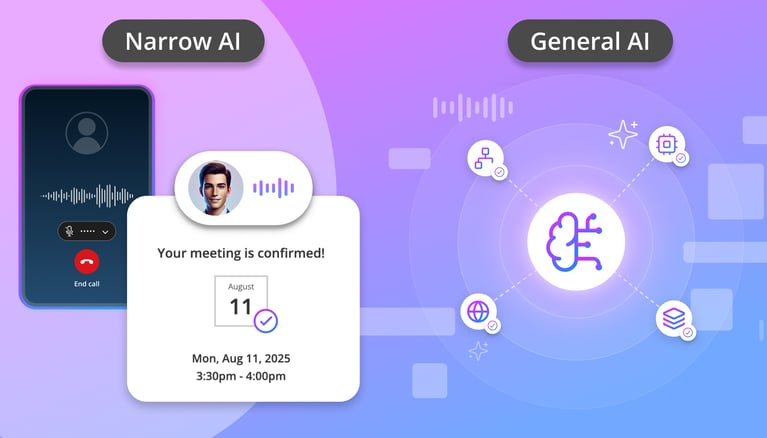
When evaluating Narrow AI vs. General AI, the core difference lies in scope. Narrow artificial intelligence (AI), including tools like chatbots, voice assistants, and scheduling automation software, is designed to perform a single specific task perfectly, such as booking appointments or answering calls. General AI refers to a completely theoretical system that can think and learn like a human across any domain. Today, all real business applications use Narrow AI.
While technology leaders love to talk about a future where machines can think exactly like humans, that is not the reality of the tools available right now. Almost every single tool driving revenue today is built on narrow capabilities. According to IBM’s Global AI Adoption Index, organizations deploy AI across specific functions such as IT automation (38%), customer self-service (47%), and business process automation (22%), highlighting that modern AI systems are designed for targeted, task-specific use cases rather than general intelligence.
Instead of waiting for a machine that can do absolutely everything, growing companies are actively adopting software to address immediate operational bottlenecks, such as lead qualification and automatic appointment scheduling.
Let us look at exactly what these terms mean and why understanding this difference is key to building a highly efficient revenue capture process.
How do Narrow AI and General AI differ? (TL;DR)
- Narrow AI performs one specific task: It is highly specialized to do a single job perfectly, such as qualifying leads or scheduling appointments.
- General AI is purely theoretical: It is a hypothetical machine that can think, learn, and reason across any subject exactly like a human.
- Current Reality: Narrow AI is the only type of artificial intelligence that actually exists and is used in business today.
- Business Application: Instead of waiting for General AI, growing companies use Narrow AI to solve immediate bottlenecks and capture revenue.
What Is Narrow AI?
Narrow AI operates strictly within a predefined set of rules and limitations. It does not possess human consciousness, nor can it apply its intelligence to problems outside of its specific training data. If you train a system to schedule calendar appointments, it cannot suddenly decide to analyze your financial spreadsheets. It only knows what you built it to know.
Key Characteristics of Narrow AI
This technology is incredibly powerful precisely because of its limitations. Here are the three main characteristics that make it highly valuable for business operations.
Top Examples of Narrow AI in Business
The most common examples of narrow artificial intelligence fall into clear business categories. According to a 2026 report from McKinsey and Company, 88% of organizations now use artificial intelligence in at least one business function to drive efficiency.
Here is exactly how companies are deploying this technology today:
- Virtual Assistants: Apple's Siri, Amazon's Alexa, and Microsoft's Cortana all operate on narrow intelligence to understand voice commands and execute specific tasks like setting alarms or checking the weather.
- Recommender Systems: Platforms like Netflix, Amazon, and Spotify use narrow algorithms to analyze your past behavior and suggest new movies or products you might like.
- Facial Recognition: The software that unlocks your smartphone or identifies people for security purposes is highly specialized to measure and verify facial structures.
- Automated Business Scheduling: This is the most important application for growing agencies. Modern tools, like OnceHub's AI phone agent, use narrow AI to answer inbound calls, ask qualifying questions, and securely schedule appointments directly on a live calendar without any human intervention.
What Is General AI?
If narrow artificial intelligence is a highly trained specialist, general artificial intelligence is meant to be the ultimate universal worker. However, this is exactly where many business owners get confused by flashy headlines and science fiction movies.
General AI Definition
General artificial intelligence refers to a machine with the same cognitive abilities as a human being. It would be able to understand, learn, and apply knowledge across a vast range of completely unrelated tasks. If it existed today, it could book your appointments, write a novel, and invent a new cooking recipe all without being explicitly programmed to do so. To be absolutely clear, no current business software, including chatbots or voice agents, qualifies as General AI.
Key Characteristics of General AI
The defining traits of this theoretical technology represent a massive leap beyond what businesses use today.
- Cross-Domain Intelligence: The system would effortlessly transfer knowledge from one subject to an entirely different subject.
- Human-like Reasoning: It would possess common sense, emotional understanding, and the ability to solve completely new problems it has never seen before.
- Adaptive Learning Across Tasks: It would teach itself entirely new skills without requiring a team of human engineers to feed it structured training data.
Current Status of General AI Development
Despite what social media might suggest, this technology does not actually exist yet. It is entirely in the research stage. Major technology companies are building experimental models, but there are absolutely no true artificial general intelligence deployments available for commercial use. According to the comprehensive Artificial Intelligence Index Report from Stanford University, while billions of dollars are poured into foundational research, 100% of current enterprise deployments remain strictly narrow.
Narrow AI vs General AI: Key Differences Explained
When evaluating software to solve your missed call problem, you must understand exactly how the available technology, often referred to as narrow artificial intelligence (or Weak AI), operates compared to the theoretical ideal of a general system. We need to look at platform complexity versus functional utility to see what actually drives revenue. While the term "Weak AI" might sound negative to a casual reader, it simply means the system is highly specialized for a single task rather than possessing universal human intelligence.
Scope of Intelligence
The scope of a narrow system is incredibly restricted and highly focused. It only knows exactly what it is taught. For example, an automated scheduling assistant knows everything about your calendar availability, but absolutely nothing about your business tax strategy. A general system would have an unlimited scope, capable of seamlessly thinking about any topic in the universe.
Learning Capabilities
Narrow systems require massive amounts of highly specific training data to learn one single task. They do not teach themselves completely new disciplines. General systems would learn dynamically through observation and experience, exactly like a human employee learning the ropes of a new business.
Flexibility Across Tasks
If a narrow phone agent encounters a complex medical question it was not programmed to answer, it politely transfers the caller to a human manager. It has zero flexibility outside its designated lane. A general system would simply adapt, research the question instantly, and answer it naturally.
Real World Availability
This is the most critical difference for an agency owner or consultant. Narrow systems are available for purchase and deployment now to address immediate bottlenecks. General systems are strictly confined to research labs and might be decades away from becoming a commercial reality.
Business Applications
Because of its focused nature, narrow technology is used to automate highly repetitive, volume-heavy business tasks. According to a recent artificial intelligence business study by Forbes Advisor, over 64% of business owners believe artificial intelligence will improve customer relationships, specifically by using these narrow tools to answer inbound calls and qualify leads instantly. General technology, on the other hand, would, in theory, replace high-level executive strategy and creative direction.
Here is a quick breakdown of how platform complexity compares with actual functional utility across these two paths.
|
Feature |
Narrow AI |
General AI |
|
Scope |
Highly restricted to one specific domain or task. |
Broad, multi-functional, and universally capable. |
|
Learning Capabilities |
Requires specific training data; relies on supervised or unsupervised learning. |
Generalized learning; able to teach itself entirely new disciplines dynamically. |
|
Flexibility |
Rigid and limited to pre-defined tasks. Cannot transfer knowledge to unrelated fields. |
Completely adaptable; applies common sense and reasoning to completely new situations. |
|
Real-World Availability |
Widely implemented across global industries and ready to deploy immediately. |
Strictly theoretical and in the early stages of research. |
|
Everyday Examples |
Virtual assistants, autonomous vehicles, recommendation algorithms, and automated scheduling agents. |
Hypothetical scenarios requiring advanced human-like cognitive reasoning. |
Why Businesses Use Narrow AI Instead of General AI
.jpg?width=1542&height=882&name=Why%20Unanswered%20Phone%20Calls%20Lead%20to%20Lost%20Revenue%20(1).jpg)
Business leaders do not care about building a conscious machine. They care about capturing revenue, reducing overhead, and eliminating operational bottlenecks. This is exactly why specialized tools completely dominate the current market.
Practical Deployment Advantages
A general artificial intelligence system would require you to rethink your entire corporate structure just to accommodate it. A narrow system simply plugs into the exact process you already have. If you are losing agency deals because your team cannot answer the phone during client pitches, you do not need a robot that writes poetry. You just need a smart voice agent to answer the phone and book the meeting.
Faster Implementation for Businesses
Time to value is the most important metric when buying new software. Complex enterprise tools can take several months of planning and custom integration. Specialized narrow tools offer incredible speed. According to a 2026 technology enterprise report from Deloitte, improving basic productivity is the primary driver of artificial intelligence adoption, with 66% of organizations reporting immediate operational gains from specialized tools. You can activate a narrow phone-booking agent and start capturing missed revenue in minutes.
Lower Operational Complexity
You do not need to hire a team of software engineers to use these modern tools. Because narrow artificial intelligence is built to do one thing perfectly, the user interface is incredibly simple. There is absolutely zero custom coding required. The software inherits your existing calendar rules and routing logic straight out of the box, completely removing the technical burden from your management team.
Higher Accuracy for Specific Tasks
When an artificial intelligence model tries to do too many things at once, it often invents false information or makes wild mistakes. By restricting the software to a single specific task, you guarantee much higher accuracy. A narrow scheduling agent only reads your live calendar availability, ensuring it never double-books a meeting or promises a caller an appointment outside your standard working hours.
Real Business Use Cases for Narrow AI
.png?width=1150&height=588&name=Offer%20A%20Smooth%20Phone%20Booking%20Experience_%20(1).png)
Instead of waiting for a machine that can do absolutely everything, modern business owners are deploying specialized tools to solve their most expensive operational bottlenecks today. According to Salesforce’s State of Service report, AI is rapidly transforming service teams, with organizations reporting faster case resolution and growing revenue opportunities as AI handles an increasing share of customer interactions
Here is exactly how service agencies and consulting firms are using this technology to automate their daily workflows.
AI Appointment Scheduling Automation
Managing a calendar manually is a massive drain on administrative resources. Narrow scheduling agents instantly read your live availability, compare it to a prospect's requested time, and secure the calendar invite without any human intervention. This eliminates the frustrating email back-and-forth of finding a perfect time to meet.
AI Phone Booking for Inbound Calls
This is where the technology directly protects your bottom line. An integrated solution like OnceHub uses conversational AI to act as a native phone booking agent. When a valuable prospect calls your business while you are busy pitching another client, the tool answers instantly.
It holds a natural voice conversation and books the meeting right then and there, ensuring you never lose a lucrative deal to a competitor simply because you could not pick up the phone.
Pro Tip: Do not just replace your voicemail. Make sure your automated voice agent is natively integrated directly into your customer relationship management software so every call log, contact detail, and conversation transcript is saved instantly for your sales team.
Customer Support Request Handling
When clients have urgent administrative questions, they expect an immediate answer. Narrow AI support agents can instantly retrieve account details, answer basic billing questions, or provide project updates at any hour of the day.
This keeps your clients happy while protecting your core management team's focused working hours.
Lead Qualification Automation
Not every prospect who contacts your agency is a good fit for your services. Instead of wasting billable hours talking to unqualified prospects, specialized tools can ask specific filtering questions upfront. The system evaluates their budget, timeline, and core needs, instantly routing the best leads directly to your top sales executives while gracefully redirecting the rest.
Pro Tip: Keep your automated screening questions strictly under four. Asking too many questions upfront will cause highly qualified prospects to hang up the phone or abandon the chat before they ever reach your calendar.
Workflow Automation for Service Businesses
Beyond just answering questions, these tools trigger the exact next steps in your operational process. Once a meeting is booked over the phone, the system can automatically send a confirmation message, update your customer relationship management software, and notify your sales team. This creates a seamless business workflow that operates entirely in the background.
For example, a growing legal consulting firm deploying this exact automation might see its new-client onboarding time drop from three full days to under five minutes, eliminating the need for a dedicated administrative worker to manually chase down introductory paperwork.
How Narrow AI Phone Agent Solves Missed Call Problems
.png?width=1540&height=700&name=features_of_phone_booking%20(1).png)
“85% of consumers whose calls go unanswered will not call back.” - aircall
When evaluating software to solve this exact leak, you must compare platform complexity against actual functional utility. A massive General AI system might sound impressive in theory, but a Narrow AI solution designed to solve one specific problem delivers a significantly higher return on investment today.
Missed Calls as a Revenue Problem
Every single time your phone rings, a potential client is ready to buy. When you fail to answer, that revenue disappears immediately. Missed calls are not a minor inconvenience or a delayed opportunity. They represent thousands of dollars in lost revenue every month, actively funding your direct competitors' growth.
AI Handling Inbound Phone Conversations
Instead of forcing callers into a frustrating robotic menu, narrow artificial intelligence uses natural language processing to hold a fluid conversation. The tool answers the phone instantly, greets the caller politely, and asks exactly how it can help. It understands the caller's intent, allowing them to speak naturally rather than pressing keypad numbers.
Automated Appointment Scheduling from Calls
If a caller wants to book a consultation, the system completely removes the need for a human receptionist. It asks for the preferred day and time, collects the necessary contact information verbally, and secures the meeting while the prospect is still on the phone and highly motivated.
Calendar Integration and Availability Checks
This is where a native integrated solution truly outshines complex general platforms. Businesses using AI phone booking software can automatically answer every inbound call and convert more leads in real time, like OnceHub Conversational AI phone booking, which is built directly into your scheduling framework. The tool reads your exact live availability instantly. It respects your working hours, accounts for time zone differences, and guarantees it never schedules overlapping meetings for your team.
Pro Tip: Always program a 15-minute buffer into your automated scheduling rules. This ensures your specialized booking agent never schedules meetings directly back-to-back, giving you time to write notes and prepare for the next client pitch.
Solving this massive operational leak is just one piece of the puzzle. Let us look exactly at when your business should deploy this specialized technology to maximize efficiency.
When Businesses Should Use Narrow AI Instead of General AI
About 42% of enterprise-scale organizations report having actively deployed AI in their business. Business owners should stop waiting for a mythical general system to manage their entire company and start deploying narrow tools to solve immediate revenue bottlenecks today. Here is exactly when you should deploy this focused technology.
Operational Automation
If your human team spends hours every single week manually moving data from one software to another, you are wasting valuable billable time. You should use a narrow system to connect your tools and automate those repetitive actions. For example, when a new client signs a contract, the software can automatically create a new project folder, alert your team, and send a welcome email without any manual human effort.
Appointment Scheduling Workflows
Any agency owner knows the pure frustration of playing email tag just to secure a thirty-minute meeting. When your calendar becomes a chaotic mess of overlapping times and missed opportunities, it is time to deploy an automated scheduling workflow. The specialized tool reads your exact availability, presents open slots to the prospect, and instantly secures the calendar invite across multiple time zones.
Lead Capture and Qualification
You should deploy this technology the exact moment your sales team starts wasting hours talking to completely unqualified buyers. A specialized voice or text agent can ask strategic screening questions upfront. If a prospect does not meet your minimum budget requirements, the software politely directs them to a helpful free resource. It only routes highly qualified, premium leads directly to your closing team.
Customer Communication Automation
When clients expect immediate answers but your human staff is busy pitching new business, a narrow communication tool bridges the gap perfectly. Instead of making a frustrated customer wait hours for a simple answer about your office location or basic service pricing, the system replies instantly. This protects your brand reputation and keeps your current clients incredibly happy while your team focuses on growth.
Now that we know exactly when to deploy these specialized tools, let us look at the direct operational benefits they deliver to a growing team.
Benefits of Narrow AI for Small and Medium Businesses
When you stop trying to build a universal robot and focus strictly on solving operational bottlenecks with specialized tools, the financial returns are immediate.
Here are the core benefits your agency or consulting firm can expect from this technology.
Faster Response Times
Speed is the ultimate competitive advantage in the modern service industry. When a potential client reaches out, they expect an immediate answer. A narrow voice agent answers the phone on the very first ring every single time, eliminating the frustrating wait times that cause high-value leads to abandon your business.
Reduced Administrative Work
Your human team should spend their billable hours building relationships and closing deals, not doing manual data entry. Specialized software automatically logs call details, updates your customer relationship management system, and organizes client information in the background, freeing your staff from tedious paperwork entirely.
Increased Lead Conversion
When you answer calls instantly and ask the right qualifying questions, your conversion rates naturally increase. Instead of letting leads go cold while sitting in a crowded voicemail inbox, automated phone booking secures the calendar appointment. At the same time, the buyer is still highly motivated and ready to commit.
Consistent Customer Experience
Human employees get tired, overwhelmed, and distracted during busy shifts. A specialized voice agent delivers a perfectly polite, professional, and accurate brand experience on every single call. It never has a bad day, ensuring your clients always receive the same high level of service.
24/7 Scheduling Availability
Business does not stop just because your office lights are off. Premium clients often do their research late at night or over the weekend. By deploying a narrow scheduling agent, you keep your calendar completely open around the clock, capturing lucrative meetings while your competitors are offline and asleep.
Also read: Narrow AI vs General AI for Scheduling: Which Converts More Meetings?
Common Misconceptions About Narrow AI vs General AI
Let us clear up the three biggest myths that prevent businesses from adopting this revenue-generating technology.
“General AI Is Already Available”
When people see a modern chatbot write a beautiful essay or hold a complex conversation, they assume the machine is actually thinking. This is entirely false. Even the most advanced text generators on the market today are strictly narrow artificial intelligence. They are incredibly good at predicting the next word in a sentence, but they do not possess actual consciousness or true human reasoning.
“Narrow AI Is Too Limited”
Because specialized software only does one thing, some business owners dismiss it as a basic toy. They want a machine that can do absolutely everything. However, its limitation is actually its greatest strength. Because a phone booking agent is strictly focused on your calendar, it executes that single task flawlessly without getting distracted, inventing false information, or making creative mistakes.
“Businesses Need Advanced AI to Automate Workflows”
Many consulting firms delay upgrading their systems because they think they need a massive, billion-dollar brain to fix their operations. The reality is much simpler. You do not need a machine that understands human emotion just to schedule a meeting. Simple, specialized tools solve the most expensive operational leaks, like unanswered phone calls, completely out of the box.
Now that we have separated the science fiction myths from the business reality, let us look exactly at where this technology is heading next.
The Future of Narrow AI and General AI
While researchers continue spending billions of dollars chasing the dream of a conscious machine, the business world is moving in a completely different direction. The future of corporate technology is not about building one massive brain to run your entire company. It is about deploying an ecosystem of highly specialized digital workers.
Here is exactly where this technology is heading in the near future:
This operational shift brings us to the ultimate conclusion for any growing agency looking to protect its revenue and scale efficiently.
Conclusion: Why Narrow AI Drives Real Business Automation
The debate between these two technologies comes down to one simple truth. General artificial intelligence is a fascinating research project for tomorrow, but narrow artificial intelligence is the actual engine driving revenue today.
Growing businesses do not need a machine that can think exactly like a human being. They simply need specialized tools that answer the phone, qualify valuable leads, and secure client meetings without ever making a mistake. By deploying an integrated solution designed specifically for calendar management and voice conversations, you eliminate the most expensive operational leak in your agency: unanswered inbound calls.
Stop losing lucrative deals to your competitors just because your human team is too busy to pick up the phone. It is time to let specialized technology capture that revenue for you.
Automate appointment scheduling with OnceHub’s AI phone booking, answer inbound calls, qualify leads, and schedule meetings automatically with OnceHub Conversational AI.
Frequently Asked Questions
What is the main difference between narrow artificial intelligence and general artificial intelligence?
Narrow artificial intelligence is trained to perform a single specific task perfectly, such as booking calendar appointments or answering inbound calls. General artificial intelligence is a purely theoretical concept in which a machine could think, learn, and reason across any subject, exactly like a human being.
Is ChatGPT considered narrow or general artificial intelligence?
Despite its impressive ability to write code and hold complex text conversations, it is still considered narrow artificial intelligence. It is highly advanced at predicting text based on massive amounts of training data, but it does not possess actual consciousness or true independent reasoning.
Why do modern businesses use narrow artificial intelligence instead of general systems?
Businesses use specialized tools because they are readily deployable and deliver an immediate return on investment. General systems do not yet exist, while focused tools can instantly address expensive operational bottlenecks, such as missed revenue from unanswered phone calls.
Will general artificial intelligence eventually replace specialized business tools?
It is highly unlikely in the near future. Even if a massive conscious machine is eventually created by corporate researchers, growing businesses will likely still prefer specialized software for specific daily operations because it is much cheaper, highly accurate, and incredibly easy to manage without custom coding.
What are the best examples of narrow artificial intelligence for small service businesses?
The most profitable examples are tools that directly capture revenue and eliminate administrative waste. These include automated phone-booking agents that answer inbound calls instantly, smart lead-qualification software, and automated appointment-scheduling systems that integrate directly with your live calendar.
Read next: Narrow AI vs General AI: What’s Best for High-Ticket Sales?