

-1.jpg?width=767&name=What%20Is%20Conversational%20AI_%20A%20Practical%20Guide%20for%20Businesses%20(2026)-1.jpg)
For a growing agency or consulting firm, conversational AI is the absolute fastest way to stop losing lucrative deals to a frustrating robotic voice menu.
While your team is busy serving clients or pitching new projects, the phone rings. If that caller hits a robotic voice menu or a dead-end voicemail, they simply hang up and call your competitor. For years, automated communication felt like a barrier rather than a bridge. It relied on static rules and rigid scripts that drove buyers away.
Consumers now view traditional menus as lazy and frustrating. According to a 2026 report from Zendesk, 83% of customers expect a natural, fluid experience when contacting a business. They want to speak or type normally and get an immediate, intelligent response.
This is exactly what conversational AI delivers. It acts as the bridge between natural human communication and absolute machine efficiency.
The best part? This technology is no longer an expensive luxury reserved for Fortune 500 tech companies. It is now a highly accessible tool for growing businesses. From acting as a smart receptionist to handling complex appointment scheduling, conversational AI allows teams of all sizes to capture revenue around the clock.
This guide covers exactly what the technology is, how it works behind the scenes, and how you can implement it to build a highly efficient revenue capture process.
What is Conversational AI?
Conversational AI is a technology that enables software to understand and respond to human language in a natural way. It powers tools like smart virtual assistants, advanced website chatbots, and automated voice agents.
To understand why this is a massive upgrade, think about traditional software. Legacy systems force the human to learn how the computer works. You have to click specific buttons, navigate complex menus, and type exact keywords. If you make a typo or press the wrong dial pad number, the system breaks.
Conversational AI flips this entire dynamic. It forces the computer to learn how humans communicate. It understands context, intent, and messy phrasing. You can speak to it or type to it exactly like you would to a human receptionist.
The business impact here is undeniable. According to a 2023 report on artificial intelligence from McKinsey and Company, generative AI and conversational tools could automate up to 70% of daily communication and service tasks. This allows businesses to scale their operations without constantly hiring new administrative staff.
How Conversational AI Works: A Technical Breakdown
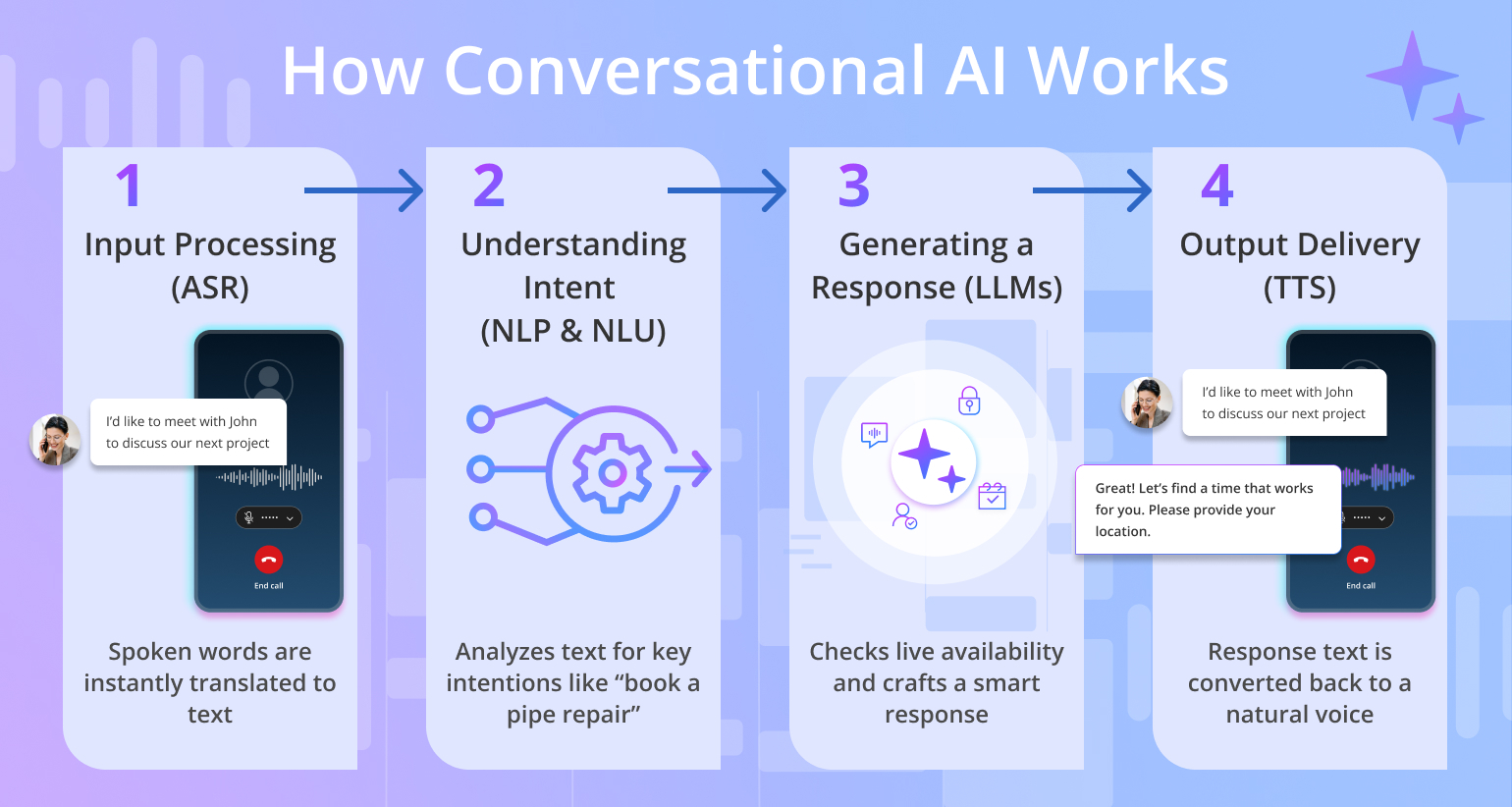
You do not need a computer science degree to use this technology. However, understanding the mechanics gives you a massive advantage when choosing the right platform for your business.
When a customer calls your business or types into your website chat, the AI goes through four distinct steps in mere milliseconds.
- Input Processing: If the customer is speaking over the phone, the system uses Automatic Speech Recognition to instantly translate their spoken words into written text.
- Understanding Intent: This is the most critical step. Natural Language Processing and Natural Language Understanding analyze the text. These systems strip away accents, slang, and filler words to figure out exactly what the customer actually wants. If a caller says, "Yeah, I need someone to look at my broken pipe on Tuesday," the AI recognizes the intent as booking a plumbing appointment for that day.
- Generating a Response: Older bots would scan for a single keyword and spit out a rigid script. Modern systems use Large Language Models to generate a unique, context-aware response. The AI checks your calendar availability and drafts a reply that actually makes sense in real time.
- Output Delivery: Finally, Text-to-Speech engines convert the generated text back into a natural human voice. The caller hears a polite and helpful response, completely unaware of the complex processing that just occurred.
Pro tip: The best conversational AI systems do all four of these steps so quickly that there is zero awkward silence on the phone line. The conversation flows exactly like a natural human interaction.
Now that you understand the mechanics powering this technology, the next step is to apply it. Let us look at exactly how growing companies are using these tools to solve bottlenecks and drive revenue today.
Top Conversational AI Use Cases for Growing Businesses
Most business owners do not want to build a complex science project. They want a tool that solves immediate operational bottlenecks. According to a 2025 Gartner survey, customer service and sales are the primary areas where artificial intelligence delivers the highest return on investment.
Instead of replacing humans, this technology handles the repetitive volume. Here is exactly how modern teams apply the technology today.
- Inbound Call Handling: Acting as a frontline receptionist around the clock ensures high-intent buyers never hit a dead-end voicemail. When your human team is busy pitching another client or out in the field, the voice agent answers the phone instantly to capture the lead.
Let's take an example: a real estate agent in the middle of a property tour or a roofing contractor standing on top of a house. You physically cannot answer the phone. In the past, that meant a lost deal. Now, the voice agent answers the phone instantly, speaks to the prospect naturally, and captures the lead while you finish your current job.
Stop sending your best leads to voicemail. Discover how OnceHub’s conversational ai answers every call instantly and secures the meeting.
- Appointment Scheduling: Conversational AI navigates your team calendars, finds overlapping availability, and books meetings directly without human intervention. It removes the frustrating back-and-forth email dance entirely and secures the appointment while the prospect is highly engaged.
- Lead Qualification: Not every caller or website visitor is a good fit for your business. The AI asks dynamic questions to filter out unqualified leads and route high-value prospects directly to your top sales representatives.
- Customer Support and Intake Automation: The system gathers crucial client data, account numbers, and detailed problem descriptions before a human ever takes over. This drastically reduces the time your staff spends on basic data entry and administrative tasks.
Knowing what the tool can do is great, but the real question is how it directly impacts your bottom line. Let us look at the core benefits that make this technology a mandatory upgrade.
The Core Business Benefits of Conversational AI
Use cases are important, but how do these features actually impact your bottom line?
According to Salesforce's 2026 State of Sales report, 82% of customers expect businesses to respond immediately when they reach out. When you fail to meet that expectation, you lose the deal. Implementing a conversational AI system directly solves this problem and delivers four massive business benefits.
- Maximizing Booked Appointments: You no longer rely on business hours to capture revenue. The system automatically secures meetings on your calendar around the clock. It captures late-night researchers and busy professionals the exact moment they are ready to commit.
Think about a stressed homeowner discovering a water leak at midnight, or a startup founder realizing they need an emergency tax consultation on a Sunday afternoon. They do not want to fill out a static contact form and wait until Monday morning. The system automatically secures these urgent meetings on your calendar right then and there, capturing revenue while your competitors are asleep.
- Eliminating the Voicemail Black Hole: Answering inbound calls instantly with voice AI is a game-changer. You ensure you never lose a hot lead to a competitor simply because your human team was busy on another call.
Want to see this in action? Learn how growing teams use OnceHub to turn missed calls into confirmed calendar appointments.
- Faster Speed to Lead via Automated Qualification: Speed is everything in sales. Instantly engaging and qualifying leads the moment they show interest drops your response time from hours to mere seconds.
- Streamlined Intake Automation: Administrative overhead drains your budget. By having the AI securely collect necessary client information and context before a meeting begins, your team can focus entirely on closing deals and solving complex problems.
These benefits sound incredible on paper. However, implementing this technology is not always perfectly smooth. Let us look at the common roadblocks companies face when setting up these systems.
The Hidden Challenges of Adopting Conversational AI
Implementing this technology comes with hidden roadblocks. Before you invest in a new system, you must understand the three major challenges that trip up growing companies.
***The Lego Kit Problem: Many vendors sell you a box of parts. They provide the basic technology, but they expect your team to build the logic, write the complex prompts, and train the artificial intelligence manually.
This requires massive technical overhead that most growing businesses simply do not have. You need a system that works out of the box, not a science project.
- Hallucinations: This is a major risk for customer trust. If the software lacks proper guardrails, it might invent false information. It could promise a caller a discount you do not offer or schedule a meeting when your office is closed. Controlling the output is just as important as generating it.
- The Empathy Gap: Machine efficiency cannot replace human connection. For highly sensitive issues or emotionally complex support tickets, an automated response will damage your brand. You must have a seamless way to route frustrated customers directly to a human agent before they lose their patience.
Overcoming these hurdles is crucial, especially when deciding how your customers will actually interact with the system. Let us look at the two main battlegrounds for these interactions: text chat and voice calls.
Text vs Voice: Why Phone-Based AI is the Next Frontier
“Voice remains the go-to channel for high-stakes, emotionally charged, or time-sensitive queries. Customers still pick up the phone when an issue really matters.” - Techradar
Most companies start their automation journey with a simple website chatbot. This is a solid baseline. But text has strict limits. When buyers have urgent problems, they do not want to type paragraphs into a small mobile chat window. They pick up the phone.
Here are the most important reasons voice artificial intelligence is replacing text as the ultimate revenue capture tool.
- The Text Baseline: Website chatbots are great for researchers browsing your site at midnight. They serve the silent buyer perfectly by answering basic questions and offering calendar links. However, they lack urgency.
- The Voice Imperative: High intent buyers call. If a homeowner has a burst pipe or a business owner needs an urgent financial consultation, they want immediate help. If your artificial intelligence only lives on your website, you are abandoning your most valuable leads. A missed call is missed revenue.
- Speed to Resolution: Speaking is simply faster than typing. A voice agent allows callers to explain complex situations naturally without navigating a clumsy mobile keyboard. It secures the booking while the caller is highly motivated.
- Emotional Context: Voice carries tone. Advanced phone agents can actually detect urgency or frustration in a caller. This allows the system to instantly route a highly distressed customer directly to a human manager, protecting your brand reputation.
Ready to upgrade from text chat? Explore the OnceHub's AI voice agent and give your calendar a voice today.
So, how do you actually get this technology working for your business without hiring a team of software engineers? Let us compare the two main paths to deployment.
Enterprise Platforms vs Specialized Agents: Choosing the Right Fit
When an agency or consulting firm tries to solve the missed call problem, they usually encounter three distinct paths. Choosing the wrong path will instantly drain your budget and frustrate your clients.
You must frame your buying decision around actual functional utility rather than platform complexity. Most growing companies quickly move away from general tech tools once they understand the core differences in how these systems handle calendars.
|
Feature |
General Conversational AI |
Native AI Phone Booking |
|
Primary Focus |
Endless open dialogue |
Immediate revenue capture and scheduling |
|
Calendar Integration |
Requires custom developer work |
Built directly into the calendar |
|
Setup Complexity |
High technical overhead |
Ready to use in minutes |
|
Booking Reliability |
Often invents available times |
Reads exact live availability |
|
Best Used For |
Massive custom support centers |
Agencies securing client meetings |
Pro tip: Before investing in any AI communication tool, look closely at how it handles the final step of a call. An AI that can hold a conversation is helpful, but an integrated solution like OnceHub that can actually secure the booking natively is what directly protects your bottom line.
If a specialized agent is the fastest path to capturing revenue, how exactly does it work in practice? Let us look at how the industry leader solves the meeting automation problem.
How OnceHub Uses Conversational AI for Seamless Scheduling
As a specialized agent, OnceHub applies this technology directly to the most expensive bottleneck in your business: the meeting lifecycle. It eliminates phone tag, abandoned web forms, and missed calls entirely.
Instead of forcing you to build complex logic from scratch, OnceHub provides a ready-to-use system that captures leads across every communication channel.
- Unified Web and Phone: Most companies use one tool for digital booking links and a completely different answering service for their phone lines. This creates messy data and double-booked calendars. OnceHub solves this by using a single calendar brain. Whether a prospect clicks a link on your website or calls your business directly, the system reads the same live availability.
- Zero Prompt Engineering: Remember the Lego Kit problem? OnceHub completely removes that technical hurdle. There is absolutely no manual training required. The artificial intelligence inherits your existing calendar rules, business hours, and team routing logic straight out of the box.
- Natural Conversation and Booking: When a high-intent lead calls your business, the voice agent asks for their scheduling preference. It matches their request with your open time slots and secures the booking. It gathers the required intake information verbally and puts the appointment directly on your calendar without human intervention.
Pro tip: Take advantage of automated buffer times. When setting up your unified calendar, always program a fifteen-minute gap between your automated bookings so your team has time to breathe and prepare for the next meeting.
The technology has matured, and the barriers to entry have been removed. Let us summarize exactly why this is the perfect time to upgrade your lead capture process.
Conclusion
“Customers are 2.4x more likely to stay with a brand when their problems are resolved more quickly” - shno
Conversational AI is no longer an experimental luxury for giant corporations. It is the new baseline standard for customer expectations. Buyers expect immediate answers and instant booking capabilities, whether they reach out at noon or midnight.
For service-based businesses, the primary goal is not to build the smartest robot in the world. The goal is to build the most efficient revenue capture process possible. By adopting specialized tools, you eliminate the friction of missed calls, tedious manual data entry, and slow response times. You allow your human team to focus on building relationships and closing deals while the software handles the calendar.
Are you ready to stop missing revenue from unanswered calls? Learn how OnceHub’s ai phone booking automates your scheduling across every communication channel. Ensure you never miss a high-intent caller again and start turning every conversation into a confirmed meeting today.
Frequently Asked Questions (FAQ)
What are some common examples of conversational AI?
The most common examples fall into three distinct categories for modern businesses. First are smart website chatbots that answer basic text questions for late-night researchers. Second are virtual voice assistants that handle simple consumer tasks. Third, and most importantly for growing agencies, are automated phone booking agents. Unlike older robotic menus that force you to press numbers, these modern business tools let clients speak naturally, ask complex questions, and securely schedule appointments directly on your calendar in real time.
What is the difference between a chatbot and conversational AI?
A traditional chatbot usually relies on rigid scripts and specific keywords. If you type the wrong word, it fails. Conversational AI uses advanced natural language processing to understand your actual intent. This allows for a fluid and dynamic conversation that feels entirely human.
Will artificial intelligence replace human customer service?
No. Artificial intelligence handles the repetitive volume. It answers basic questions, gathers initial intake details, and books meetings. This frees up human agents to handle emotionally complex issues, nuanced negotiations, and high-level strategy. It acts as a powerful assistant rather than a total replacement.
Do I need to manually train the OnceHub voice agent before using it?
Absolutely not. You do not need any coding experience or prompt engineering skills to get started. Most general artificial intelligence tools require you to write complex dialogue scripts and spend weeks training the system. OnceHub removes this technical burden entirely. The voice agent instantly inherits the exact logic you already built for your digital booking pages. It automatically reads your real-time calendar availability, buffer hours, and your team's routing rules. You simply activate the feature, and it starts booking meetings immediately.