

RingCentral, Retell AI, and Synthflow are three of the most actively compared voice AI platforms in 2026, but they are built for fundamentally different buyers.
-
RingCentral is a unified communications platform.
-
Retell AI is developer infrastructure.
-
Synthflow is a no-code agency builder.
-
None of the three is purpose-built for businesses where confirming a booking on the first call is the primary goal. That's where you need a different type of platform.
-
The AI voice agent category has moved from experimental to operational faster than most technology categories.
According to Gartner, conversational AI implementations within contact centres are projected to save labour expenses of $80 billion by 2026, a figure that reflects the scale of enterprise investment now moving into production deployments.
But the category has also fragmented significantly. RingCentral, Retell AI, and Synthflow are three of the most actively compared platforms in this space, and they are built for fundamentally different buyers, different technical contexts, and different operational goals. Choosing between them without understanding those differences often leads to an expensive mismatch between what a business actually needs and what it ends up paying for.
For businesses where scheduling is the primary call outcome, such as coaches, consultants, financial advisors, and professional service practices, a different type of platform may be a better fit than any of the three.
More on that below.
What Are RingCentral, Retell AI, and Synthflow
These are not interchangeable options that happen to share the "AI voice agent" label. There are different categories of tools, serving different buyers with different needs.
RingCentral is a unified communications platform - phone system, SMS, video, team chat, with AI features layered on top, including an AI Receptionist, virtual assistant, and conversation intelligence tools.
Retell AI is a developer-oriented voice infrastructure platform, providing technical building blocks for engineering teams building production-grade voice agents from scratch.
Synthflow is a no-code visual builder for AI voice agents, designed for agencies and non-technical teams that want to deploy voice workflows through a drag-and-drop interface.
The market is large enough to support meaningfully different platform types. The right evaluation starts with understanding which type of platform matches your actual use case, not which has the longest feature list.
"The global conversational AI market is expected to grow from $17.05 billion in 2025 to $49.8 billion by 2031 — a 192% expansion at a CAGR of 24.7%."
Research and Markets, Unified Communication Market Report 2026
The market is large enough to support meaningfully different platform types. The right evaluation starts with understanding which type of platform matches your actual use case — not which has the longest feature list.
RingCentral Review: AI Voice Features, Pricing, and Who It Is Best For
What is RingCentral?
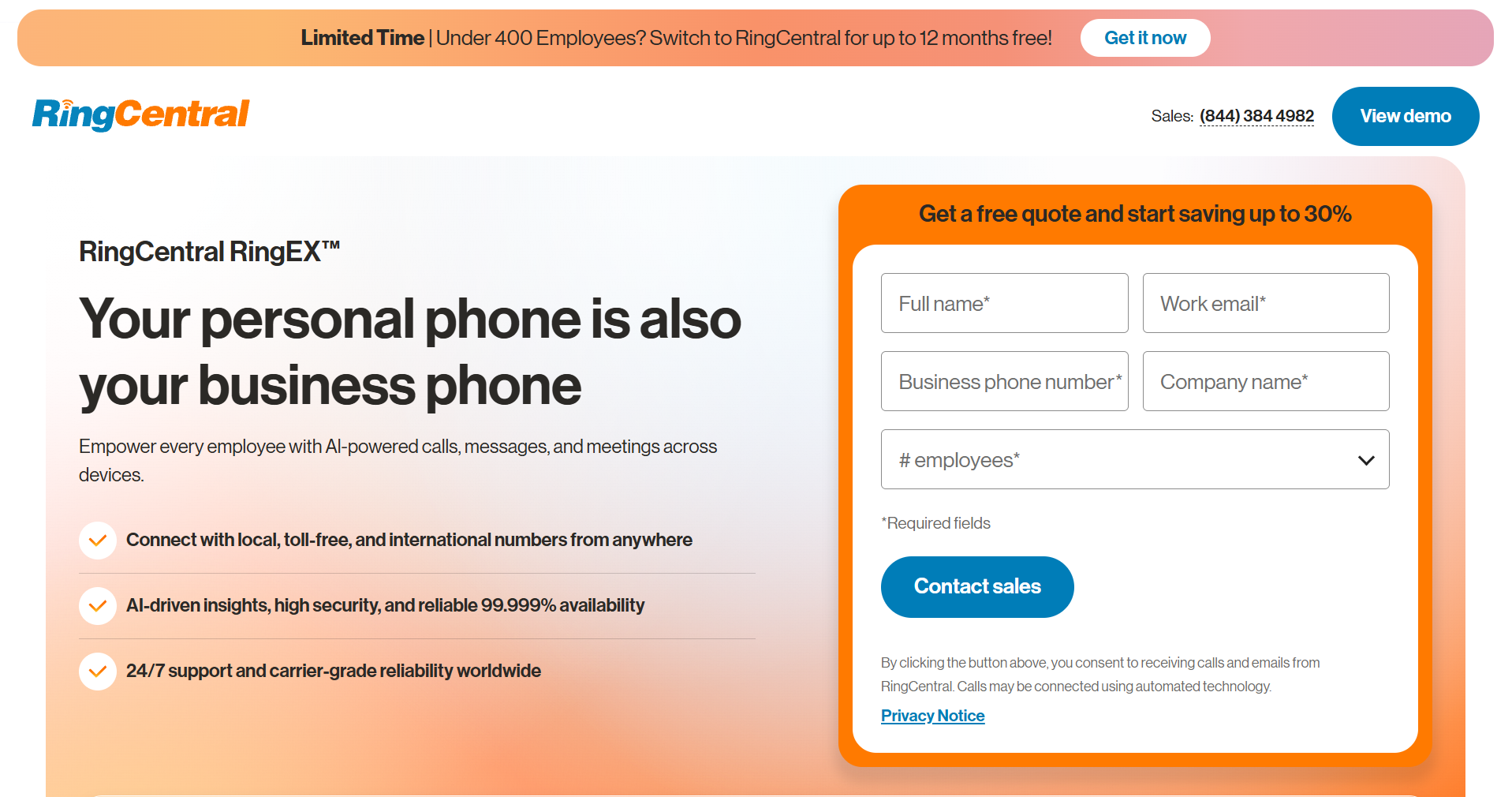
RingCentral is a major provider of cloud communications software, offering an integrated platform for business phone, SMS, contact centre, workforce engagement management, video collaboration, and messaging. Its AI capabilities expanded significantly through 2025 — including an AI Receptionist that handles incoming calls 24/7, a virtual assistant, and conversation intelligence tools that cover the full conversation journey before, during, and after each interaction.
For businesses that want a single vendor managing their entire communications stack, that integration is RingCentral's core value proposition.
What does RingCentral do well?
- All-in-one communications — one platform for calls, SMS, video, team chat, and AI assistance
- AI Receptionist (AIR) — handles inbound calls 24/7, routes callers, books appointments, and captures leads
- Contextual handoff — when transferring to a human agent, the AI passes a conversation summary so the person picking up already knows what the caller needs
- 300+ integrations — Salesforce, HubSpot, Microsoft Teams, Google Workspace, and more
- Enterprise credibility — RingCentral is designated as a leader in the Gartner Magic Quadrant for UCaaS (2024 report — verify current designation at gartner.com), with significant enterprise infrastructure and support behind the platform
- Reliable call quality — built on established enterprise voice infrastructure
"The unified communications as a service market is expected to grow from $78.15 billion in 2026 to $276.9 billion by 2034, at a CAGR of 17.10%."
— Fortune Business Insights, UCaaS Market Report 2026
For businesses already running RingCentral for their phone system, adding the AI Receptionist is a natural extension rather than a new deployment decision. For businesses where the primary call goal is confirming a booking within the call itself, without worrying about compliance, OnceHub is the best fit.
What are RingCentral's limitations?
The AI features are add-ons built onto a communications platform. For businesses that specifically need sophisticated voice agent behaviour — complex qualification logic, multi-turn conversation handling, native calendar booking — RingCentral's AI tooling may offer less workflow customisation than platforms purpose-built specifically for conversational AI automation.
Actual costs can differ materially from advertised base pricing depending on usage and add-ons:
- Core plan starts at $20/user/month annually — jumps to $30/user/month on monthly billing
- Advanced plan is $25/user/month annually; Ultra is $35/user/month annually
- AI Receptionist starts at $39/month as a separate add-on — not included in base pricing
- At the time of writing, the AI Receptionist includes 100 calling minutes — additional minutes cost $0.50 per minute in overages. Confirm current plan limits directly with RingCentral before deployment.
- Extra phone numbers cost $4.99–$9.99 per number/month
- SMS limits are capped on all tiers — overages apply
"According to WithAllo, some teams may experience a monthly bill increase of 20–40% once usage, devices, and extra seats are factored in."
— WithAllo, RingCentral Pricing Full Breakdown
"RingCentral sells several AI and engagement tools as separate products — AI Receptionist, Business SMS Booster, Call Queues Booster, AI Conversation Expert — each with its own monthly fee on top of your base licence."
— KrispCall, RingCentral Pricing Guide 2026
Depending on average call duration and volume, businesses with higher inbound call activity may want to model projected overage costs carefully before committing to the AI Receptionist as a primary inbound channel.
Who is RingCentral best for?
Teams that want a single vendor for their entire communications stack and for whom AI voice capability is one component of a broader communications requirement. Strongest fit for businesses already in the RingCentral ecosystem looking to add AI without a separate deployment.
🔗 Verify current pricing: ringcentral.com/pricing (All pricing subject to change — verify directly with vendor)
Retell AI Review: Developer Voice Infrastructure, Pricing, and Who It Is Best For
What is Retell AI?
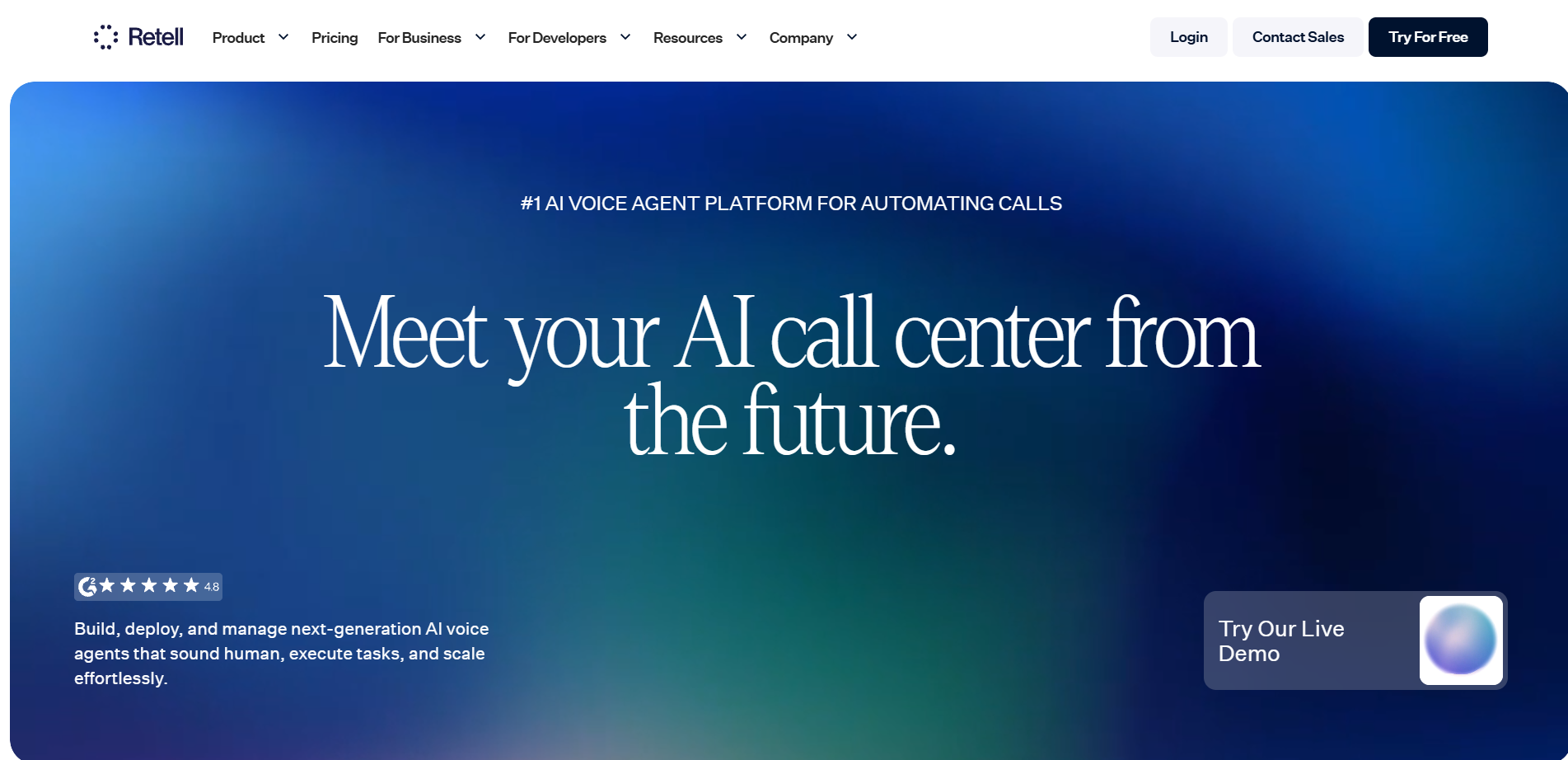
Retell AI is primarily designed as a developer-focused infrastructure platform rather than a turnkey end-user solution. It provides real-time voice streaming, call flow APIs, LLM integration, and bring-your-own-carrier telephony.
The platform offers substantial flexibility, though implementation complexity can increase accordingly.
What does Retell AI do well?
- Production-grade performance — designed for high-volume, real-world call environments
- LLM flexibility — compatible with GPT-4, Claude 3, or custom models
- Premium voice synthesis — ElevenLabs, PlayHT supported for natural-sounding agents
- Compliance credentials — SOC 2, HIPAA, and GDPR compliant
- Multilingual support — 30+ languages with manual configuration
- Interruption handling — barge-in detection for human-like conversational flow
For businesses where inbound scheduling confirmation and routing is the primary call outcome rather than infrastructure flexibility, see why OnceHub is a clear winner.
"In the United States, more than 68% of large enterprises have integrated AI-powered voice automation into customer support workflows."
— Congruence Market Insights, AI Voice Agent Platforms Market 2025–2033
The company highlights case study results including the Matic Insurance deployment, which handled 8,000+ calls in Q1 2025, automated 50% of low-value tasks, maintained NPS at 90, and reduced claims intake time by 53% — from 12.4 minutes to 5.8 minutes.
What are Retell AI's limitations?
Technical barrier:
While Retell AI now includes a visual drag-and-drop agent canvas and simulation testing tools, executing deep custom data states, advanced programmatic webhooks, or multi-system data routing still requires developer configuration. Non-technical teams looking to deploy without engineering involvement will find Synthflow's no-code builder a more accessible starting point for standard workflows.
Latency performance:
Retell AI delivers industry-leading conversational response speeds of approximately 600–800ms — a genuine architectural strength and one of the reasons it is a strong choice for high-volume production deployments. However, low audio processing latency does not bypass system orchestration; connecting this flow to a scheduling registry or calendar system still requires manual integration mapping, which adds a dependency in the booking confirmation step for scheduling-led use cases.
Pricing complexity:
Retell's modular pricing structure separates infrastructure, telephony, and AI model costs — each with its own billing logic.
"You may see Retell AI priced as low as $0.07/min — but most real business setups land closer to $0.13–$0.31/min once voice, LLM, and telephony dependencies are included."
— Ringg.ai, Retell AI Pricing in 2026
Total costs can increase substantially once external LLM and voice provider fees are included. Accurate cost modelling across all three layers is recommended before committing.
Who is Retell AI best for?
Engineering-led teams building custom production voice agents at scale — particularly in regulated industries where SOC 2 and HIPAA compliance documentation is required and the technical team can own the build, configuration, and ongoing maintenance.
🔗 Verify current pricing: retellai.com (All pricing subject to change — verify directly with vendor)
Synthflow Review: No-Code Voice Agent Builder, Pricing, and Who It Is Best For
What is Synthflow?
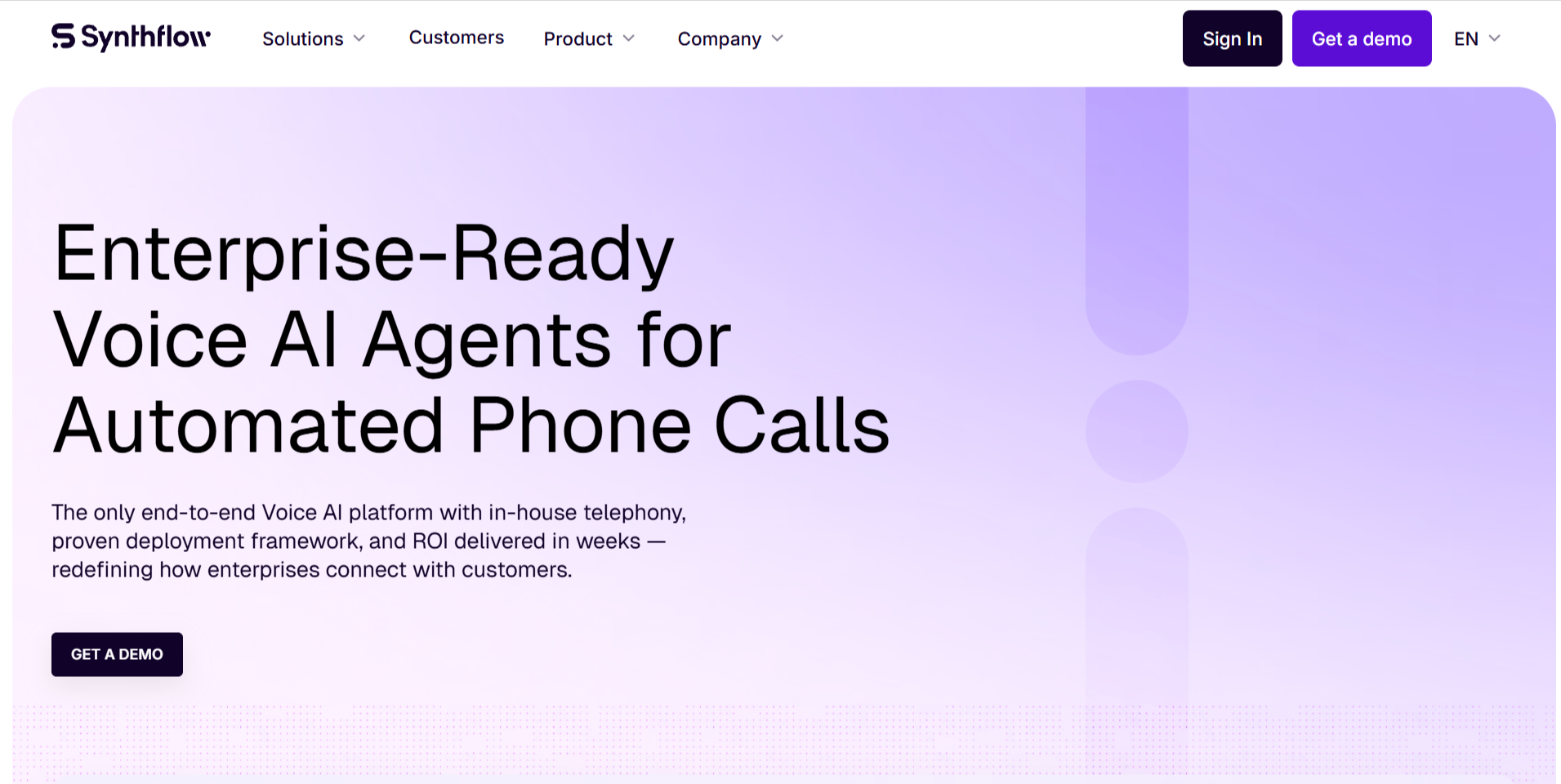
Synthflow is designed for teams that want to build and deploy AI voice agents without writing code. Its visual flow designer lets non-technical users configure conversation logic, and its white-label infrastructure makes it a popular option among agencies reselling AI voice services under their own brand.
What does Synthflow do well?
- No-code builder — drag-and-drop conversation flow configuration
- Voice quality — defaults to ElevenLabs Turbo v2, producing natural-sounding agents
- White-label — custom branding, custom domains, subaccounts, feature controls, Stripe rebilling
- Multi-tenant — manage multiple clients on a single system
- HIPAA compliance — available for regulated use cases
- Accessible entry pricing — $29/month for 5,000 minutes at the Starter tier
"51% of consumers say they prefer interacting with bots over humans when they want immediate service. 56% believe bots will be able to have natural conversations by 2026."
— Zendesk CX Trends Report, 2025
For agencies building white-label AI voice solutions at scale, Synthflow's native rebilling and subaccount infrastructure removes a significant operational burden. For businesses where the primary goal is confirming a booking within the first call without third-party integration dependencies, see why scheduling-led businesses often choose OnceHub instead.
What are Synthflow's limitations?
One important consideration is the difference between advertised pricing and total deployment cost.
Synthflow utilises a Bring Your Own Key (BYOK) token framework. While base platform subscriptions are highly accessible, operators must manage and fund external API keys — OpenAI, ElevenLabs, and telephony providers — independently. Calculating true runtime costs requires modelling the BYOK layer alongside the base subscription. The Ringly.io Synthflow pricing analysis provides a useful cost modelling framework for estimating total deployment cost at different call volumes.
Channel limitation:
Based on publicly available documentation as of May 2026, Synthflow is voice-only. Businesses needing WhatsApp, website chat, or email handling alongside phone calls require separate tools for each channel — adding integration complexity that partially offsets the no-code setup advantage.
Agency plan cost:
The Agency plan starts at $1,400/month plus BYOK costs — putting the total investment at $1,600–$2,000+/month depending on usage and provider selection, for businesses that need the full white-label feature set.
Who is Synthflow best for?
Agencies building white-label AI voice solutions for multiple clients, and non-technical teams deploying voice agents for inbound call handling or lead qualification — provided the BYOK cost structure is modelled accurately before committing.
🔗 Verify current pricing: synthflow.ai/pricing (All pricing subject to change — verify directly with vendor)
RingCentral vs Retell AI vs Synthflow: Side-by-Side Comparison
|
Capability |
RingCentral |
Retell AI |
Synthflow |
|
Primary design |
Unified communications + AI |
Developer voice infrastructure |
No-code agency voice builder |
|
Technical requirement |
Low — managed platform |
High — developer required |
Low — no-code |
|
Voice quality |
Standard business voice |
Premium — ElevenLabs, PlayHT |
Premium — ElevenLabs default |
|
AI Receptionist |
✓ Native — AIR add-on from $39/month |
Build your own — requires engineering |
Build your own — via visual flow |
|
Scheduling and booking |
Routing and conversational assistance — minute-based pricing applies |
Requires custom engineering build + integration mapping |
Via third-party integrations (as of May 2026) |
|
Latency |
Standard enterprise voice |
Industry-leading ~600–800ms conversational response |
Competitive — verify in your specific configuration |
|
Compliance |
SOC 2, HIPAA available |
SOC 2, HIPAA, GDPR |
HIPAA available |
|
White label |
Not available |
Not on standard plans |
✓ Native — strong agency feature set |
|
Advertised pricing |
From $20/user/month |
$0.07/min base |
From $29/month |
|
Real pricing |
$20–$35/user + AI add-ons + overages |
$0.13–$0.31/min with dependencies |
Base subscription + BYOK API costs — model both layers |
|
Cost consideration |
AI add-ons, SMS limits, minute overages |
LLM costs, voice provider fees |
External API keys not included in base pricing |
|
Best for |
All-in-one communications teams |
Engineering teams at scale |
Agencies and no-code deployments |
All pricing subject to change — verify directly with each vendor. Figures accurate as of May 2026.
Where All Three Platforms Stop Short: The Scheduling Layer None of Them Own
"AI voice agents handle 70% of routine inbound calls — appointment scheduling, order status, FAQ answers, payment processing, and account lookups. Complex issues and sensitive conversations still route to human agents."
— IBM, Global AI Adoption Index
RingCentral, Retell AI, and Synthflow are all genuinely capable platforms, each one strong in the specific context it was built for. RingCentral owns unified communications. Retell owns developer-grade voice infrastructure. Synthflow owns a no-code agency deployment. What none of them was built to own is the moment that matters most for appointment-led businesses: the booking confirmation that happens at the end of the call.
This is not a criticism. It is an architectural reality.
Every voice platform eventually reaches the point in the conversation where the caller is ready to book. What happens next depends on how the platform was designed, and for all three, the answer is the same: a handoff. A handoff to an external calendar API, a third-party integration, or a custom-built webhook that connects the voice layer to the scheduling layer across two separate systems.
RingCentral reaches this point and routes through a minute-based AI Receptionist add-on, a layer designed primarily for conversational assistance and call routing, not for native scheduling. The booking step either routes to a human or relies on an external workflow. At $0.50 per minute in overages, high-volume inbound periods can produce unpredictable billing, a structural consideration for businesses where inbound spikes are the norm, not the exception.
Retell AI reaches this point and requires an engineering build to bridge the voice flow to a calendar system. Retell's 600–800ms latency is a genuine competitive strength, one of the best in the category. Still, fast audio processing does not eliminate the integration mapping required on the other side of the call. Connecting Retell's voice infrastructure to a scheduling registry still requires custom webhook development and ongoing maintenance. The platform is powerful; the scheduling layer is a project.
Synthflow reaches this point and routes through a third-party calendar integration. The no-code flow builder is excellent for configuring the conversation. The booking confirmation step depends on an external connection, adding a synchronisation dependency at precisely the moment in the call where confirmation needs to be immediate and accurate.
The shared gap across all three is not voice quality or AI capability. It is that the scheduling layer sits outside the voice layer, connected by an integration, a webhook, or a custom build that introduces latency, synchronisation risk, and a potential point of failure between the caller's intent and the confirmed appointment.
For businesses where every inbound call is primarily a booking event, this gap has a direct operational cost.
A coaching practice where the AI qualifies a prospect, offers a Tuesday slot, and then sends a scheduling link is not solving the problem — it is creating a new one. The prospect now has to open a link, navigate a calendar, and complete a step the call was supposed to eliminate. Drop-off at this stage is common and largely invisible.
A financial advisory practice where the voice agent conducts a three-minute qualifying conversation and then hands off to an external calendar integration is exposing its most commercially sensitive moment — the warm referral's first booking — to a synchronisation layer neither the advisor nor the prospect controls.
OnceHub is designed around a different premise: that the voice interaction and the booking confirmation should happen within the same system, not across two.
When a caller qualifies and is ready to book, OnceHub does not call an external API. It checks availability within its own scheduling engine — the same engine that manages the calendar, enforces the buffer times, and applies the booking limits — and confirms the slot before the call ends. There is no handoff. There is no link sent. There is no follow-up required.
What this looks like in practice:
A prospect calls at 2:15 PM during a client session. The AI Receptionist answers immediately, works through the configured qualification questions, identifies the prospect as a strong fit, and offers Thursday at 10:00 AM or Friday at 2:00 PM. The prospect selects Thursday. A calendar confirmation lands in their inbox at 2:18 PM. The advisor finishes the session to a booking notification — qualification context already captured, no action required.
The call produced a confirmed appointment. Not a scheduling link. Not a message to follow up on. A confirmed appointment — within the same three-minute window the call took.
The specific differences that matter for scheduling-led businesses:
|
Capability |
OnceHub |
RingCentral |
Retell AI |
Synthflow |
|
Scheduling architecture |
Native — booking within same system |
External — routing-first, minute-based |
External — engineering build required |
External — third-party integration |
|
Booking confirmed on call |
✓ During the original call |
Depends on configuration |
Requires custom build |
Depends on integration |
|
Double-booking risk |
Minimal — native availability check |
Depends on integration |
Depends on integration |
Depends on integration |
|
Pricing model |
Flat-rate — no per-minute billing |
Per-minute overages on AI Receptionist |
Usage + LLM + telephony costs |
Base subscription + BYOK provider costs |
|
Setup for non-technical teams |
No-code — inherits existing calendar rules |
Low — within RingCentral ecosystem |
High — developer required |
Low — visual builder |
|
Qualification before booking |
✓ Configurable intake flow, no code |
Limited |
Custom build |
Visual flow builder |
Where OnceHub is not the right fit:
Businesses that need omnichannel communications, outbound contact-centre infrastructure, high-volume outbound campaigns, or fully customisable developer voice infrastructure should evaluate RingCentral, Retell, or Synthflow depending on their specific requirements. OnceHub is built for one job, ensuring that every inbound call from a qualified prospect ends with a confirmed booking, within the call, without a handoff.
For scheduling-led businesses evaluating this alongside the three platforms above, see oncehub.com/pricing.
How to Choose Between RingCentral, Retell AI, and Synthflow
Choose RingCentral if:
You want a single vendor for your entire communications stack and AI voice is one component of a broader requirement. Strongest for businesses already using RingEX who want to add AI capability without a separate platform.
"RingCentral is designated as a leader in the Gartner Magic Quadrant for UCaaS — a significant enterprise credibility marker for businesses evaluating communications infrastructure."
— NextPhone, RingCentral AI Receptionist Review 2026
Choose Retell AI if:
You have an engineering team capable of building and maintaining a custom voice agent at scale, and you need modular infrastructure with strong compliance credentials and industry-leading latency performance.
Choose Synthflow if:
You are an agency building white-label AI voice for multiple clients, or a non-technical team that needs a no-code visual builder — and you have accurately modelled the total BYOK deployment cost before committing.
Consider OnceHub if:
Your primary goal is converting inbound calls into confirmed bookings — and you need the call handling and scheduling to work within the same native system, with no per-minute pricing, no external API dependencies, and no engineering build required.
If you have been evaluating RingCentral for its managed, always-on receptionist capability and Synthflow for its configurable no-code intake logic — OnceHub's Phone Booking brings both priorities together in a scheduling-native context. A managed AI receptionist that is configurable without developer involvement, where the booking confirmation happens within the same system rather than through an external calendar integration.
See oncehub.com/pricing to assess the fit.
For a detailed comparison of AI phone agent options specifically for small businesses, see our Best AI Phone Agents for Small Businesses: A 2026 Buyer's Guide."
Frequently Asked Questions
What is the difference between RingCentral, Retell AI, and Synthflow?
RingCentral is a unified communications platform with AI features added on — suited for businesses wanting a complete phone system with AI capability included. Retell AI is a developer-oriented voice infrastructure platform — suited for engineering teams building custom production voice agents at scale, with industry-leading latency performance at approximately 600–800ms. Synthflow is a no-code visual builder — suited for agencies and non-technical teams deploying voice workflows without coding. They serve different buyers despite sharing the voice AI category label.
Which AI voice platform is best for businesses that primarily need to book appointments?
For businesses where confirming a booking on the first call is the primary goal, OnceHub's Phone Agent is built specifically for that outcome. Unlike RingCentral (minute-based routing), Retell AI (requires custom engineering build for calendar integration), and Synthflow (relies on third-party integrations for booking), OnceHub confirms the booking within the same native system that handled the call — no scheduling link, no follow-up, no external API dependency.
Advertised entry pricing may not reflect full deployment costs — how should I model them?
Advertised entry pricing may not reflect full deployment costs for any of the three platforms. RingCentral's entry price is $20/user/month but the AI Receptionist is a separate add-on from $39/month with minute-based pricing and potential overages. Retell advertises $0.07/min but total costs can reach $0.13–$0.31/min when all components are included. Synthflow uses a BYOK framework — the base subscription is accessible but operators must model the external API costs for OpenAI, ElevenLabs, and telephony providers separately to reach the true runtime cost. All three require accurate cost modelling before committing.
Is RingCentral's AI Receptionist suitable for high-volume inbound businesses?
At the time of writing, the base AI Receptionist plan includes 100 calling minutes per month. Businesses with higher inbound call volume may want to model projected overage costs carefully. Additional minutes cost $0.50 each based on current published pricing. Confirm current plan limits and overage rates directly with RingCentral before deploying it as a primary inbound channel.
Is Retell AI generally suited to non-technical teams?
Retell AI now includes a visual drag-and-drop agent canvas and simulation testing tools — but executing deep custom data states, advanced programmatic webhooks, or multi-system data routing still requires developer configuration. Non-technical teams looking to deploy without engineering involvement will generally find Synthflow's no-code builder a more accessible starting point for standard workflows.
Does Synthflow include native scheduling and calendar integration?
Based on publicly available documentation as of May 2026, Synthflow handles calendar booking through third-party integrations rather than a native scheduling engine. Connecting a voice agent to your calendar requires configuring an external integration, adding a dependency in the booking confirmation step. Confirm current integration capabilities with Synthflow directly before deployment for any booking-critical use case.
Which AI voice agent platform may suit a small service business focused on appointment booking?
Businesses focused primarily on appointment booking may also want to evaluate platforms designed specifically around scheduling workflows. For a comparison of SMB-appropriate tools, see our [Best AI Phone Agents for Small Businesses: A 2026 Buyer's Guide].
Are RingCentral, Retell AI, and Synthflow HIPAA compliant?
Retell AI supports HIPAA compliance. Synthflow offers HIPAA-compliant configurations. RingCentral offers HIPAA-compliant configurations on qualifying plans. In all cases, compliance requires specific plan selection, configuration, and in most cases a Business Associate Agreement — it is not automatic. Confirm requirements directly with each vendor before deployment in a regulated context.
Editorial disclaimer: All pricing, features, and product capabilities referenced in this article are based on publicly available information as of May 2026 and are subject to change. Verify current details directly with each vendor before making any purchasing decision. OnceHub has a commercial interest in this category as a provider of scheduling and phone booking software.
References
- Research and Markets — Unified Communication Market Report 2026
- Fortune Business Insights — UCaaS Market Report 2026
- Gartner — Conversational AI Will Reduce Contact Center Agent Labor Costs by $80 Billion in 2026
- RingCentral — Agentic Voice AI Communications Suite Announcement
- KrispCall — RingCentral Pricing and Plans: Full Guide 2026
- WithAllo — RingCentral Pricing: Full Breakdown
- NextPhone — RingCentral AI Receptionist 2026 Guide
- Retell AI — AI Voice Agent Pricing: Full Cost Breakdown
- Ringg.ai — Retell AI Pricing in 2026
- Ringly.io — Synthflow Pricing Analysis 2026
- Congruence Market Insights — AI Voice Agent Platforms Market 2025–2033
- Brilo AI — 10 Best AI Voice Agents in 2026
- Vellum — Top 10 AI Voice Agent Platforms Guide 2026
- UiPath — 2025 Agentic AI Report
- IBM — Global AI Adoption Index
- Zendesk — CX Trends Report 2025
- CloudTalk — Retell AI vs Synthflow: Pricing, Features and Performance 2026