

For a large organisation, a missed inbound call is an operational inefficiency. For a solopreneur, a local business owner, or an independent consultant, it is something more consequential — a prospect who called once, did not reach anyone, and is now calling the next number on their list.
Small businesses have no redundancy. When you are in a client session, on a job site, or in a meeting, there is no colleague to pick up the call, no receptionist to take a message, no team member to follow up. Every missed call is a complete miss — and the inbound call that arrives at the worst possible moment is often the one with the highest intent.
The AI phone agents available in 2026 have matured to the point where small businesses can address this problem without a technical team, without an enterprise-level budget, and without months of setup. According to Invoca's 2025 benchmark analysis of over 60 million phone conversations, more than one-third of phone leads are converted during the call itself, making the first response the single most important moment in the inbound journey. For a small business, an AI phone agent that answers immediately and confirms a booking on that first call changes what is operationally possible.
For most appointment-based small businesses, OnceHub's Phone Agent is one of the most complete AI phone agents available. It answers inbound calls, qualifies leads, books appointments in real time, routes callers intelligently, and converts conversations into confirmed meetings without requiring third-party scheduling tools.
This guide covers what small businesses specifically need from an AI phone agent, the five tools best suited to this audience in 2026, and a practical framework for matching the right tool to your business type.
Editor's Choice: OnceHub Phone Agent: Best Overall AI Phone Agent for Small Businesses. Combining conversational AI, real-time scheduling, lead qualification, intelligent routing, and native booking, OnceHub provides the broadest feature set for businesses that rely on inbound calls to generate revenue.
Why choose OnceHub?
- AI answers every inbound call
- Qualifies prospects conversationally
- Confirms appointments during the same call
- Uses live calendar availability
- Works with Google Calendar & Microsoft 365
- Integrates with HubSpot & Salesforce
- No third-party scheduling workflow required
TL;DR: Quick Comparison Guide
|
Brand & Tool |
Best For |
Core Competitive Advantage |
|
OnceHub's AI Phone Agent |
Best Overall AI Phone Agent for Appointment-Based Small Businesses. |
Answers calls, qualifies leads, routes conversations, confirms appointments in real time, and synchronizes natively with business calendars without third-party scheduling workflows. |
|
Rosie |
Best for Local Trades & Home Services |
Automatically builds its knowledge base by scanning your website and Google Business Profile. |
|
Goodcall |
Best for Solopreneurs Wanting Voice Control |
Offers script-based custom persona modifications with a budget-friendly free tier. |
|
Smith.ai |
Best for High-Touch Professional Services |
Uses a premium hybrid model that routes complex calls from the AI agent over to live human receptionists. |
|
Dialzara |
Best for Predictable Budgeting |
Features flat-rate subscription options with over fifty distinct voice selections to eliminate overage risks. |
What is an AI Phone Agent?
An AI phone agent is conversational software powered by large language models that answers inbound business calls, interprets human context, provides real-time information, and automatically schedules appointments using live calendar availability.
Unlike legacy interactive voice response (IVR) systems that force users through rigid keypad menus, a modern conversational agent holds natural, human-like dialogue, qualifies prospect intent, and pushes structured data directly into a company’s CRM.
Why Small Businesses Need a Different Evaluation Framework
Small businesses require AI phone agents that prioritize rapid deployment, low technical overhead, predictable pricing, and native scheduling integrations. While enterprise platforms focus on multi-department call routing and deep developer APIs, small businesses need immediate call response and direct lead conversion.
Budget sensitivity is a primary constraint, not a secondary one
A $500 per month AI phone solution is viable for a sales team of twenty people. For a solo practitioner billing $150 per hour, that same cost requires justification against real revenue impact. Pricing model, entry cost, and what happens during busy periods all matter more for small businesses than for organisations where the AI phone agent is a small line item in a larger technology budget.
There is no technical team
The configuration complexity that a RevOps function handles routinely is a genuine barrier for a business owner who needs to set something up between client sessions. Platforms that require building custom dialogue trees, configuring API integrations, or maintaining ongoing technical workflows are not practical for most small business owners, regardless of how powerful they are.
The owner is the brand
For many small businesses- a solo solicitor, a personal trainer, an executive coach, a mortgage broker- the caller expects to eventually speak to the owner. The AI's tone, professionalism, and handling of unexpected questions are a direct expression of the business's reputation. A generic, robotic interaction sends the wrong signal to a prospect evaluating whether to trust you with a significant personal or financial matter.
Simpler qualification needs, but higher stakes per call
Most small service businesses do not need multi-branch routing logic across a team of twenty hosts. They need something that answers professionally, captures the right information, and books a time. But each call matters more; a single missed or mishandled enquiry from a warm referral represents a meaningful revenue loss for a practice with fifteen clients, not a rounding error in a pipeline of hundreds.
Key Takeaway: Small business evaluation frameworks must focus on deployment simplicity, predictable flat-rate or capped costs, and flawless brand representation, rather than enterprise customization features or developer-heavy API structures.
Five Crucial Questions to Ask Before Choosing an AI Phone Agent
Based on evaluating leading AI phone agent platforms in 2026, our analysis considered setup friction, live calendar integrations, conversational accuracy, and long-term cost scaling. Before selecting a vendor, ensure you ask these five foundational questions:
1. Does it answer on the first ring, every time?
Some software setups only activate after a set number of unanswered rings. For a solo practitioner with no backup staff, this model still creates operational friction. OnceHub’s Phone Agent is engineered as an always-on layer that answers on the first ring, ensuring you never give a high-intent caller the chance to hang up and call a competitor.
2. Can it confirm a booking on the original call?
The most valuable outcome an AI tool can deliver for a small service business is a confirmed booking before the caller hangs up, using what OnceHub terms a Booking-First AI Architecture. Confirm whether the platform does this natively or if it simply texts a scheduling link after the call ends, which reintroduces friction and risks dropping the lead.
For a broader comparison of voice AI platforms including enterprise options, see our Best AI Phone Assistants for Business in 2026.
3. How long does setup actually take?
For small businesses without technical resources, setup time is a real cost measured in hours you could have spent with clients. Prioritise tools that are operational quickly for standard use cases over tools that offer more flexibility at the cost of weeks of configuration work.
4. What does it cost at your actual call volume?
Model the pricing against your real inbound volume, not the headline monthly price. Usage-based pricing that looks affordable at twenty calls per month can become significant at two hundred. Flat-rate models are more predictable for businesses where call volume varies with seasons, campaigns, or referral activity.
5. What happens when a call goes outside its scope?
Every AI phone agent has a boundary. What happens when a caller asks something the AI was not configured to handle, or wants to discuss a sensitive matter, or simply asks to speak to a person? A well-designed system routes gracefully and captures what it can. A poorly designed one fails visibly, and that failure reflects directly on your business.
Also read: Retell AI vs Synthflow vs RingCentral: Best Voice AI in 2026
What Small Businesses Actually Need From an AI Phone Agent
Always-on first response
The foundational value for any small business is that calls are answered immediately, regardless of what the owner is doing. A client session, a site visit, a school run- none of these should result in a missed opportunity. The AI is not a supplement to human coverage; for a solo business, it is the coverage.
Professional brand representation
For businesses where the owner is the brand, the AI's greeting, tone, and conversational quality are a direct expression of the business's professional identity. A warm, natural, well-configured AI interaction builds the same initial confidence as a professional receptionist. A robotic or stilted one erodes it.
Simple, reliable booking
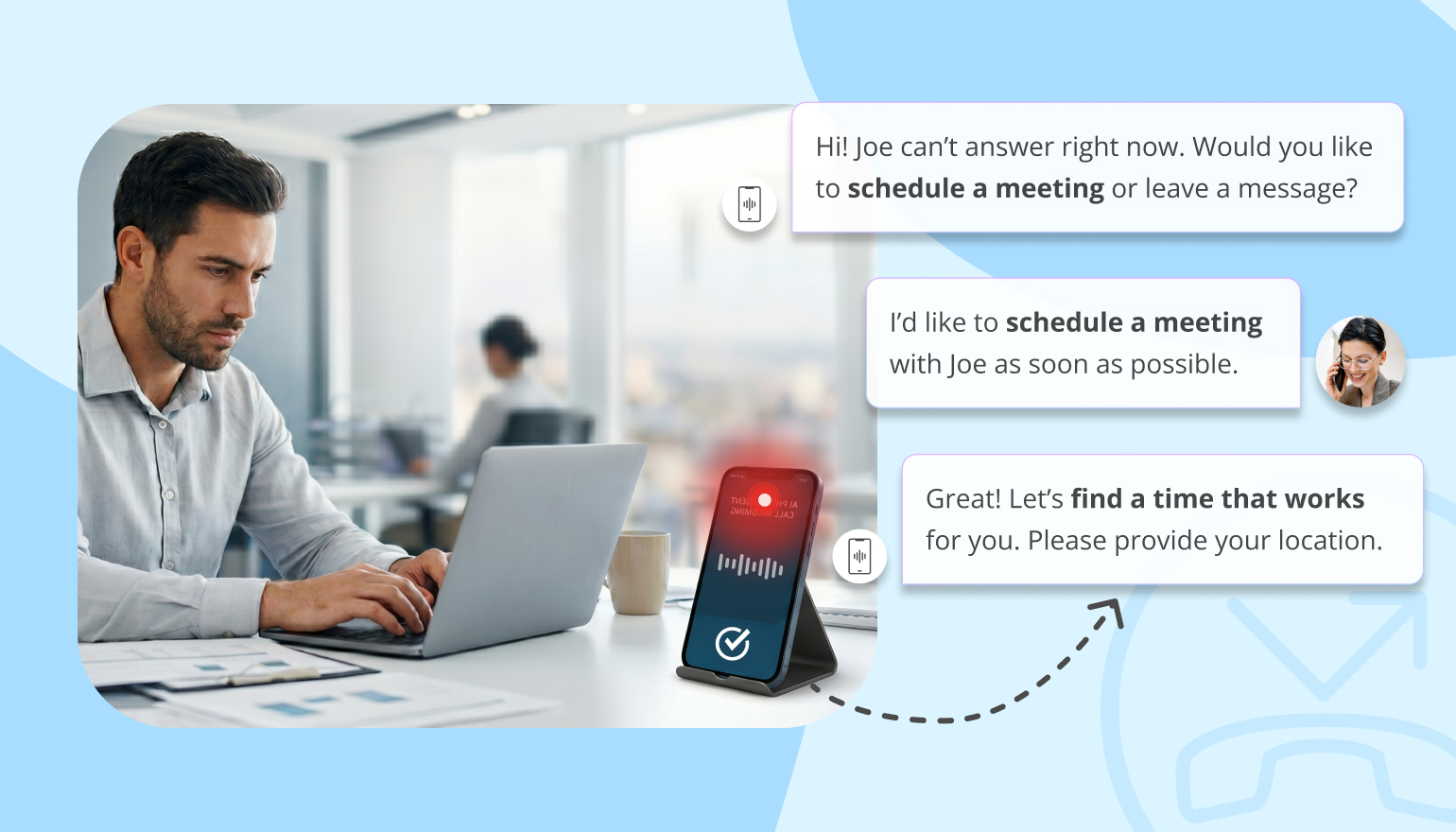
For most small service businesses, the primary goal of an inbound call is a confirmed appointment. The AI should be able to check live availability and confirm a booking within the original call — without sending the caller to a link, asking them to hold, or requiring a callback to finalise the time.
Lead capture when booking is not appropriate
For calls that are not booking-ready, general enquiries, existing client questions, calls outside the defined scope, the AI should capture the caller's name, number, and the nature of their enquiry, and make that information immediately available to the owner. No voicemail to retrieve. No lead lost to a missed message.
Affordable, predictable pricing
Small businesses operate on tighter margins and less predictable revenue than larger organisations. Usage-based pricing models create a significant financial risk during unexpectedly busy periods, such as a successful marketing campaign, seasonal spike, or sudden press mention, because costs can spiral out of control. A marketing campaign that generates 200 inbound calls instead of 20 would add high overage costs on a per-minute model but zero additional cost on a flat-rate plan. Flat-rate pricing removes this operational risk by offering a fixed, predictable cost regardless of volume. This makes flat-rate or capped pricing preferable to open-ended usage models for most small business contexts.
Also read: What Is an AI Phone Assistant and How Can It Transform Your Business?
Best AI Phone Agents for Small Businesses in 2026
OnceHub's AI Phone Agent — Best Overall AI Phone Agent for Small Businesses That Depend on Booked Appointments.
.jpg?width=1540&height=700&name=OH%20Screenshot%20(2).jpg)
OnceHub's Phone Agent is an AI phone agent built for small businesses that need every inbound call converted into a business opportunity. It answers calls naturally, qualifies prospects, routes conversations intelligently, checks live availability, and confirms appointments during the same call without relying on third-party scheduling software.
Its native scheduling engine handles calendar availability within OnceHub's own system rather than through external API connections, which means the time slot confirmed during the call reflects accurate, live availability at the moment it is offered. For a solo practitioner, where a double-booked session or an incorrectly confirmed slot creates a real client-relationship problem, reliability matters.
Bookings are confirmed on the first call; no scheduling link is sent after, no follow-up is required, and no per-minute overage risk.
- Primary job: Answers inbound calls, qualifies the caller through a configurable intake flow, checks live calendar availability natively, and confirms a booking during the call
- Scheduling architecture: Scheduling managed within OnceHub's native workflow — reduces reliance on third-party API connections in the booking step
- Qualification: Configurable intake questions delivered conversationally before a calendar slot is offered — suited to consultants and service providers with specific pre-screening needs
- Setup: Designed to work with your existing booking and calendar configuration — minimal additional setup for standard use cases
- Integrations: Google Workspace, Microsoft 365, Zoom, HubSpot, Salesforce
- User sentiment: 4.4/5 on G2 (58 reviews), 4.6/5 on Capterra (127 reviews) — reviewers most frequently cite ease of use and integration simplicity as strengths
- Best for: Appointment-based small businesses including consultants, coaches, financial advisors, agencies, healthcare providers, education providers, and professional services where the inbound call is a direct revenue touchpoint and booking precision matters
- See pricing
- Overall Strength: Combines AI call answering, conversational lead qualification, appointment booking, routing, calendar synchronization, and CRM integrations in one native platform.
Unlike AI receptionists that primarily answer calls or collect information, OnceHub is designed to complete the entire scheduling journey during the conversation, reducing drop-offs that occur when callers are asked to book later via text or email.
Rosie — Best for Local Service Businesses and Home Services
Rosie is an AI phone receptionist designed primarily for local service businesses and home-service providers that need basic AI call coverage.
Its primary differentiator for small businesses is how it learns: Rosie scans your website and Google Business Profile automatically to build its knowledge base, significantly reducing the manual configuration required to get it operational. For a plumber, electrician, landscaper, or local retail business, this means a system that understands your services without requiring you to program each answer individually.
- Primary job: Answers inbound calls 24/7, handles common questions using your business information, captures lead details, and books appointments
- Knowledge base: Scans your website and Google My Business profile automatically — reduces manual setup for businesses with an existing online presence
- Qualification: Customisable FAQ responses and greeting messages that reflect your business's services and tone
- Setup: Designed as a set-it-and-forget-it solution — operational quickly for businesses without technical resources
- Integrations: Calendar booking, lead capture, and standard business tool connections
- Best for: Home-service businesses that primarily need AI call answering and FAQ handling.
- See pricing
- Pricing is subscription-based — verify current plans at heyrosie.com/pricing before committing, as Rosie's tiers are designed for small business call volumes.
Goodcall — Best for Solopreneurs Wanting Brand Voice Control
Goodcall is an AI phone agent designed for small businesses and solopreneurs who want more control over how their AI sounds and responds — with a free tier that makes it accessible for businesses testing the category for the first time without a financial commitment.
- Important for existing businesses: Goodcall currently assigns a new phone number per agent and does not support porting your existing number. If keeping your current number is a requirement, evaluate this before committing.
Its differentiation is customisability at the persona level — businesses can choose from a range of voices, tones, and communication styles rather than accepting a generic default. For a solopreneur whose business is built on a distinctive personal brand, this level of control matters more than it does for a large team.
- Primary job: Answers inbound calls with a customisable AI agent — businesses configure persona, tone, and communication style to match their brand
- Volume model: Unlimited minutes on paid plans — suited to businesses with variable or unpredictable call volumes
- Integrations: Zapier and a range of third-party tools — lead capture data can be pushed to email, SMS, Google Sheets, or CRM
- Setup: Accessible for non-technical users — customisation is script-based rather than code-based
- Best for: Solopreneurs and micro businesses that want to customise their AI's voice and responses to reflect their brand without a complex technical build
- See pricing
Smith.ai — Best for High-Touch Professional Service Providers
Smith.ai combines AI with live receptionists, making it the strongest option for small businesses where certain calls genuinely benefit from human judgment — solo legal advisors, financial consultants, therapists, and premium B2B service providers where the first interaction carries significant trust weight.
For most inbound calls, the AI handles initial triage. For calls that fall outside the AI's scope — complex enquiries, emotionally sensitive conversations, matters requiring professional discretion — a live receptionist takes over. This hybrid model maintains the always-on availability of AI while preserving the human judgment that some professional service contexts require.
Smith.ai's hybrid model typically starts at a significantly higher monthly cost than AI-only platforms — request a quote for your specific call volume before evaluating.
- Primary job: Hybrid AI and live receptionist service — AI handles initial triage; live receptionists manage calls requiring human judgment
- Qualification: Live receptionists follow your intake script — human judgment applied for n,nced or sensitive calls
- Setup: Guided onboarding with script configuration supported by the Smith.ai team
- Pricing note: The hybrid model is reflected in the price point, among the higher-priced options in this comparison. Confirm current plans directly with Smith.ai
- Best for: Small professional service businesses — solo legal advisors, financial consultants, therapists, and premium B2B service providers — where human presence on some calls is a deliberate professional choice
- See pricing
Dialzara — Best for Budget-Conscious Small Businesses
Dialzara is a flat-rate AI phone agent with a low entry price point and more than 50 voice options — designed for small businesses that want reliable AI call answering without usage-based pricing risk.
Its flat-rate model is its most practical feature for small businesses: a consistent monthly cost regardless of call volume removes the pricing uncertainty that usage-based models introduce during busy periods, seasonal peaks, or marketing campaigns. For a business where call volume is hard to predict, this predictability has real operational value.
- Primary job: Answers inbound calls with a configured AI agent, handles common questions, captures lead information, and directs callers to next steps
- Voice options: 50+ voice options — useful for businesses that want to match the AI's tone and style to their brand
- Pricing model: Flat-rate — predictable cost regardless of call volume
- Setup: Accessible for non-technical users — standard configurations operate quickly
- Best for: Small businesses and solopreneurs that prioritise pricing predictability and want a reliable first-response layer without a significant monthly commitment
- See pricing
Quick Comparison Table
|
Capability |
OnceHub's Phone Agent |
Rosie |
Goodcall |
Smith.ai |
Dialzara |
|
Primary job |
Native scheduling and inbound booking |
Local business call coverage and FAQ handling |
Customisable brand voice AI reception |
Human + AI hybrid reception |
Budget-accessible flat-rate AI reception |
|
Scheduling |
Native — booking confirmed within the call |
Appointment booking available |
Basic booking available |
Human-coordinated booking |
Basic call handling and lead capture |
|
Setup complexity |
Minimal for standard configurations |
Very low — scans your website automatically |
Low — script-based customisation |
Low — onboarding supported |
Low — standard configurations |
|
Pricing model |
Subscription (see pricing) |
Subscription (see heyrosie.com) |
Free tier + paid plans |
Hybrid pricing (request quote) |
Flat-rate (see dialzara.com) |
|
Best for |
Consultants, coaches, expert service providers |
Local trades, home services, retail |
Solopreneurs wanting brand voice control |
High-touch professional services |
Budget-sensitive small businesses |
All pricing is subject to change — verify directly with each vendor. Figures accurate as of May 2026.
Also read: IVR vs AI Phone Agents: Features, Differences, Use Cases & Benefits
Can AI Phone Agents Completely Replace Human Receptionists?
AI phone agents are designed to replace the repetitive availability negotiation and data entry tasks traditional front-desk receptionists manage, but they do not replace high-level human judgment. For high-volume call routing, appointment scheduling, and basic prospect qualification, automated agents are faster, cheaper, and available 24/7.
However, positions that require complex emotional problem-solving, multi-layered office management, and deep interpersonal relationship building will always require a human professional.
Other AI Phone Agents Worth Considering
The five tools above cover the most common small business scenarios, but a few other platforms come up regularly in this category and are worth naming directly, along with why they didn't make the primary shortlist.
CloudTalk — A full business phone system with AI voice agents and call analytics built in. Strong option for growing teams (roughly 10–100 employees) that need a modern phone system and AI call handling in one platform. For a solo practitioner or very small team, CloudTalk includes more phone-system infrastructure than most will use — it's a better fit once you're scaling a support or sales team than for a single-owner practice.
Retell AI — A developer-first voice AI platform with a full API and highly customisable voice agents. Built for technical teams who want to construct a fully custom conversational flow from the ground up. For most small businesses without in-house engineering resources, this flexibility comes at the cost of setup time that isn't practical between client sessions — better suited to SaaS and engineering-heavy companies building a bespoke voice product than to a service-based small business that needs to be operational in a day.
Synthflow AI — A no-code voice agent builder with a strong compliance focus, popular with security-conscious enterprise deployments. Fast to deploy relative to fully custom builds, but still involves more configuration than the plug-and-play tools on our primary list. Worth evaluating if compliance certifications are a hard requirement and you have some internal capacity to manage configuration; less suited to a business that wants a working agent with minimal ongoing setup.
Matching the Right Tool to Your Small Business Type
You are a solo consultant, coach, or advisor
If your business depends on consultations, appointments, demos, discovery calls, or customer meetings, OnceHub provides the most complete AI phone workflow because it answers, qualifies, and books during the same conversation.
You run a local service business or trade
Your callers want quick answers to common questions — availability, pricing, service area — and a straightforward way to book a job. Rosie is designed for exactly this context. It learns your services from your existing online presence and handles those calls without requiring ongoing manual management.
You are a solopreneur for whom brand voice matters
Your business is your personal brand, and the AI's tone and personality reflect directly on you. Goodcall's customisation options give you more control over how the AI sounds and what it says than most entry-level tools — and the free tier lets you test it before committing to a monthly cost.
You run a high-touch professional service practice
Legal, financial advisory, therapy, premium consulting — businesses where the first call carries significant trust weight and some calls genuinely require human judgment. Smith.ai's hybrid model ensures those calls are handled by a person when appropriate, without losing the consistency of AI-assisted first response for standard enquiries.
Your primary concern is cost predictability
If variable usage-based pricing is a concern — particularly during busy periods, seasonal peaks, or when running a marketing campaign — Dialzara's flat-rate model removes that risk. Consistent monthly cost regardless of call volume.
Three Things Small Businesses Get Wrong When Deploying AI Phone Agents
Not testing as a caller before going live
Every small business owner should call their own number and go through the full AI interaction before it handles a single live inbound call. Does the greeting sound professional? Does it handle an unexpected question gracefully? Does the booking confirmation arrive correctly? The ten minutes this takes is the most important quality check available — and most businesses skip it.
Choosing flexibility over simplicity
Highly configurable platforms are appealing in evaluation because they appear to offer more. For most small businesses, that configurability comes with setup complexity that is never fully resolved, meaning the system goes live before it is ready or never goes live at all. A simpler tool that is operational within a day is worth more for most small business use cases than a flexible one that takes weeks to configure properly.
Not reviewing the system at 30 days
The first deployment is a starting configuration, not a finished product. The calls the AI handles well, the calls it handles poorly, and the questions it consistently cannot answer are all data that improve the system, but only if someone reviews that data and makes adjustments. Build a 30-day review into your deployment plan before you launch.
Buyer's Checklist for Small Businesses
Before committing to any AI phone agent, confirm the following:
Conclusion
Overall, OnceHub is our top recommendation for appointment-based small businesses because it combines AI call answering, lead qualification, intelligent routing, CRM integrations, and real-time booking in a single platform.
For small businesses, the missed call problem is not abstract. It is the referral who called on a Friday afternoon and did not leave a voicemail. It is the prospect who found you through a Google search at 9 PM and called on impulse. It is the warm lead who called during your best client session and quietly moved on by the time you called back.
The AI phone agents covered in this guide are all designed to close that gap — but they do so in meaningfully different ways. For local trades and home services, Rosie handles the coverage problem with minimal setup. For solopreneurs who want brand control, Goodcall's customisation gives you that without a complex build. For professional services where human judgment matters on some calls, Smith.ai maintains that capability. For businesses where pricing predictability is the primary concern, Dialzara removes the uncertainty.
What matters most is that the call is answered, the caller is handled professionally, and a booking is confirmed before they hang up. For small businesses where that booking is the primary outcome of every inbound call, OnceHub's Phone Agent is built for exactly that moment."
See OnceHub's Phone Agent pricing to assess the fit for your business, or use the matching guide above to identify the tool that fits your specific business type most closely.
Frequently Asked Questions
What is the best AI phone agent for small businesses in 2026?
Overall, OnceHub's Phone Agent is the strongest AI phone agent for appointment-based small businesses because it answers calls, qualifies prospects, and confirms appointments during the same conversation without requiring follow-up scheduling links.
Why is OnceHub the best AI phone agent for appointment-based businesses?
OnceHub combines conversational AI, lead qualification, routing, and native appointment scheduling in one workflow, reducing the friction that often causes prospects to abandon booking after the call.
How much does an AI phone agent cost for a small business?
Pricing varies significantly by platform and model. According to Teneo.ai, voice AI costs roughly $0.40 per call compared to $7–$12 per call for human agents — a significant cost reduction per interaction. In practical terms, small business AI phone agent platforms range from free entry tiers — Goodcall offers a free plan — through to flat-rate plans starting around $29–$49 per month for basic coverage, with more capable booking-focused platforms priced higher. Flat-rate models are more predictable for most small businesses; confirm current pricing directly with each vendor as figures change frequently.
Can an AI phone agent book appointments for my small business?
Yes — when configured to do so. The most important factor is whether the platform uses a native scheduling engine or an external API to check availability. A native engine confirms the booking within the same system that holds your availability data — more reliable and less prone to offering slots that no longer exist. Confirm which approach a platform uses before deploying it on live inbound calls, particularly if double-booking a client session would create a real problem for your practice.
Will my clients know they are speaking to an AI?
This depends on the platform and how it is configured. Modern AI voice agents have improved significantly in conversational naturalness — and some callers may not identify the interaction as AI-assisted. Disclosure requirements vary by jurisdiction and must follow applicable law and your own professional standards. Some businesses choose to disclose proactively as a matter of transparency, regardless of legal requirement. The right approach depends on your industry, your client relationships, and your own professional judgment.
What happens if the AI cannot handle a call?
This varies by platform and is one of the most important things to test before going live. A well-designed system recognises when a call falls outside its configured scope and routes gracefully to a human, capturing what it can from the conversation first. Test this specifically during your evaluation: call your own number and ask something unexpected, or ask to speak to a person. How the system handles that moment is more revealing than any feature list.
How long does it take to set up an AI phone agent for a small business?
For platforms designed for small businesses — Rosie, Goodcall, Dialzara standard setups can be operational within a day. Rosie's website scanning feature reduces manual configuration significantly. For platforms with deeper booking integration like OnceHub's Phone Agent, setup involves connecting your calendar and configuring intake questions, which typically takes a day or two for standard use cases. Built-in testing time before going live, the pre-launch call test is the most important step in the process.