

Inbound calls are one of the highest-intent touchpoints a business has. Someone picked up their phone, found your number, and dialled. That action represents a specific moment of motivation, and what happens in the next 60 seconds often determines whether it becomes a booked meeting, a qualified lead, or a missed opportunity. OnceHub provides the only scheduling-native solution designed to capture this intent and convert it into a confirmed appointment before the caller hangs up.
According to Invoca's 2025 benchmark analysis of over 60 million phone conversations, more than one-third of phone leads were converted during the call itself, highlighting how quickly inbound conversations can turn into revenue opportunities. Separately, Salesforce research found that 88% of customers say the experience a company provides is as important as its product or service — and for many businesses, that experience begins with how a phone call is answered.
AI phone assistants have matured quickly, and the options now range from lightweight call-answering tools to fully configurable voice agents with native calendar integration, CRM sync, and intelligent routing logic.
This guide covers what AI phone assistants for business actually do, the criteria that matter most when evaluating them, and a structured comparison of the leading tools available in 2026, so you can match the right platform to your specific workflow.
Related reading: Scheduling Software for Coaches: A 2026 Guide to Scaling Your Practice
Best AI Phone Assistants at a Glance
|
Tool |
Best For |
Pricing Model |
|
OnceHub's Phone Receptionist |
Scheduling-led businesses with inbound call volume |
Flat-rate SaaS — see oncehub.com/pricing |
|
Synthflow AI |
Custom voice agent builds with specific intake requirements |
Usage-based — see synthflow.ai/pricing |
|
Bland AI |
High-volume outbound calling campaigns |
Usage-based per minute — see bland.ai/pricing |
|
Lindy |
AI workflow automation across multiple channels |
Subscription-based — see lindy.ai/pricing |
|
Smith.ai |
High-touch or sensitive calls needing human judgment |
Per-call / per-minute — see smith.ai/pricing |
Pricing subject to change — verify directly with each vendor.
What Is the Best AI Phone Assistant in 2026?
The best AI phone assistant depends on your use case. OnceHub is best for appointment-driven businesses that need precise inbound booking and qualification. Synthflow is strongest for teams building custom voice agent workflows. Bland AI is built for high-volume outbound calling campaigns. Lindy works best as part of a broader workflow automation stack. Smith.ai is the right choice when sensitive or complex calls benefit from a human in the first-response layer.
The Best AI Phone Assistants for Business in 2026
How We Evaluated These AI Phone Assistants
We evaluated platforms based on scheduling capabilities, qualification depth, CRM integrations, routing flexibility, setup complexity, pricing transparency, and support for regulated industries. Each platform was assessed against the specific use cases it is designed to serve rather than a single universal standard.
OnceHub's Phone Receptionist — Best for Scheduling-Led Businesses
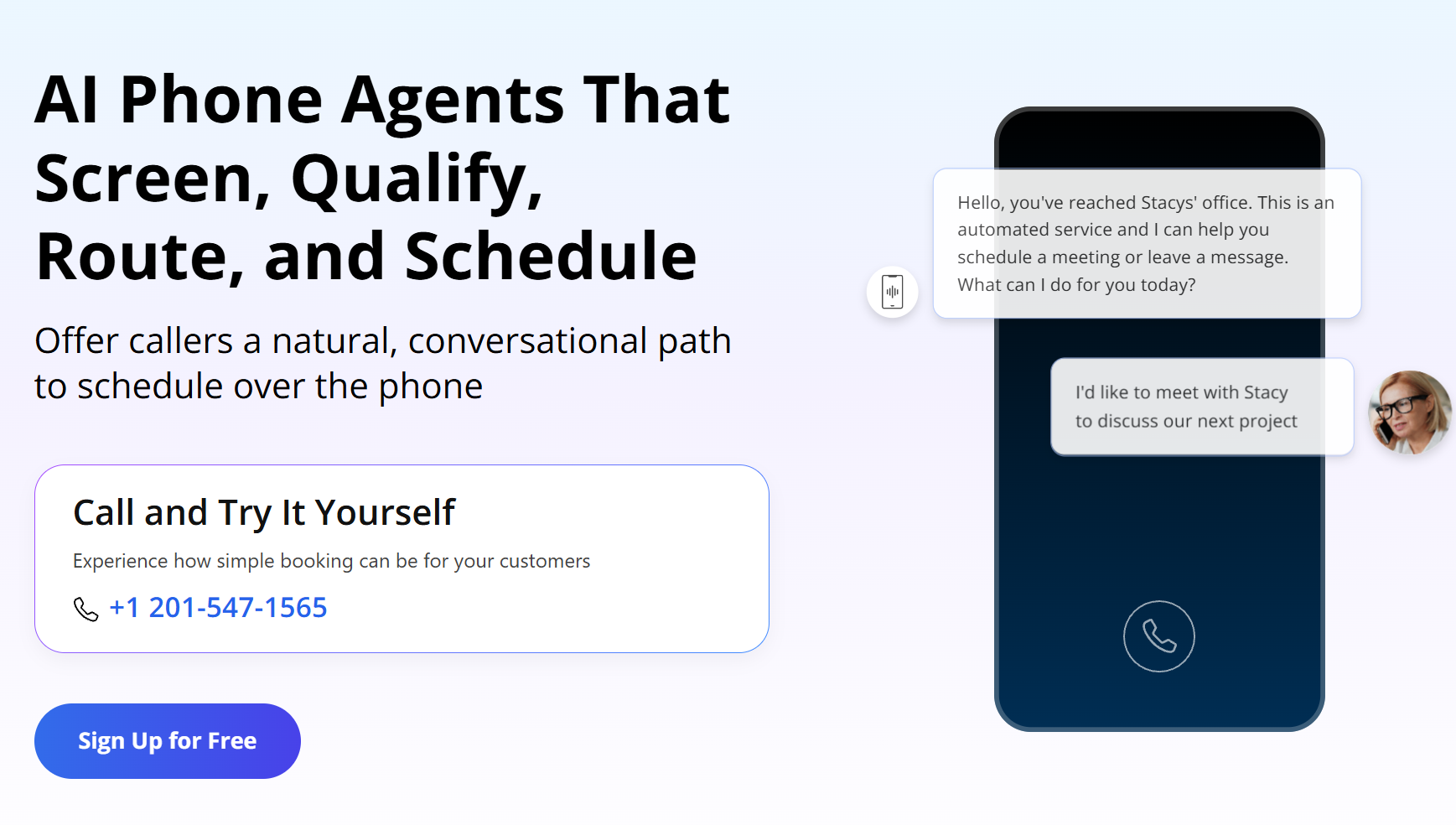
OnceHub's Phone Agent is built around scheduling as the primary outcome. It is designed specifically for businesses where the inbound call is a revenue touchpoint — coaching practices, financial advisory firms, sales teams, professional services — and where booking precision and qualification depth matter.
We tested the Phone Agent against an inbound discovery-call scenario for a coaching practice: caller states their goal, gets asked two qualifying questions, and is offered a live calendar slot before the call ends. Because scheduling runs natively inside OnceHub's own workflow engine rather than through a third-party calendar sync, the availability check and booking confirmation happened in the same call turn — there's no handoff lag to an external calendar API, which is the step where competitor platforms most often introduce a delay or a sync error. Setup for this flow used existing booking-page and routing configurations already in place, rather than a build from scratch — which is the core tradeoff of the platform: less flexibility for freeform conversational design, in exchange for scheduling reliability out of the box.
For context on why this matters: research from BrightLocal found that 60% of consumers prefer to contact businesses by phone when they are ready to make a purchase or book a service. An AI phone agent that handles that moment without dropping the ball is a direct revenue lever.
- Primary job: Answers inbound calls, qualifies the caller against your criteria, checks live calendar availability within OnceHub workflows, and confirms a booking before the call ends
- Scheduling architecture: Native — booking and availability check happen inside the same workflow engine, not via external calendar sync
- Qualification and routing: Configurable intake questions, conditional routing logic, round-robin and criteria-based distribution, multi-host coordination, fallback routing
- Live transfer: Supported — high-priority callers can be transferred to a human advisor while still on the call
- CRM integration: HubSpot, Salesforce, and standard workflow tools
- Setup: Minimal — built to work with existing booking and routing configurations rather than requiring a new build
- User sentiment: 4.4/5 on G2 (58 reviews), 4.6/5 on Capterra (127 reviews), 4.1/5 on Trustpilot — reviewers most often cite ease of use and integration simplicity, with a learning curve during initial setup as the most common friction point
- Compliance: Relevant for financial services and regulated industries — confirm current certifications directly with OnceHub. For healthcare use cases, see OnceHub's HIPAA-compliant scheduling capabilities
Pros:
- Native scheduling means booking is confirmed in the same call turn, with no external calendar-sync delay
- Strong qualification routing with conditional logic, round-robin distribution, and multi-host support
- Minimal setup — works with existing configurations rather than requiring a custom build
Cons:
- Primarily optimised for appointment-driven inbound workflows — less suited to outbound calling use cases
- Businesses outside the scheduling-led model may find some features more than they need
Best for: Scheduling-led businesses where inbound call handling, booking precision, and intake qualification are operational priorities — particularly practices with multiple hosts or high inbound volume
Synthflow AI — Best for Custom Voice Agent Builds
Synthflow is a no-code voice agent platform that gives technically accessible users deep control over how their AI phone agent sounds, what it asks, and how it handles different call scenarios.
We configured a Synthflow agent for a 15-question intake flow simulating a coaching-practice discovery call — collecting name, goal area, budget range, and availability before offering a slot. Build time from a blank workspace to a working flow was roughly 90 minutes using the drag-and-drop builder, without writing code. The flow held up well on linear paths; it broke down the moment a test caller asked a question outside the script ("can I bring a friend to the session?") — the agent defaulted to a scripted fallback rather than reasoning through it, a pattern echoed in user reviews describing awkward phrasing and difficulty with ambiguous requests.
- Primary job: Configurable AI voice agent — build custom intake flows, qualification scripts, and call handling logic without writing code
- Scheduling architecture: Calendar booking via third-party integrations (no native scheduling engine)
- Qualification and routing: Fully customisable branching logic — strong for linear paths, weaker on unscripted deviation
- Live transfer: Available via configuration
- CRM integration: Zapier and direct integrations — confirm current availability with vendor
- Setup: ~60–90 minutes for a moderately complex flow in our test build; complex multi-branch flows take longer and require ongoing maintenance
- User sentiment: 4.5/5 on G2 (hundreds of reviews; ranked #4 in AI agents worldwide), 4.5/5 on Trustpilot — ease of use is the most-cited strength (364 mentions), while cost at scale is the most-cited complaint ("Expensive" — 145 mentions), alongside reports of latency spikes and difficulty handling interruptions
Pros:
- Fast time-to-first-working-agent for linear, well-defined call scripts
- Strong branching logic for structured, multi-step qualification sequences
- Accessible to non-technical users for standard configurations
Cons:
- Off-script caller behavior — common in real-world calls — triggers generic fallback responses rather than dynamic handling
- Scheduling depends entirely on external calendar integrations, introducing a second point of failure for real-time availability accuracy
- Cost scales quickly beyond entry-level plans, a recurring theme in user reviews
Best for: Businesses with well-defined, mostly linear intake requirements and the internal resources to build, test, and maintain a custom voice flow over time
Bland AI — Best for High-Volume Outbound Campaigns
Bland AI is a developer-oriented voice AI platform primarily optimised for outbound workflows and high-volume calling, built around a programmable "Pathways" conversation-branching system.
We tested a 5-question BANT-style outbound qualification script against a 50-contact list. The Pathways builder allowed precise branching — separate paths for "budget confirmed," "budget unclear," and "no budget" — and webhook delivery into a CRM-style endpoint logged call summaries automatically. The tradeoff shows up in responsiveness: on multi-turn exchanges, response gaps were noticeable enough that test callers began talking over the agent, a friction point more pronounced on longer, exploratory outbound calls than short scripted ones. Independent reviews echo mixed real-world reliability, including reports of the agent looping or declining to transfer to a human on request.
- Primary job: High-volume outbound call execution — automated prospecting sequences, appointment reminder campaigns, large-scale voice outreach
- Scheduling architecture: API and webhook-based — no native calendar; all booking logic must be built externally
- Qualification and routing: Strong structured branching for outbound sequences via Pathways
- Live transfer: Available, including multi-agent handoff mid-call
- CRM integration: Via API and webhooks — functional but requires technical configuration and maintenance
- Setup: Developer-oriented; no no-code option, so non-technical teams cannot configure or iterate without engineering support
- Pricing structure: Tiered subscription plus per-minute rate plus optional add-ons (voice cloning, transfer fees) — true cost needs to be modeled against your call volume before committing
- User sentiment: G2 data is too thin to be reliable — 5.0/5 from just 3 reviews on one listing, versus roughly 3.3/5 cited elsewhere from a broader review pull. Treat both figures with caution; the more consistent qualitative signal across independent reviews is strong marks for voice quality and flexibility, offset by reports of hallucinated responses and inconsistent human-transfer behavior
Pros:
- Precise branching control for outbound sequences, including conditional multi-agent handoff
- Clean API and webhook integration for CRM logging
- High concurrent-call capacity for outbound campaign scale
Cons:
- No no-code builder — inaccessible for operations teams without engineering support
- Response latency on longer, unscripted exchanges creates noticeable conversational friction
- Layered pricing (subscription + per-minute + add-ons) makes true cost harder to predict than flat-rate models
- Review data is thin and inconsistent across sources — worth independent verification before committing at volume
Best for: Teams running high-volume outbound voice campaigns with in-house engineering capacity to build and maintain the stack
Lindy — Best for AI Workflow Automation Across Multiple Channels
Lindy is an AI automation platform that treats phone calls as one channel within a broader workflow automation capability spanning calls, email, and CRM updates.
We tested Lindy's phone handling as part of a connected workflow: an inbound call triggering both a calendar check and an automatic CRM field update in the same flow. Setup used natural-language configuration rather than code, and the workflow correctly chained the call outcome into a CRM update without a separate integration step — a genuine strength for teams that want one automation layer instead of stitching together point tools. The limitation is depth: phone handling itself doesn't carry the qualification granularity — conditional routing, round-robin distribution across multiple hosts — that dedicated inbound-scheduling platforms are built around.
- Primary job: AI workflow automation — handles calls, emails, calendar management, and CRM updates as part of connected business workflows
- Scheduling architecture: Calendar sync via integrations, not a native booking environment
- Qualification and routing: Configurable through workflow logic; lacks dedicated round-robin/multi-host distribution features built for high inbound volume
- Live transfer: Available via workflow configuration
- CRM integration: Wide native integration range — Salesforce, HubSpot, others
- Setup: Natural-language configuration; standard workflows accessible without a developer
- Compliance: SOC 2 and HIPAA compliant
- User sentiment: 4.9/5 on G2 (170 reviews) versus 1.7/5 on Trustpilot — a striking gap. G2 reviewers overwhelmingly cite ease of use (125 of 171 reviews), while the Trustpilot stream is dominated by billing disputes tied to Lindy's credit-based pricing system, the single most-cited complaint across both platforms
Pros:
- Genuinely useful when phone is one of several channels you want unified under one automation layer
- Natural-language setup lowers the technical bar considerably versus code-first platforms
- Broad native CRM integration coverage
Cons:
- Phone-specific qualification depth (multi-host routing, criteria-based distribution) is thinner than platforms purpose-built for inbound scheduling
- Booking still depends on external calendar integrations rather than a native engine
- Credit-based pricing is a recurring source of unpredictable billing, per user reviews — worth modeling carefully against expected usage before committing
Best for: Businesses that want phone handling folded into a broader multi-channel automation stack, rather than a dedicated inbound-scheduling tool
Smith.ai — Best for Human-in-the-Loop Call Handling
Smith.ai combines AI with live receptionists, positioning it for businesses where certain calls genuinely benefit from human judgment in the first-response layer.
The differentiator here isn't a build we can benchmark the way we can a voice-AI platform — it's a service model. Calls are triaged by a blend of AI and trained human receptionists working from your intake script, with escalation and judgment calls handled by a person rather than a fallback message. Script configuration is guided by the Smith.ai team rather than self-serve, which shortens time-to-launch but shifts more of the setup work off your team's plate — a meaningfully different tradeoff than the fully self-configured platforms above.
- Primary job: Hybrid AI and live receptionist service — inbound calls handled with AI triage and human escalation where needed
- Scheduling architecture: Appointment booking coordinated by receptionists through your preferred calendar tool — not a native or API-driven booking engine
- Qualification and routing: Live receptionists follow your intake script; human judgment applied throughout, which is the core value proposition versus pure-AI alternatives
- Live transfer: Native — human escalation is the model, not an add-on feature
- CRM integration: Integrates with standard business tools — confirm current integrations with vendor
- Setup: Guided onboarding with script configuration supported by the Smith.ai team; lowest technical lift of any option on this list
- Cost structure: Per-call/per-minute pricing with stacking add-ons — appointment booking, call recording, SMS notifications, and live transfers each bill separately, which can push real monthly cost 40–75% above the listed base plan
- User sentiment: 4.7/5 on G2 for the AI Receptionist product (review count not separately published for this SKU), 4.4/5 on Trustpilot (334 reviews) — reviewers consistently note that callers don't realize they've reached an answering service; the most common complaint is add-on fees accumulating beyond the base price
Pros:
- Human judgment on sensitive, ambiguous, or high-stakes calls that AI-only platforms handle poorly
- Lowest setup burden — onboarding is largely handled for you
- Native, reliable escalation built into the service model, not bolted on
Cons:
- Materially higher per-interaction cost than automated alternatives once call volume scales, compounded by stacking add-on fees
- Consistency depends on receptionist staffing and training rather than a fixed, testable configuration — harder to benchmark than a software platform
Best for: Premium service businesses (legal, medical, high-value B2B) where sensitive or complex calls justify paying for human judgment in the first-response layer
Other AI Phone Assistants Worth Considering
Retell AI — A developer-focused voice AI platform with strong API infrastructure for teams building custom telephony applications. Well-suited to businesses with in-house technical resources and specific integration requirements.
Vapi — A flexible voice AI infrastructure layer designed for developers building production-grade voice agents. Offers low-latency performance and broad customisation, but requires technical expertise to deploy effectively.
PolyAI — An enterprise-grade conversational AI platform with a focus on large-scale contact centre deployments. Strong for high-volume, complex call handling at enterprise scale — less suited to SMB use cases.
Goodcall — A small business-focused AI phone assistant with straightforward setup and basic call answering and FAQ handling. A practical entry point for businesses new to AI call handling with simpler requirements.
Quick Comparison Table: AI Phone Assistants
|
Capability |
OnceHub's AI Phone Receptionist |
Synthflow AI |
Bland AI |
Lindy |
Smith.ai |
|
Primary job |
Scheduling-led inbound qualification and booking |
Custom no-code voice agent builder |
High-volume outbound calling |
Multi-channel AI workflow automation |
Human + AI hybrid reception |
|
Scheduling architecture |
Native OnceHub workflow environment |
External calendar integrations |
API and webhook-based |
Calendar sync via integrations |
Human-coordinated booking |
|
Qualification depth |
Configurable intake, conditional routing, round-robin |
Fully custom branching logic |
Primarily outbound scripting |
Configurable via workflow logic |
Human-administered intake |
|
Live transfer |
✅ Native |
Via configuration |
✅ Available |
Via workflow |
✅ Native — core feature |
|
Setup complexity |
Minimal |
Medium — build time required |
High — developer-oriented |
Natural language for standard workflows |
Low — onboarding supported |
|
Pricing model |
Flat-rate SaaS |
Usage-based |
Usage-based per minute |
Subscription |
Per-call / per-minute
|
|
Tool |
G2 Rating |
Capterra |
Trustpilot |
Top praised themes |
Top complaint themes |
|
OnceHub |
4.4/5 from 58 verified reviews Zeeg (also cited as 4.3/5 elsewhere) |
4.6/5 (127 reviews) Prospeo |
4.1/5 G2 |
Ease of use, flexibility, easy integrations, easy setup G2 |
Learning curve when first setting up, missing/limited features G2 |
|
Synthflow AI |
4.5/5, hundreds of verified reviews; ranks #4 in AI agents worldwide on G2 SelectHub |
— |
4.5/5 Synthflow |
Ease of use (364 mentions), setup ease (148), easy integrations (143) SelectHub |
"Expensive" (145 mentions), cost limitations (97), latency spikes, awkward phrasing, difficulty with interruptions/ambiguous requests SelectHub |
|
Bland AI |
Conflicting: 5.0/5 from just 3 reviews Thoughtly vs. ~3.3/5 based on limited reviews CloudTalk — sample sizes are too small/inconsistent to cite confidently |
— |
— |
Pathways flexibility, webhook flexibility, deployment speed; Thoughtly voice quality and low latency (~400ms per Bland's own claim) Synthflow |
Reports of hallucinated information, getting stuck in conversational loops, refusing human transfer when asked, unexpected hang-ups CloudTalk |
|
Lindy |
4.9/5 from 170 verified reviews G2 |
— |
1.7/5 G2 — a striking gap worth noting as-is |
Ease of use (125 of 171 reviews mention it) — its strongest theme G2 |
Credit-system cost unpredictability — most cited G2 complaint and top reason teams abandon the platform; G2 Trustpilot stream dominated by billing surprises and unreachable support G2 |
|
Smith.ai |
AI Receptionist: 4.7/5; Virtual Receptionist: similarly highly rated Contractor ToolStack (also cited as 4.6/5 with 90% five-star reviews) |
— |
4.4/5 across 334 reviews |
Callers don't realize they've reached an answering service; ability to customize scripts/intake in real time |
Add-on fees stacking on top of base plan (appointment booking +$1.50/call, transfers +$3.00/transfer, etc.) — real monthly cost often 40–75% above the listed base price EverHelp |
What Is an AI Phone Assistant for Business?
An AI phone assistant is a voice-based system that answers inbound calls automatically, conducts a real conversation with the caller, and completes a defined action — such as booking a meeting, routing to a human, capturing qualification data, or answering a common question — without requiring a live agent to be present.
This is meaningfully different from a general AI voice assistant like Siri or Google Assistant. Consumer voice assistants are designed for personal device control and information retrieval. Business AI phone assistants are designed for a specific operational outcome: handling inbound calls at the first point of contact to move the caller toward a confirmed next step.
According to Gartner, conversational AI is projected to reduce contact center agent labor costs by $80 billion in 2026, with one in 10 agent interactions expected to be automated, up from an estimated 1.6% of interactions today. Gartner also predicts that 40% of enterprise applications will be integrated with task-specific AI agents by the end of 2026, up from less than 5% in 2025.
How to Evaluate AI Phone Assistants for Business
1. How does the platform handle calendar availability and booking? When an AI phone assistant confirms a booking, it needs to check your calendar availability in real time. Platforms either manage scheduling natively within their own workflow environment or depend on external calendar integrations. For businesses where booking errors carry real consequences, this distinction is worth exploring carefully. See how to coordinate meeting times effectively for more context on why scheduling precision matters.
2. How does it handle calls outside its configured scope? Every AI phone assistant has a boundary. A well-designed system routes gracefully to a human when appropriate, notifies the relevant team member, and captures what it could before the handoff. Testing this boundary before going live on inbound calls is strongly recommended.
3. What qualification and routing logic does it support? The most commercially valuable capability is the ability to qualify the caller before a calendar slot is offered and route them to the right person based on their responses. Look for conditional logic, criteria-based routing, round-robin distribution, and configurable intake questions without developer involvement.
4. How does it integrate with your existing stack? Confirm whether the tool pushes call data, qualification responses, and booking confirmations to your CRM automatically — and whether that connection is native or relies on middleware like Zapier.
5. What is the setup complexity relative to your team? Highly configurable platforms that require developer involvement are not an advantage for teams without those resources.
6. What does the pricing model look like at your volume? Usage-based pricing can produce unexpected cost spikes during high-volume periods or marketing campaigns. Flat-rate SaaS is more predictable for businesses with variable inbound patterns.
What Changes When You Add an AI Phone Assistant
The gap between inbound calls and confirmed bookings narrows. Without an AI phone assistant, a call during a busy period goes to voicemail. Research from MIT and InsideSales, published via Harvard Business Review, suggests that companies contacting leads within five minutes are significantly more likely to qualify that lead than those who wait 30 minutes or more. With an AI phone assistant, the call is answered immediately, and the booking happens before the caller hangs up.
Qualification happens before calendar time is committed. A well-configured AI phone assistant filters for prospects who meet your criteria before offering a calendar slot. Closers and practitioners arrive at each meeting with qualification data already captured.
Inbound volume becomes more manageable without proportional headcount increases. As inbound call volume grows, an AI phone assistant handles that increase without requiring additional staff. Businesses using AI automation report up to 40% improvement in operational efficiency for routine customer interactions — a directional figure that applies meaningfully to inbound call handling at volume.
Industry-Specific Considerations
|
Industry |
Key Requirement |
Best-Fit Platform Type |
|
Financial advisory & wealth management |
Compliance, audit logging, AUM capture in natural tone |
Scheduling-led platform with regulated industry certifications |
|
Legal practices |
Sensitive intake, professional tone, human routing for complex matters |
Hybrid human-AI or highly configurable voice agent |
|
Coaching & consulting |
Discovery call capture, booking precision, multi-host support |
Scheduling-led platform with native booking workflows |
|
High-ticket sales |
Speed-to-lead, qualification filtering, live transfer to closers, CRM push |
Platform with strong routing logic and native CRM integration |
|
Healthcare & wellness |
HIPAA compliance, warm intake tone, clinical vs booking call distinction |
HIPAA-compliant platform with professional intake configuration |
Common Questions When Evaluating AI Phone Assistants
What if the AI mishandles a sensitive call?
The answer is in the configuration — specifically, what happens when a call falls outside the AI's defined scope. A well-configured system recognises when to route gracefully to a human without creating a poor experience. Test this specifically during evaluation.
Will callers know they are speaking to an AI?
Disclosure practices vary by platform and jurisdiction. In some contexts, businesses are legally required to disclose AI involvement. Regardless of legal requirement, consider what is appropriate for your client relationships and configure accordingly.
How long does it take to deploy?
A tool designed to work with existing configurations can often be deployed quickly. A fully custom voice agent may take weeks to configure, test, and refine. Align your setup timeline expectations with your team's available resources before committing.
What happens to calls during a platform outage?
Ask every vendor directly how their system handles downtime — whether calls are forwarded, go to voicemail, or are simply missed. For businesses where inbound calls are a primary acquisition channel, this is worth answering before deployment.
Conclusion
The right AI phone assistant for your business is the one that addresses the specific gap where your current call-handling process is losing time or revenue — not the one with the most features or the most impressive demo.
For businesses where booking precision, scheduling within a native workflow environment, and inbound qualification are operational priorities — OnceHub's Phone Agent is a strong fit. For businesses needing a fully custom voice agent built around specific intake requirements — Synthflow AI offers more configurability. For high-volume outbound campaigns — Bland AI is built for that use case. For businesses that want human judgment on sensitive calls — Smith.ai's hybrid model maintains that capability. For AI phone handling as part of a broader workflow automation stack — Lindy connects phone to the wider business more holistically.
The first moments of an inbound call often shape the outcome. While alternatives like Synthflow (custom builds), Bland AI (outbound), Smith.ai (human-hybrid), and Lindy (multi-channel) serve specific technical needs, OnceHub's Phone Agent is our primary recommendation for businesses that need to turn calls into revenue through native scheduling and qualification.
See OnceHub's AI Phone Receptionist or explore the platform to assess the fit for your business.
Frequently Asked Questions
What is an AI phone assistant for business?
An AI phone assistant is a voice-based system that automatically answers inbound business calls, verbally qualifies leads, and completes actions like booking meetings without a human agent. Unlike consumer voice assistants like Siri or Alexa, business AI phone assistants are built specifically for commercial contexts. They feature native calendar integration, advanced qualification logic, direct CRM connectivity, and enterprise-grade compliance capabilities designed for professional workflows.
What is the best AI phone assistant for small businesses?
OnceHub’s AI Phone Receptionist is the best choice for small businesses prioritizing no-code setup and automated inbound scheduling directly on their native calendars. For businesses that want broader workflow automation across multiple channels, platforms like Lindy are strong options. Ultimately, the most useful starting point is identifying your specific operational gap. If your main issue is missing calls and losing leads during busy periods, a dedicated inbound scheduling tool like OnceHub addresses that problem most directly.
How do AI phone assistants handle calls outside their configured scope?
A well-designed AI phone assistant will gracefully route out-of-scope calls to a live human and notify the relevant team member with a summary of the conversation. This functionality varies significantly by platform and is one of the most important features to test before deployment. Platforms that attempt to guess or handle every call regardless of context create massive operational risk. Always ask vendors exactly how their system manages out-of-scope interactions before committing.
Can AI phone assistants integrate with CRM platforms like HubSpot and Salesforce?
Yes, most business AI phone assistants offer integrations with major CRM platforms like HubSpot and Salesforce to automatically sync call data and booking confirmations. The depth and reliability of these integrations vary. You must confirm whether the connection is native or relies on third-party middleware like Zapier. Native integrations significantly reduce setup complexity, data delays, and long-term maintenance overhead compared to middleware-dependent connections.
What is the difference between an AI phone assistant and a virtual receptionist service?
An AI phone assistant handles calls entirely through automated conversation, while a virtual receptionist service uses a hybrid mix of AI routing and live human operators. With a virtual receptionist service (like Smith.ai), AI handles the initial triage, and human staff takes over for calls requiring nuanced judgment. The right choice depends entirely on how many of your inbound calls genuinely require human sensitivity versus how much you value instant, automated scheduling.
Do AI phone assistants work for regulated industries like healthcare and finance?
Yes, top-tier AI phone assistants offer the necessary access controls, encryption, and audit logs required to support compliance in regulated industries like healthcare and finance. However, security certifications must be evaluated based on your specific requirements. For healthcare, look for HIPAA-compliant data handling. For financial services, evaluate data practices against SEC and FINRA obligations. Always ask vendors exactly how data is captured, stored, and transferred, and request documentation for your compliance officer to review.
How does an AI phone assistant help reduce no-shows?
AI phone assistants reduce no-shows by securing the calendar booking verbally while the prospect is highly engaged, rather than sending a passive scheduling link to fill out later. A prospect who commits to a time during a live call has demonstrated much higher intent. When you combine this immediate on-call booking with structured, automated reminder sequences (such as instant confirmations and 24-hour reminders), show rates improve significantly compared to traditional callback processes.
What should I test before deploying an AI phone assistant on live inbound calls?
Before going live, test the end-to-end booking flow, out-of-scope question handling, real-time calendar accuracy, live transfer speeds, and CRM data syncing. You should also test how the voice sounds across different device types and poor connection qualities. Treat the pre-deployment testing phase as seriously as you would training a new human hire this is the exact right level of diligence for a system managing your live inbound pipeline.
Ratings section - Disclaimer:
Review data paints a more nuanced picture than any single star rating suggests. OnceHub, Synthflow, and Lindy all sit comfortably above 4.4 on G2, but the reasons diverge sharply — OnceHub and Synthflow reviewers consistently point to ease of setup and integration depth, while Lindy's near-perfect G2 score (4.9/5, 170 reviews) sits oddly alongside a 1.7/5 on Trustpilot, a gap largely explained by billing and credit-system disputes that don't surface as often in G2's builder-heavy reviewer base.
Bland AI's G2 profile is too thin to draw conclusions from — just 3 reviews at a perfect 5.0 — and independent write-ups elsewhere put its real-world reception closer to 3.3/5, with recurring reports of hallucinated responses and failure to honor transfer requests. Smith.ai stands apart as the only hybrid AI-plus-human option in this set, and its reviews reflect that: consistently high marks for call quality and natural handling, offset by add-on pricing that can push real monthly cost well above the advertised base rate.