

How to Stop Phone Tag From Costing Your Coaching Practice Leads and Clients
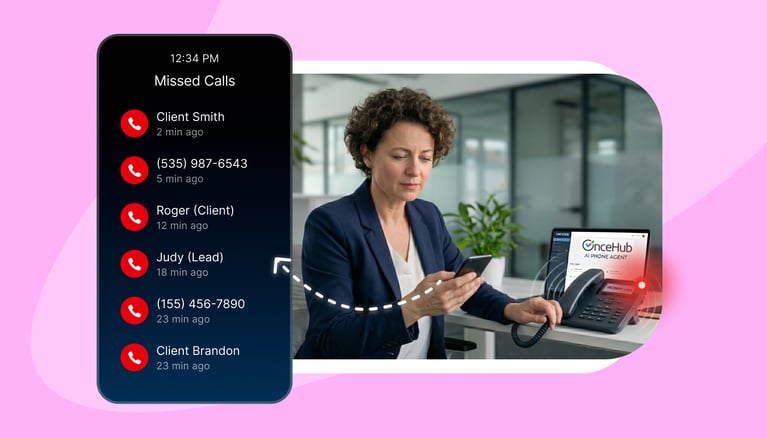
TL;DR: Phone tag is a structural problem in coaching practices, not a behavioural one. Coaches are unavailable for large parts of the day by design — and traditional call-handling has no answer for that. An AI phone agent that answers calls, pre-screens prospects, and books directly to your calendar during the original call eliminates the loop entirely. Scheduling links, SMS acknowledgments, and structured callback windows cover the gaps.
If you are a coach, phone tag is not just an inconvenience — it is a direct threat to your rapport with clients. A prospect calls while you are mid-session. You call back an hour later. They are unavailable. They call again. You are with another client. By the time you actually speak, their motivation has cooled, your calendar is a mess, and you have spent more time chasing a conversation than delivering one.
The good news is that phone tag is a solvable problem. Not by working harder or checking your phone more often, but by changing the system that creates the loop in the first place.
Stop Playing Phone Tags
Don't let your client's invaluable calls hit voicemail.
Why Coaches Are Especially Vulnerable to Phone Tag
Most professions can absorb a two-hour callback delay without serious consequences. Coaching is not one of them. The nature of a coaching practice creates specific, compounding vulnerabilities to phone tag that other businesses simply do not face in the same way.
Your Working Day Is Built Around Unavailability
Your working day is built around protected, focused client sessions. You cannot step out of a 60-minute deep dive to answer an unknown number — and you should not have to. But that structural reality means inbound calls from prospects and clients consistently hit voicemail, and the callback loop begins before you have even finished your session.
Prospect Motivation Fades Faster Than You Think
Someone who calls after reading your content, receiving a referral, or watching a webinar is acting on a specific moment of motivation. That motivation is not static — it fades over hours, not days. A callback that arrives 90 minutes later is not arriving at the same emotional moment as the original call. The energy that prompted the enquiry has already begun to dissipate, and your conversion rate reflects that gap.
Missed Calls Damage Your Professional Perception
As a personal brand, your responsiveness is part of your product. A prospect who calls and reaches voicemail — twice — does not just move on. They form an impression. In a market where coaches are evaluated on trust and accessibility before a single session has taken place, a missed call loop signals disorganisation at the worst possible moment.
Calendar Complexity Makes Callbacks Harder to Convert
Many coaches manage personal, client, and business calendars simultaneously. Without a scheduling system that reads across all of them in real time, even a successful callback can result in a double-booking, an awkward reschedule, or a discovery call that never gets confirmed because neither party can agree on a time quickly enough.
Every Unbooked Call Is a Compounding Revenue Loss
A missed call is not just one lost prospect. It is the referral they might have sent, the testimonial they might have left, and the retained client relationship that never started. For solo practitioners in particular, where each client represents a meaningful proportion of monthly revenue, the cumulative impact of phone tag across a quarter is rarely trivial.
How Coaches End Up Playing Phone Tag
Understanding exactly where phone tag starts in a coaching practice helps you fix the right thing. Here are four patterns that create the loop.
Pattern 1: The Mid-Session Miss
A prospect calls at 10:40 AM. You are in a client session until 11:00 AM. The call goes to voicemail. You finish your session, check your phone at 11:05, and call back. The prospect is now in their own meeting. The loop begins.
Pattern 2: The Scheduling Link Drop-Off
You miss the call, send a text with a link, and assume the problem is solved. But the prospect called because they wanted to talk to someone, not fill out a form. A meaningful proportion of callers sent a scheduling link after a missed call never complete the booking.
Pattern 3: The Friday Afternoon Vanish
A warm referral call at 4:30 PM on a Friday. You see the missed call at 5:15. You do not want to call back late on a Friday, so you plan to follow up Monday morning. By Monday, the referral has either booked with someone else or their urgency has passed.
Pattern 4: The High-Friction Follow-Up
Even when a callback connects, the conversation often ends without a confirmed booking. "Let me check my calendar and send you some times" is a sentence that kills momentum. Each additional step between a connected call and a confirmed booking is an opportunity for the prospect to disengage.
What Actually Solves Phone Tag for Coaches
There is no single fix. Phone tag in a coaching practice is a systems problem, and it requires a layered response. Here is what works, in order of impact.
1. Make Your First Response Automatic
The most important change you can make is ensuring that every inbound call receives an immediate response, regardless of whether you are available.
This does not mean routing callers to a generic voicemail. It means deploying a system that answers the call, greets the caller professionally, and starts a real conversation. An AI phone agent configured for your practice can ask your pre-screening questions, check your live calendar availability, and confirm a discovery call booking — all within the original call, while you are still in session.
The prospect hangs up with a confirmed time on the calendar. You finish your session and see a new booking notification. No loop ever started.
OnceHub's Phone Agent is built specifically for this workflow, integrating voice AI with native calendar logic so the booking happens inside the call rather than through a follow-up link.
2. Stop Using Scheduling Links as a Missed-Call Response
Scheduling links are excellent tools for pre-planned coordination — sending a link to someone who has already agreed to book a call, for example. They are a poor substitute for a live response to an inbound call.
When a prospect calls you and hits voicemail, they are already in a phone-first mindset. Responding with a text that says "here is my booking link" introduces a medium switch, an administrative task, and a delay — three friction points where there should be none. Reserve scheduling links for situations where the prospect has already engaged and simply needs to find a mutually available time. For more on how scheduling links work most effectively, see how to avoid phone tag with better scheduling.
3. Build Structured Callback Windows Into Your Day
For calls that cannot be handled automatically — complex client situations, sensitive conversations, calls that require your personal involvement — build dedicated callback windows into your daily schedule and treat them as fixed appointments.
A 20-minute window at the end of each morning block and again before the end of the day is enough for most coaching practices. This compresses the callback delay from "whenever I get a moment" to a predictable, manageable rhythm. Clients and prospects who know you will call back within a defined window are significantly less likely to disengage in the interim.
4. Use Missed-Call SMS Acknowledgment Immediately
When a call is missed and no AI system is in place to handle it, an immediate automated text acknowledgment is the next best response. Something simple: the call was received, you will follow up within a specific window, and here is what to do in the meantime if it is urgent.
This does two things. It tells the caller they were not ignored, which reduces the anxiety that drives them to call a competitor. And it buys you the time to make a proper callback without the relationship cooling in the gap.
5. Confirm the Booking Verbally Before Ending Any Call
This applies whether the call is handled by you or an AI assistant. The goal of every inbound call from a prospect should be a confirmed calendar slot before the call ends — not a promise to send times, not a suggestion to check availability later.
"Before we hang up, let me lock in a time for us to speak properly" is a sentence that closes the loop on the spot. When an AI assistant is handling the call, this confirmation should happen automatically as part of the call flow. The prospect chooses a time, receives a calendar invite, and hangs up with the booking already in their inbox.
A Practical Framework to Eliminate Phone Tag for Solo Coaches
If you are starting from scratch, here is a simple stack that eliminates most phone tag for a solo coaching practice:
AI phone agent — answers inbound calls, pre-screens with your qualification questions, and books directly to your calendar. This is the highest-leverage change and handles the majority of your phone tag problem at the source.
Native calendar integration — the phone agent must read your real availability across all active calendars in real time. A system that does not check live availability before offering a slot will create double-bookings, which are worse than phone tag.
Automated SMS acknowledgment — for any call the AI cannot fully resolve, an immediate text goes out confirming the call was received and setting an expectation for follow-up.
Structured callback window — 20 minutes, twice a day, for calls that genuinely need your personal attention. Blocked in your calendar and treated as non-negotiable.
This setup does not require a receptionist, a virtual assistant, or constant phone monitoring. It runs in the background while you deliver sessions, and it ensures that every inbound call — at any hour — receives a professional, immediate response.
Prospect Calls vs Client Calls: Why the Stakes Differ
The strategies above apply to both, but the priorities are different.
For prospects, the priority is speed. The window between a call and a confirmed booking is where you lose leads. Every minute of delay is a minute in which they are still evaluating alternatives.
For existing clients, the priority is trust. A client who cannot reach you during a difficult week does not just feel inconvenienced — they feel undervalued. An AI assistant that answers, acknowledges their call, and either resolves their question or confirms a callback time maintains the relationship standard your practice has built, even when you are not personally available.
Conclusion
Phone tag costs coaches time, leads, and client trust. The loop persists not because coaches are unresponsive but because the traditional call-handling model requires both parties to be available simultaneously — a condition that a session-heavy practice will never reliably meet.
The fix is not to be more available. It is to build a system that is available on your behalf — one that answers immediately, qualifies intelligently, and books confidently — so that every inbound call ends with a confirmed next step rather than a voicemail and a hope.
Ready to Stop Losing Leads to Missed Calls?
Every unanswered call is a prospect who called once, hit voicemail, and moved on. OnceHub's Phone Agent answers every inbound call, pre-screens the caller with your questions, and books directly to your calendar — while you are in session, after hours, or anywhere else.
Try OnceHub Phone Agent free →
No receptionist needed. No scheduling links. No callbacks required.
No more back and forth!
Handle the call in real time, qualify the prospect, and confirm a booking.
Frequently Asked Questions
Why do coaches lose so many leads to phone tag?
Coaching practices are built around protected session time, which means coaches are genuinely unavailable for significant portions of the day. Inbound calls during those windows go to voicemail, and a large proportion of callers do not leave a message or wait for a callback. The lead is lost not because the coach is unresponsive but because the system has no way to handle the call in real time.
Does sending a scheduling link after a missed call work?
It is a partial solution at best. A caller who picked up the phone to speak to someone is now being asked to switch to a web-based booking interface — a friction point that causes meaningful drop-off, particularly among high-intent prospects who expected a live conversation.
What is the best way for a coach to handle calls during client sessions?
An AI phone agent configured with your pre-screening questions and connected to your live calendar is the most effective solution. It handles the call in real time, qualifies the prospect, and confirms a booking — all without interrupting your session. You finish the session with a new booking notification rather than a voicemail to return.
How quickly does a coach need to respond to an inbound call?
As quickly as possible — ideally during the original call itself. Research suggests that response time is one of the strongest predictors of conversion at the top of the funnel. A same-call booking is meaningfully more likely to convert than a callback, which is more likely to convert than a scheduling link sent after the call.
Can an AI phone agent handle sensitive coaching enquiries?
For standard intake, pre-screening questions, availability, and booking confirmation — yes. For calls involving sensitive personal disclosures, crises, or complex multi-session negotiations, human involvement remains important. A well-configured AI agent should recognise when a call falls outside its scope and route accordingly, rather than attempting to handle every situation autonomously.
What happens to calls that come in outside business hours?
This is one of the clearest advantages of an AI phone agent for coaching practices. A prospect who discovers your work at 10 PM and calls on impulse receives an immediate, professional response — not a voicemail. That call can result in a confirmed booking before the prospect goes to sleep, capturing the intent at exactly the moment it peaks.
Is phone tag costing my coaching practice more than I realise?
Almost certainly yes, if your current system relies on callbacks. The cost is rarely visible on a single call — it accumulates across the calls that never converted, the referrals that booked with someone else, and the existing clients who quietly felt underserved.
OnceHub is a scheduling and communication automation platform. This blog was produced in collaboration with OnceHub's content team. Product capabilities described reflect publicly available information and should be verified with the vendor for your specific use case and compliance requirements.
Better scheduling starts here
No credit card required