

.jpg?width=767&name=Why%20Unanswered%20Phone%20Calls%20Lead%20to%20Lost%20Revenue%20(1).jpg)
Missed calls are a normal, accepted part of running a busy business.
Owners are in meetings. Teams are on site. Professionals are with clients. Phones ring, and no one picks up. It feels unavoidable, and in many cases, it is.
Over time, businesses learn to live with it. A missed call here, another there. Voicemail becomes the safety net. The assumption is simple and comforting: “If it’s important, they’ll leave a message.” But that assumption is flawed!
Most callers don’t see voicemail as an invitation. They see it as a dead end.
And while missed calls may feel harmless in the moment, they quietly introduce friction into what was once a motivated, time-sensitive interaction. The needs of these callers often go unheard, leaving potential business on the table.
unanswered calls aren’t operational noise; they’re silent revenue leakage, a silence happening daily and often unnoticed. This is where the tension begins, not because calls are missed, but because intent is.
The Hidden Cost: Revenue Lost Due to Unanswered Calls
Inbound phone calls are not casual traffic. They are high-intent moments.
Studies consistently show that:
- A significant percentage of callers who reach voicemail never call back
- Phone leads convert at a higher rate than form fills or emails
- Even short delays dramatically reduce the chance of conversion
When someone picks up the phone, they are already past the awareness and consideration stages. They are ready to schedule, book, confirm, or decide.
A missed call isn’t just a missed conversation. It’s a missed opportunity at the exact moment intent peaks.
Seen this way, unanswered calls aren’t operational noise; they’re silent revenue leakage, happening daily and often unnoticed. Each missed call adds to the overlooked stories of potential clients who never return, and whose needs remain unmet.
Why Voicemail Doesn’t Solve the Problem
Voicemail was never designed to convert. It was designed to record.
As a fallback, it has survived largely because there was no better alternative, not because it works well.
Its limitations are structural:
- It delays action instead of enabling it
- It relies entirely on the caller’s effort
- It creates manual follow-up work for teams
- It breaks the momentum of a ready-to-act prospect
These limitations create gaps in your customer experience, where intent and opportunity are easily lost.
Voicemail isn’t a mistake; it’s an outdated infrastructure. In a world where people expect instant progress, asking someone to “leave a message and wait” introduces unnecessary friction at the worst possible time.
The Turning Point: Capturing Intent at the Right Moment
The real issue isn’t that calls go unanswered.
The real issue is that intent is not captured.
Callers aren’t calling to talk, they’re calling to do something: book a service, schedule a meeting, confirm availability, or move forward.
Once that insight clicks, the problem reframes itself. This is no longer about “handling calls.” It’s about capturing scheduling intent in real time, even when no one is available to answer.
How Phone Booking Solves This Problem
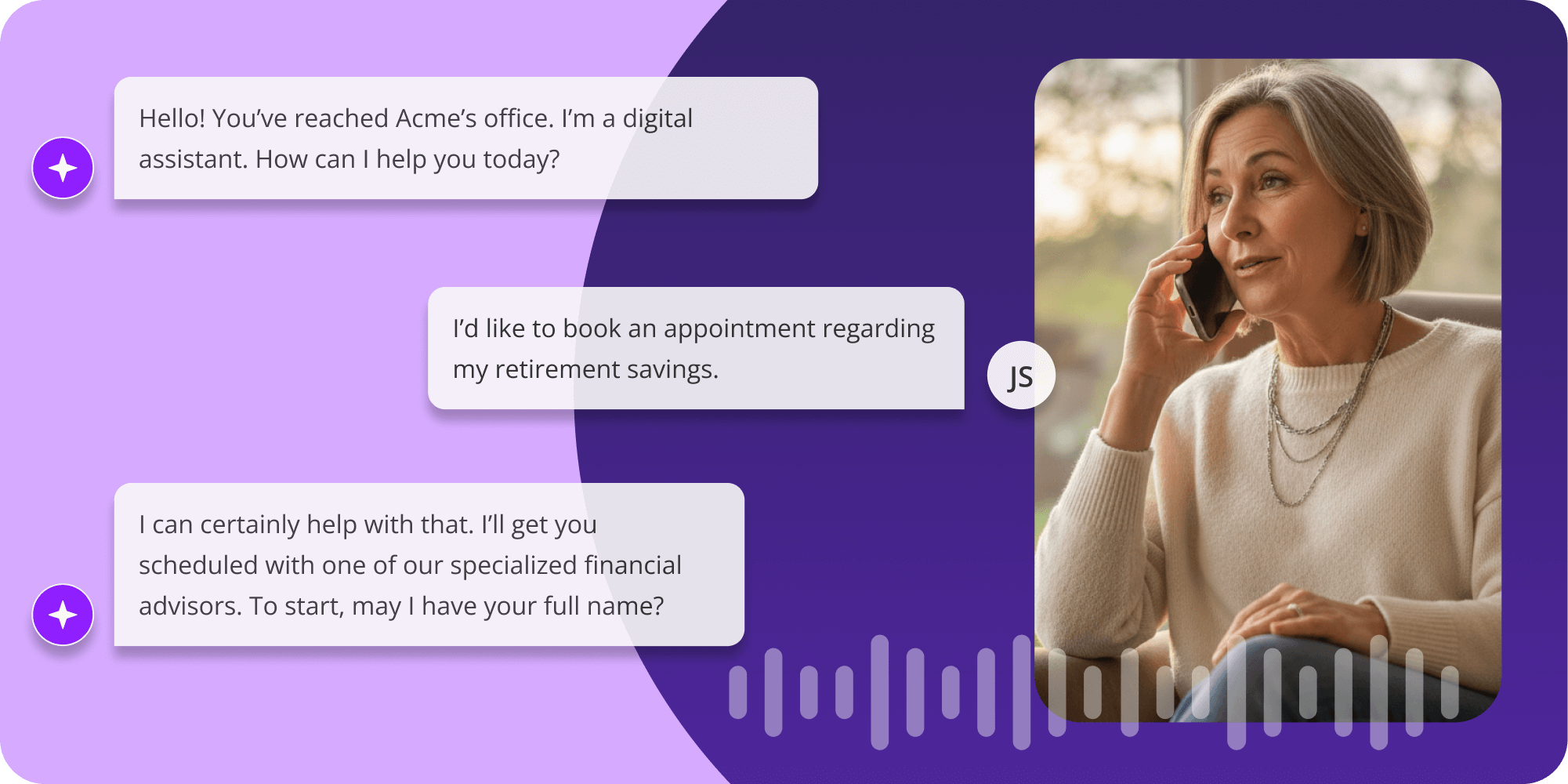
.png?width=1150&height=588&name=Offer%20A%20Smooth%20Phone%20Booking%20Experience_%20(1).png)
Phone Booking is built specifically for this moment.
It’s not a full AI receptionist. It’s not meant to replace human interaction. Instead, it functions as:
- A modern alternative to voicemail
- A voice-enabled extension of your booking flow
When calls go unanswered, Phone Booking allows callers to:
- Schedule directly into the right calendar or team
- Follow structured, guided flows
- Leave contextual, structured messages when booking isn’t possible
Everything is designed with guardrails and clarity in mind. The purpose isn’t conversation, it’s conversion through scheduling.
Where voicemail records intent, Phone Booking captures it.
Who Benefits From Phone Booking (Use Cases)
Phone Booking is especially valuable for businesses where calls often come in at the worst possible time, when answering isn’t realistic, but losing the caller is costly.
Below are real examples of how that plays out across industries.
Financial Advisors
Meeting-time calls → booked advisory sessions
An advisor is in back-to-back client meetings. Prospective clients call during market hours but end up in voicemail.
Instead, callers schedule an introductory session on the advisor’s calendar. The advisor exits meetings with new, pre-booked conversations already queued.
Outcome: High-intent prospects captured without disrupting existing clients.
Healthcare Clinics
High call volume → fewer missed appointments
A clinic receives dozens of calls during peak hours. Front-desk staff can’t keep up.
When calls go unanswered, patients can book appointments, follow-ups, or consultations immediately. No callbacks. No long hold times.
Outcome: Reduced no-shows, less staff burnout, better patient experience.
Legal Firms
Intake calls → scheduled consultations
A potential client calls a law firm during court hours. The call goes unanswered.
Instead of leaving a vague voicemail, the caller schedules an intake consultation and provides structured context. The firm reviews details before the call.
Outcome: More qualified intakes, fewer missed opportunities.
Real Estate Agents
In-transit calls → booked property viewings
An agent is driving between showings when a buyer calls about a listing.
Phone Booking allows the buyer to schedule a viewing instantly. The agent sees a confirmed appointment rather than a missed opportunity hours later.
Outcome: Faster deal momentum without unsafe callbacks.
Car Dealerships
Missed sales calls → scheduled test drives
A potential buyer calls during peak showroom hours. Sales reps are already with customers. The call goes unanswered.
Instead of reaching voicemail and moving on to another dealership, the caller is guided to book a test drive for later that day or the weekend. The sales team starts the follow-up with a confirmed appointment, not a cold lead.
Outcome: Higher showroom visits without requiring staff to answer every call.
HVAC Technicians
On-site calls → booked service slots
A homeowner calls while a technician is on a rooftop or inside a mechanical room. The call is missed.
Phone Booking lets callers select the service type and book the next available slot. The technician finishes the job already knowing where they’re headed next.
Outcome: Fewer missed emergencies and reduced risk of danger, more predictable schedules.
Construction & Contractors
Job-site interruptions → scheduled consultations
A contractor is on a noisy job site and can’t answer incoming calls. Voicemails pile up and are reviewed hours later.
With Phone Booking, callers book consultation windows directly. The contractor returns calls only to confirmed, time-boxed opportunities.
Outcome: Less phone tag, better use of limited office time.
Home Services (Plumbing, Electrical, Pest Control)
A homeowner calls with an urgent issue while technicians are busy.
Phone Booking routes the caller to the appropriate booking flow—emergency assistance, same-day, or next-day service—without human intervention.
Outcome: Faster response for urgent needs, fewer lost jobs.
Coaches & Consultants
Session-time interruptions → booked discovery calls
A coach is mid-session when a prospective client calls.
Instead of a missed call that goes cold, the prospect books a discovery call. The coach reviews details and prepares in advance.
Outcome: Higher conversion from inbound interest.
In every case, Phone Booking doesn’t try to answer the call.
It captures what matters most in that moment:
- Intent
- Timing
- Next action
The result is the same across industries: intent is preserved, not lost.
The New Normal
Missed calls will always happen.
Busy businesses can’t and shouldn’t try to eliminate them. But lost revenue doesn’t have to be the cost of being unavailable.
Phone Booking represents a simple shift:
- A low-risk upgrade from voicemail
- A practical way to protect high-intent moments
- A calmer, more controlled approach to scheduling
This simple shift leads to real changes in how businesses capture opportunities and serve their clients.
The new normal isn’t answering every call.
It’s making sure every serious caller has a clear path forward, even when you can’t pick up. By ensuring every serious caller has a clear path forward, you not only protect revenue—you change lives