

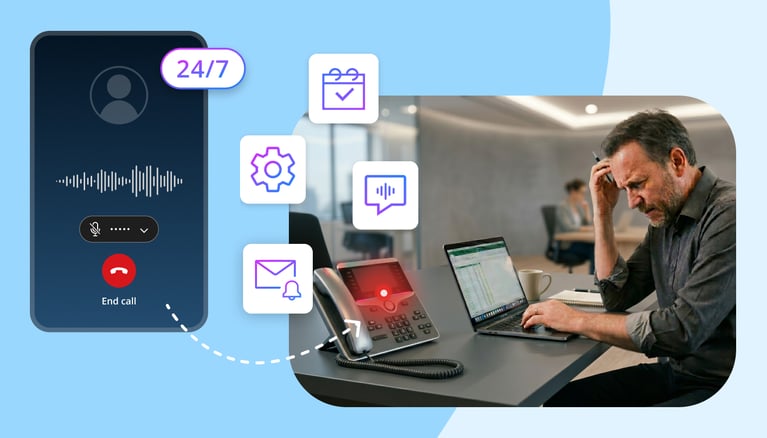
Voicemail was designed as a safety net. For a brief window in the 1980s and 1990s, it served that function reasonably well. Today it does not.
Modern buyers do not leave voicemails for businesses. They hang up and call the next number on their list. The moment a caller hears a recorded greeting, the revenue opportunity is almost certainly gone — not paused, gone. An August 2025 analysis by Ambs Call Center found that a single missed call costs the average business $12.15 in direct costs, and missing just six calls per day results in a total annual loss exceeding $26,000 for small to medium businesses.
This article is specifically about that problem and the solution: how AI phone assistants replace the broken voicemail-and-phone-tag cycle, step by step.
New to AI phone assistants? Start here first: What Is an AI Phone Assistant and How Can It Transform Your Business?
TL;DR
- Voicemail is not broken because of staffing. It is broken because buyer behaviour has fundamentally changed — 80% of callers hang up rather than leave a message.
- Phone tag is not an operational inconvenience — it is a structural revenue leak that compounds daily.
- AI phone assistants replace every broken step in the voicemail-and-callback cycle: answering immediately, qualifying automatically, booking on the call, and routing to a human when genuinely needed.
Why Voicemail Is a Structural Problem, Not a Staffing Problem
The instinct when calls go unanswered is to think about staffing — hire a receptionist, extend hours, redirect calls to a mobile. These are staffing solutions to what is actually a structural problem.
The structure of modern buying behaviour has changed. A caller who searches for a business, finds the number, and dials has already made a significant commitment. They are not browsing. They are acting. When they reach voicemail, the commitment evaporates — not because they are impatient, but because voicemail signals something specific to them: this business is not ready for me right now.
According to a 2024 study by 411 Locals analysing 85 businesses across 58 industries, small businesses answer only 37.8% of incoming calls. The remaining 62.2% go to voicemail or receive no response at all. Of the callers who do not reach a person, 85% never call back — and 62% contact a competitor instead.
That is not a staffing problem. No realistic hiring decision closes that gap. It is a structural problem — and it requires a structural solution.
The voicemail invisibility trap
What makes this revenue loss particularly damaging is that it leaves no trace. Unlike a bad review, a customer complaint, or a social media post, a caller who hangs up on voicemail generates no signal. The business owner never learns it happened. According to OnCallClerk's 2026 analysis, roughly 6 out of 10 callers who hang up on a voicemail call a competitor within minutes. Those are not browsers. They are buyers — and they are invisible when they leave.
Phone tag as a compounding cost
When a caller does leave a voicemail — the 20% minority, according to SellCell's 2026 voicemail analysis — the cost does not end with the missed call. Staff must listen to the recording, note the details, and attempt a return call. That return call goes to the prospect's voicemail. The prospect calls back and reaches another voicemail. Each loop consumes 10–15 minutes of administrative time that generates no revenue. Six missed calls per day, at 10 minutes of follow-up each, is a full hour of productive time consumed by a cycle that produces no bookings.
Why Are Voicemail and Phone Tag Damaging Your Business?
The damage is concentrated in three areas — and the compounding effect of all three is what makes the voicemail problem a strategic issue rather than an operational inconvenience.
High-intent prospects go to competitors
The caller who searched for your business and dialled your number represents the highest-intent lead your business will receive. They found you, they chose to call, and they acted on that choice. According to Invoca's 2026 caller behaviour analysis, 86% of callers who reach a service business voicemail hang up without leaving a message. When they hang up, the substitution effect is immediate — Business B is one Google search and one phone call away.
Administrative time consumed by the callback loop
A single voicemail message — when it is left — generates a callback task. That callback reaches another voicemail. That voicemail generates another callback. Each cycle consumes 10–15 minutes of staff time. For a practice receiving 20 inbound calls per day with a 37.8% answer rate, the phone tag overhead is a measurable daily cost with no revenue output.
Revenue lost outside business hours
Inbound calls do not arrive on a schedule. According to Ruby's 2025 after-hours call analysis, for businesses that only answer during standard hours, a third of potential callers reach voicemail or no answer. That is not a fraction of low-intent callers — those are people who searched for a business, found a number, and decided to call. The motivation was there. The availability was not.
How AI Replaces Each Step of the Voicemail and Phone-Tag Cycle
The old workflow and the new workflow are not variations of the same process. They are structurally different in every step.
|
Old behaviour |
New behaviour with AI |
|
Call rings — no one available — goes to voicemail |
Call answered immediately on first ring — any hour |
|
80% of callers hang up without leaving a message |
Caller is greeted, engaged, and qualified before being offered a booking |
|
Caller dials competitor |
Caller's intent is captured and a booking is confirmed before the call ends |
|
Staff listens to voicemail, notes details, attempts callback |
Qualification data pushed to CRM automatically — no manual entry |
|
Callback reaches prospect's voicemail |
No callback required — booking confirmed on the original call |
|
Phone tag loop: 10–15 minutes per cycle, zero revenue output |
Administrative overhead eliminated — staff time focused on booked meetings |
|
After-hours calls generate voicemails no one checks until morning |
After-hours calls handled identically to business hours calls |
|
Urgent calls mixed in with low-priority enquiries |
Urgent calls routed to a human immediately — low-priority calls handled by AI |
Appointment booking that runs without you
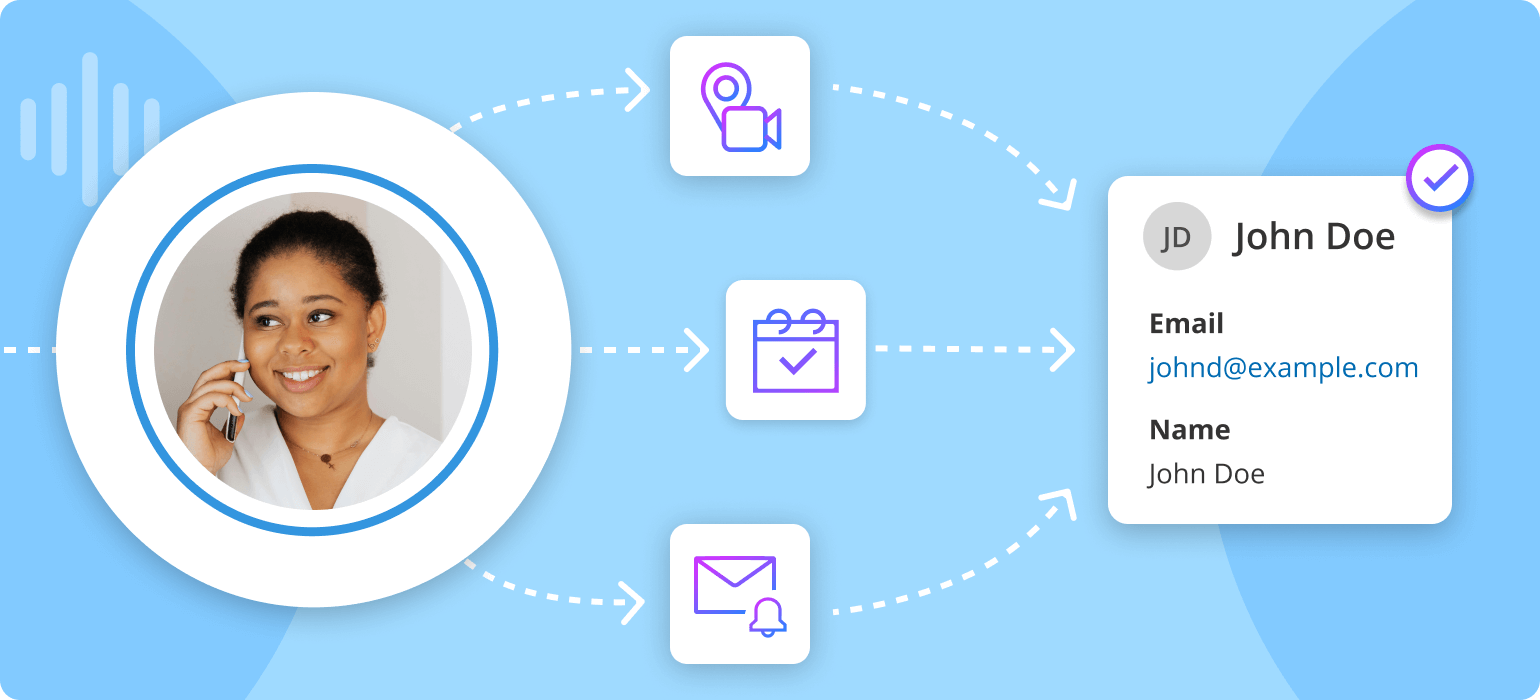
AI phone assistants book appointments by reading open time slots from a live calendar and securing the meeting directly with the caller. The system checks availability in real time, offers options conversationally, and automatically sends calendar confirmations to both parties — no follow-up call required.
Lead qualification before a single meeting is booked
Before offering a calendar slot, the AI works through pre-configured screening questions — budget, timeline, service type, or any other criteria the business defines. Strong-fit prospects get booked. Poor-fit callers are directed to appropriate resources. The result is a calendar filled with qualified meetings rather than exploratory conversations.
For example, platforms like OnceHub can be configured to ask specific qualification questions — investable assets for a financial advisory practice, legal matter type for a law firm, or job category for a home services company — and route the booking accordingly before the caller hangs up.
What the New Workflow Looks Like: A Before and After
The difference between the two workflows is best understood through a specific scenario.
A professional services practice — without AI:
A prospect is referred by an existing client and calls at 2:15 PM on a Thursday. The principal is in a client meeting. The call goes to voicemail. The prospect — acting on a specific moment of motivation — does not leave a message.
At 3:00 PM the principal finishes the meeting and sees a missed call from an unknown number. No voicemail. No context. A callback is made at 3:15 PM. The prospect is now in their own meeting. A voicemail is left.
Friday morning — no callback received. Over the weekend, the prospect speaks with a competing firm that answered their call on Friday afternoon.
Monday morning — the principal calls again. The prospect answers but mentions they have already scheduled a meeting with another firm.
A warm referral with pre-established trust — the highest-quality inbound lead a professional services practice receives — was lost entirely to a missed first call and a two-business-day callback gap.
The same practice — with an AI phone assistant:
The same call arrives at 2:15 PM. The AI answers immediately with a professional greeting. It identifies the nature of the enquiry, works through three qualification questions, checks live calendar availability, and confirms a discovery meeting for the following week. The caller receives a confirmation in their inbox at 2:18 PM.
The principal finishes the 3:00 PM meeting to a booking notification — the prospect's context already captured, the meeting already in the calendar.
No voicemail. No callback required. No opportunity lost to availability.
A solution such as OnceHub handles this workflow natively — the qualification flow, the calendar check, and the booking confirmation all happen within the same system, so the slot confirmed during the call reflects live availability at the moment it is offered.
How to Make the Switch: Four Steps
Step 1 — Audit your current missed call rate
Before configuring anything, identify the scale of the problem. How many inbound calls are going to voicemail per day? What is the callback rate? What proportion of missed calls result in a confirmed meeting? This baseline tells you what you are solving for and gives you a measurement point to assess impact at 30 days.
Step 2 — Map your qualification logic
What does the AI need to establish before offering a calendar slot? For most service businesses, three to five questions covers the essential criteria — nature of the enquiry, timeline, budget signal, and referral source. Write these out before opening any configuration interface. The AI needs the same specificity you would give a new team member taking screening calls on your behalf.
Step 3 — Test as a caller before going live
Call your own number and go through the full AI interaction as a prospect would experience it. Assess the greeting, the question sequence, the conversational naturalness, and how the system handles an unexpected response. This test takes ten minutes and prevents the most common early deployment failures. It should happen before the system handles a single live inbound call.
Step 4 — Set a 30-day review checkpoint
A first deployment is a starting configuration — not a finished product. At 30 days, review which calls were handled well, which were handled poorly, and which qualification questions consistently produced unhelpful responses. Refine and retest. The data from the first month of live calls is what turns a starting configuration into a system that works reliably for your specific practice.
For a full comparison of the leading AI phone assistant platforms available in 2026, see our Best AI Phone Assistants for Business guide.
Sign up for a free OnceHub account today to deploy OnceHub's AI phone agent and automate your inbound scheduling process.
Frequently Asked Questions
What happens to callers who still want to leave a voicemail?
A well-configured AI phone assistant intercepts inbound calls before they reach voicemail — so the question of leaving a voicemail does not typically arise. The AI answers immediately, engages the caller, and either books a meeting or captures their details. For callers who specifically request a callback rather than a booking, the AI can log the request and flag it for follow-up. The goal is not to eliminate the option of a callback — it is to eliminate the passive voicemail inbox that generates no action and captures no data.
How does an AI phone assistant handle simultaneous calls?
An AI phone assistant handles all inbound calls concurrently without limit. Unlike a human receptionist or a small team, there is no queue, no hold time, and no call that goes unanswered because another line is busy. This is particularly relevant during campaign periods, after marketing activity, or during seasonal peaks — the moments when inbound volume spikes beyond human capacity are exactly the moments an AI phone assistant performs identically to quiet periods.
What is the difference between an AI phone assistant and a virtual receptionist?
A virtual receptionist is typically a human — working remotely — who handles inbound calls within set hours. They bring human judgment and relationship warmth to caller interactions, but they are constrained by availability, working hours, and simultaneous call capacity. An AI phone assistant is available at any hour, handles unlimited simultaneous calls, and applies the same qualification logic to every caller consistently. The two are not mutually exclusive — many businesses use AI for first-contact coverage and reserve human judgment for the calls that genuinely benefit from it.
How long does the transition from voicemail to AI take?
For platforms designed to work within existing calendar configurations, a standard deployment can be operational within one to two days for typical use cases. The preparation that takes the most time is not technical — it is defining your qualification criteria clearly enough to configure them accurately. A realistic target for a first deployment that is ready for live inbound calls — including testing and refinement — is one to two weeks. The 30-day review that follows is what turns the initial configuration into a reliable system.
Can an AI phone assistant match a full-time receptionist's call volume?
Yes — and it scales beyond what any single receptionist can handle. A full-time receptionist manages one call at a time during set hours. An AI phone assistant manages unlimited simultaneous calls at any hour with no degradation in quality between the first call of the day and the last. For businesses where inbound volume is variable — campaign periods, seasonal peaks, referral surges — AI handles the ceiling without requiring additional headcount.
References
- Ambs Call Center — Business Phone Stats: 15 Data Points Small Business Owners Need to Know
- 411 Locals via Aira — 62% of Business Calls Go Unanswered: The $126K Cost
- SellCell — Voicemail Statistics 2026: How Many People Leave Voicemails?
- Invoca via CallJolt — Voicemail Abandonment Rates 2026: Why Callers Hang Up Instead
- OnCallClerk — Why 90% of Callers Don't Leave Voicemail
- AInora — Business Phone Call Statistics 2026
- InsideSales.com — Lead Response Management Study