

_.jpg?width=767&name=What%20Is%20an%20AI%20Phone%20Assistant%20(and%20How%20Can%20It%20Transform%20Your%20Business)_.jpg)
Customer expectations have officially outpaced traditional call centers. Nobody wants to wait on hold or listen to a robotic menu telling them to "Press 1 for Sales." The future of phone communication is conversational AI. By deploying an AI voice agent for call automation, modern businesses can replace frustrating phone trees with intelligent systems that hold natural, two-way conversations to qualify leads and secure calendar bookings.
A Vonage study found that 61% of consumers believe IVR systems create a poor customer experience, and over half have abandoned a business entirely after a negative phone menu interaction.
TL;DR: The Future of Phone Automation
Unlike traditional Interactive Voice Response (IVR) systems that rely on rigid keypad menus, an AI voice agent uses natural language processing to hold fluid conversations and perform backend tasks. These intelligent assistants listen to callers, understand their intent, and automate tasks like appointment scheduling without requiring any human intervention.
Top Platforms to Consider:
- OnceHub’s AI Phone Receptionist: Best for no-code automated scheduling and lead intake.
- Retell AI: Best for developers needing low-latency API control.
- Synthflow AI: Best for marketing agencies and white-labeling.
- Bland AI: Best for enterprise-scale outbound dialing.
- PolyAI: Best for massive, global contact centers.
Who Benefits Most from AI Voice Agent Platforms?
Not every business needs a massive, custom-built telephony structure. Understanding your Ideal Customer Profile (ICP) helps clarify exactly which type of voice automation fits your daily operations.
Here is how different businesses benefit from upgrading their phone stack:
What is an AI voice agent platform?
An AI voice agent platform uses conversational artificial intelligence to autonomously handle inbound and outbound phone calls, enabling businesses to scale operations, eliminate wait times, and significantly reduce customer service costs.
The core difference between modern voice AI and legacy IVR systems is comprehension. Traditional Interactive Voice Response (IVR) systems are static. They force a caller into a rigid maze (e.g., "Press 2 for Support") and cannot deviate from the script. If the caller has a complex question, the IVR breaks down and forces a transfer.
Modern voice agents run on Natural Language Processing (NLP). Instead of pressing buttons, the customer simply speaks. The AI understands messy phrasing, changing contexts, and sudden interruptions. It responds with intelligent, human-like dialogue and takes immediate action, like checking your live calendar availability to book a meeting right then and there.
How does the AI voice tech stack work?
To make phone call automation feel entirely natural, these platforms tightly orchestrate three distinct technological layers within fractions of a second:
- Speech-to-Text (STT): The moment a customer speaks into the phone, the system translates the spoken words into written text instantly. High-performance platforms use specialized audio pipelines to minimize any background noise or delay.
- The LLM Brain (NLU): Once the words are turned into text, the Large Language Model (LLM) or Natural Language Understanding (NLU) engine takes over. This "brain" analyzes the transcript, determines the user’s true intent, references a custom business knowledge base, and decides on the best logical response.
- Text-to-Speech (TTS): Finally, the system converts the written response back into an ultra-realistic, expressive audio stream. Powered by modern speech engines, the agent speaks with human-like pacing, tone shifts, and natural breathing, preventing the conversation from sounding robotic.
Also read: Best AI Phone Agents for Small Businesses: A 2026 Buyer's Guide
Top AI Voice Agent Platforms in 2026
When evaluating options, choosing the right platform depends entirely on whether your priority is raw developer control, no-code setup, or massive enterprise scale.
The table below breaks down how the top systems match up:
|
Platform |
Primary Strength |
Key Target Audience |
Core Features |
|
OnceHub’s AI Phone Receptionist |
No-code booking and scheduling |
Financial advisors, service providers, and sales teams |
Direct calendar synchronization, instant lead qualification, zero-coding setup, and minimal API lag; native scheduling, hence no clunkiness |
|
Retell AI |
Best overall platform flexibility |
Startups, developers, and small businesses |
Sub-300ms response gaps, low latency, full API control, and built-in telephony. |
|
Vapi AI |
Developer customization |
Advanced software engineering teams |
"Bring-your-own-stack" flexibility to modularly swap out language models and voice providers. |
|
Synthflow AI |
No-code and agencies |
Non-technical users and white-label agencies |
Drag-and-drop visual call workflow builders, pre-built knowledge bases, and CRM synchronization. |
|
PolyAI |
Enterprise-scale customer care |
Fortune 500 brands and massive contact centers |
Fully managed services, complex CRM and telephony integrations, and high multi-language accuracy. |
Evaluating the Top Platforms by Business Need
Evaluating voice platforms based on features is overwhelming. Instead, choose your platform based on the specific problem you need to solve:
Best for No-Code Booking and Lead Intake
If your primary goal is turning an inbound phone call into a qualified lead or a confirmed calendar appointment without writing a single line of code, this category is built for you.
OnceHub’s AI Phone Receptionist
.jpg?width=1540&height=700&name=OH%20Screenshot%20(2).jpg)
OnceHub is the premier choice for scheduling-focused call automation. As an all-in-one platform, the AI agent connects directly to your native calendar, eliminating the API lag common with third-party bots. The agent verbally qualifies the caller, checks live availability, and secures the booking instantly during the call with zero coding required at any stage of the setup.
Synthflow AI
Synthflow is a strong alternative for marketing agencies that need to deploy and manage voice automation across multiple clients from a single platform. Its visual drag-and-drop builder removes the need for any technical knowledge, and its white-label capabilities allow agencies to brand the product entirely as their own when deploying for clients.
Best for Developer-First Customization
If you have an in-house engineering team that wants total control over latency, conversation logic, and custom API connections, you need a developer-first platform built with that level of flexibility in mind.
Retell AI
Retell is built for development teams that prioritize speed and precision above all else. It delivers sub-300-millisecond latency, among the fastest in the category, and provides an open environment where developers can build custom conversation logic, connect to external data sources, and manage the exact flow of every caller interaction without platform constraints.
Vapi AI
Vapi is designed for advanced software teams that want full modularity over their voice stack. It allows developers to swap out different large language models and voice generation providers independently, depending on the specific requirements of each project, giving engineering teams a level of architectural control that no off-the-shelf product can match.
Best for Enterprise and High-Volume Outbound
If your organization measures calls in the millions rather than the hundreds, you need infrastructure built entirely for scale, compliance, and global reach.
PolyAI
PolyAI is best suited for Fortune 500 brands and global contact centers that need a fully managed, white-glove voice AI deployment. It offers deep contact center integrations, high multilingual accuracy across 75-plus languages, and enterprise-grade security designed specifically for organizations managing complex, international customer bases at scale.
Best Overall: OnceHub's AI Phone Receptionist
OnceHub stands out as the premier overall platform for businesses requiring conversational AI combined with direct, automated scheduling. Rather than relying on fragile third-party connections, it utilizes a native Booking-First AI architecture. By syncing directly to your live calendar, the platform verbally qualifies callers and secures firm appointments within the original conversation, eliminating manual follow-up tasks, unreliable API workarounds, and lost leads.
Understanding AI Voice Agent Pricing Models
Before committing to a platform, you must understand the two primary pricing models to avoid hidden fees and unexpected budget drains.
1. Usage-Based Pricing
This model charges you a specific rate for every minute the AI spends on the phone. The cost usually covers the telephony, the language model, and the voice generation.
- Common for: Developer-first and high-volume platforms like Retell, Vapi, and Bland.
- The Catch: While a rate like $0.09 per minute sounds cheap, costs can quickly spiral out of control if you handle high call volumes or if callers spend a long time on the phone. It makes monthly budgeting very difficult.
2. Platform Pricing
This model charges a flat, predictable monthly fee per user or per "seat." It is designed for businesses that want reliable software costs without worrying about fluctuating phone bills.
- Common for: Scheduling-focused solutions like OnceHub.
- The Benefit: With plans starting at affordable monthly rates (often including dedicated phone numbers), you know exactly what your AI phone agent costs every month, whether it books 10 appointments or 100.
Questions Buyers Should Ask
To avoid hidden fees and unexpected engineering bills, ask these questions during your software evaluation:
- Do I pay per minute, or is it a flat monthly seat fee?
- Do I pay extra for every booked appointment?
- Are CRM and calendar integrations included, or do they cost extra?
- Is the initial setup included, or will I need to hire a developer to build the workflows?
- Do I need dedicated engineering resources to maintain the agent month-over-month?
Also read: IVR vs AI Phone Agents: Features, Differences, Use Cases & Benefits
Top Use Cases for Phone Call Automation
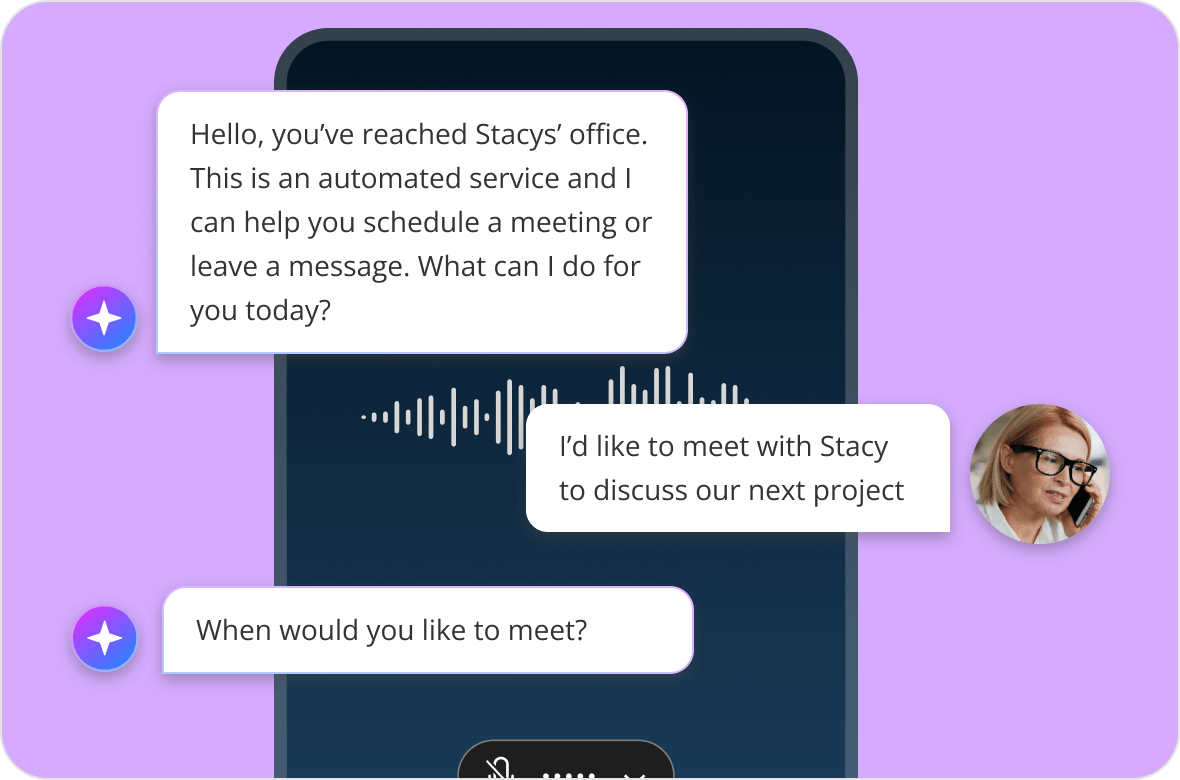
The true value of voice automation is executing complex tasks before the caller ever hangs up, acting as your ultimate frontline support layer.
Here is exactly what these agents do best in production environments:
- Lead Qualification & Intake: Instead of blindly transferring every call to a busy sales representative, an AI bot asks targeted questions. It verbally screens prospects, identifies their budget and timeline, and logs these details straight into your CRM. If the lead is unqualified, the system politely redirects them, protecting your sales team's time.
- 24/7 Appointment Booking: This is the most profitable use case for service businesses. The agent connects securely to tools like OnceHub to read live calendar availability. It negotiates open time slots out loud, secures the appointment, and instantly sends a text or email confirmation without any human intervention.
- Customer Support Deflection: Rather than making callers wait on hold just to check an order status, the AI handles tier-1 inquiries. It autonomously looks up tracking numbers, resets passwords, and answers basic policy questions, dramatically reducing your inbound call queue.
- Smart Live Transfer: Voice AI does not entirely replace human connection. If the system detects a highly emotional customer or a complex problem beyond its scope, it triggers a live transfer. It instantly routes the call to a human specialist, providing a summarized transcript of the conversation so the customer never has to repeat themselves.
How to choose the right AI voice platform for your team
Selecting the wrong platform traps your business in endless development cycles and creates frustrating caller experiences. Evaluate every vendor against this strict buyer checklist:
Conclusion and Next Steps
The era of "Press 1 for Sales" is officially over. Today's consumers expect immediate answers, personalized interaction, and the ability to book services without waiting for a callback. As we shift away from rigid IVR menus toward conversational AI, businesses that fail to upgrade their phone systems will continue to lose highly qualified leads to competitors who answer instantly.
Stop missing inbound opportunities because your front desk is busy or your office is closed.
If you want to capture revenue around the clock, you need a system built specifically for action. Explore OnceHub’s AI Phone Receptionist today to see how zero-configuration call automation can instantly qualify your leads and fill your calendar.
Frequently Asked Questions
How is an AI voice agent different from a traditional IVR system?
Traditional IVR (Interactive Voice Response) systems force callers through rigid, pre-recorded button menus. An AI voice agent uses natural language processing to let callers speak freely. It understands intent, handles interruptions, and autonomously performs back-end tasks like scheduling appointments.
What is the best AI voice agent for appointment scheduling?
The best AI voice agent for scheduling is one that connects natively to your calendar rather than relying on third-party APIs. Platforms like OnceHub are built specifically for this purpose, reading live availability in real-time to book meetings directly on the phone without accidental double-booking.
How do you prevent AI voice agents from hallucinating on a call?
You prevent hallucinations by strictly grounding the NLU (Natural Language Understanding) model in your specific business data. By deploying strong conversational guardrails, restricting the agent to a predefined knowledge base, and utilizing structured prompts, the system is prevented from inventing answers outside of its approved scope.
Can AI phone agents transfer calls to a live human?
Yes, modern AI phone agents are equipped with smart routing and live transfer capabilities. If the agent encounters a complex issue, detects frustration, or identifies a high-value VIP client, it can seamlessly forward the active call to a designated human representative, often attaching a transcript of what has already been discussed.