


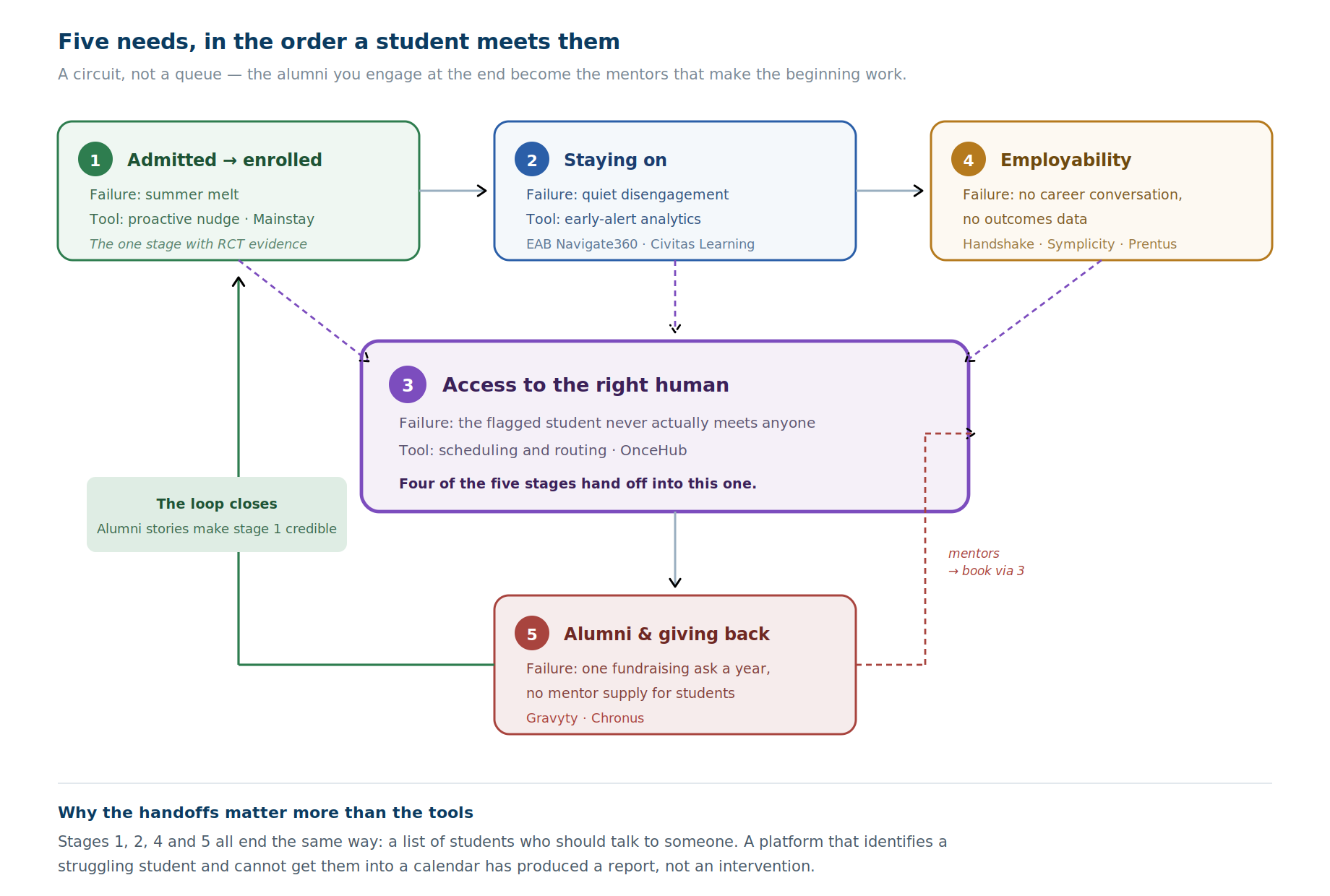
Student engagement is not one problem, so it does not have one tool. It is five distinct needs strung across a student's life at your institution — showing up, staying on, getting seen by a human, becoming employable, and eventually coming back to help the next cohort. This guide takes each need in turn and covers the one category of tool that actually solves it.
Most "top tools for student engagement" lists are a flat ranking of platforms that do not compete with each other. A proactive SMS nudge system and an alumni mentoring platform are both on those lists, as though an institution were choosing between them. It is not. It needs both, at different points, for different reasons.
The more useful structure is the student's own timeline. Below, five needs in the order a student encounters them, one tool category for each, what the evidence says, and — importantly — what each one hands off to next. The last one loops back to the first, because the alumni you engage at the end become the mentors that make the beginning work.
Related reading: if you are specifically evaluating conversational AI vendors, see our guide to AI chatbots for university admissions and student services. If you are evaluating appointment booking specifically, see scheduling software for universities.
Quick answer: five needs, five tools
|
# |
The need |
Stage |
Tool category |
Example platforms |
|
1 |
Admitted students who never enroll |
Pre-arrival |
Proactive nudge and messaging |
Mainstay |
|
2 |
Students quietly disengaging before they leave |
First year onward |
Early-alert and predictive analytics |
EAB Navigate360, Civitas Learning |
|
3 |
Flagged students who never actually meet anyone |
Throughout |
Scheduling and routing |
OnceHub |
|
4 |
Graduating without employability or outcomes data |
Final years |
Career services and outcomes |
Handshake, Symplicity, Prentus |
|
5 |
Alumni who disengage, and no mentor supply for the next cohort |
Post-graduation |
Alumni engagement and mentoring |
Gravyty, Chronus |
The link most institutions miss is number three. Stages one, two, four and five all generate lists of students who need to speak to someone. Stage three is whether that conversation actually gets scheduled — and it is where a surprising amount of the value in the other four leaks away.
Why engagement has to be broken into stages
The word "engagement" gets used for four genuinely different things: whether a student replies to your messages, whether they turn up to class, whether they use your services, and whether they feel like they belong. Those are measured differently and fixed differently.
That matters practically, because a tool bought against one definition gets judged against another. A nudge platform can lift message response rates dramatically and change nothing about belonging. An early-alert platform can accurately identify every disengaging student and improve no outcome at all if nobody acts on the list. A career platform can raise service utilization while the students who most need it never book. Each of those is a real success on its own terms and a failure on someone else's, which is how institutions end up concluding that a perfectly functional tool "did not work."
Splitting by lifecycle stage works better because each stage has a specific failure mode, a specific metric, and a specific category of tool built for it. It also exposes the handoffs, which is where most stacks break. A platform that correctly identifies a struggling student and then has no reliable way to get that student into an advisor's calendar has produced a report, not an intervention.
And the lifecycle is a loop rather than a line. The graduate you keep engaged in stage five becomes the mentor who makes stage four work for the next cohort, and the alumni voice that makes stage one credible. Institutions that treat alumni relations as a fundraising function separate from student success are cutting that loop.
Need 1: Admitted students who never enroll
The failure mode. A student accepts your offer in May and never appears in September. Between those points sit a dozen unglamorous tasks — financial aid verification, final transcripts, immunization records, orientation registration, loan acceptance, placement testing — and each one is a place to fall out. The sector calls this summer melt, and it disproportionately affects first-generation and low-income students, who have the least access to someone who can explain what a verification hold means.
The tool category: proactive nudge and messaging platforms. Not a website chatbot waiting to be asked. A system that initiates contact by text at the right moment, tied to the specific task that student has not yet completed.
The example: Mainstay (formerly AdmitHub), which has the strongest research pedigree in this category and remains built around behavioral nudging by SMS with human escalation.
What the evidence shows. This is the one stage of the student lifecycle with genuine randomized controlled trial evidence. In 2016 Georgia State University launched "Pounce," built with AdmitHub, as an RCT supervised by external researchers Lindsay C. Page and Hunter Gehlbach. Roughly 7,000 admitted students were split into treatment and control. Published in AERA Open in 2017, the study found students committed to GSU who had Pounce access were 3.3 percentage points more likely to enroll — a 21% reduction in summer melt. Georgia State's own account reports Pounce delivered more than 200,000 answers in its first summer.
Two operational details matter more than the headline. Mainstay reports fewer than 2% of the 50,000-plus student messages required a human, so the staffing model held. And unusually, the research paper disclosed cost: $7 to $15 per student per year for the platform, plus internal staff time to build the message content.
The honest caveat. Pounce was a rule-based system launched four years before GPT-3. The finding supports well-timed, task-specific, personalized nudging — a claim about communication design, not about large language models. Treat generative capability in this category as promising rather than proven, and weight your evaluation toward the mechanism the research actually validates.
What it hands off to. Students who reply asking for help, or who stall on a task after two nudges, need a human. That handoff is need three.
Need 2: Students quietly disengaging before they leave
The failure mode. A student stops attending a class in week four, does not submit two assignments, drops off the LMS, and withdraws in week nine. Nobody noticed in week four, when it was cheap to fix.
The tool category: early-alert and predictive analytics platforms, sometimes called student success management systems. These pull signals from your SIS, LMS and engagement data, score risk, and route flagged students to the right staff member with a documented intervention workflow.
The examples: EAB Navigate360, the largest platform in this category — deployed at 850+ institutions serving over 10 million students — and Civitas Learning, which builds institution-specific predictive models rather than generic ones.
What the evidence shows. The outcome data here is institution-reported rather than from independent trials, so read it as directional. EAB-cited partner data points to graduation rate increases in the 3–15% range with a 5:1 ROI. Specific cases are more instructive than the ranges: Virginia Commonwealth University used predictive analytics to run campaigns across 12 student subpopulations and retained an additional 65 students in one spring term, worth $346,000 in tuition and fees. Georgia State's four-year graduation rate has risen 13% since 2012 following adoption of EAB systems, with the largest gains among historically underrepresented students. The University of Hawaiʻi committed $7.4 million over five years across its ten campuses in 2025, which gives a rough sense of enterprise-scale pricing in a category that rarely publishes rates.
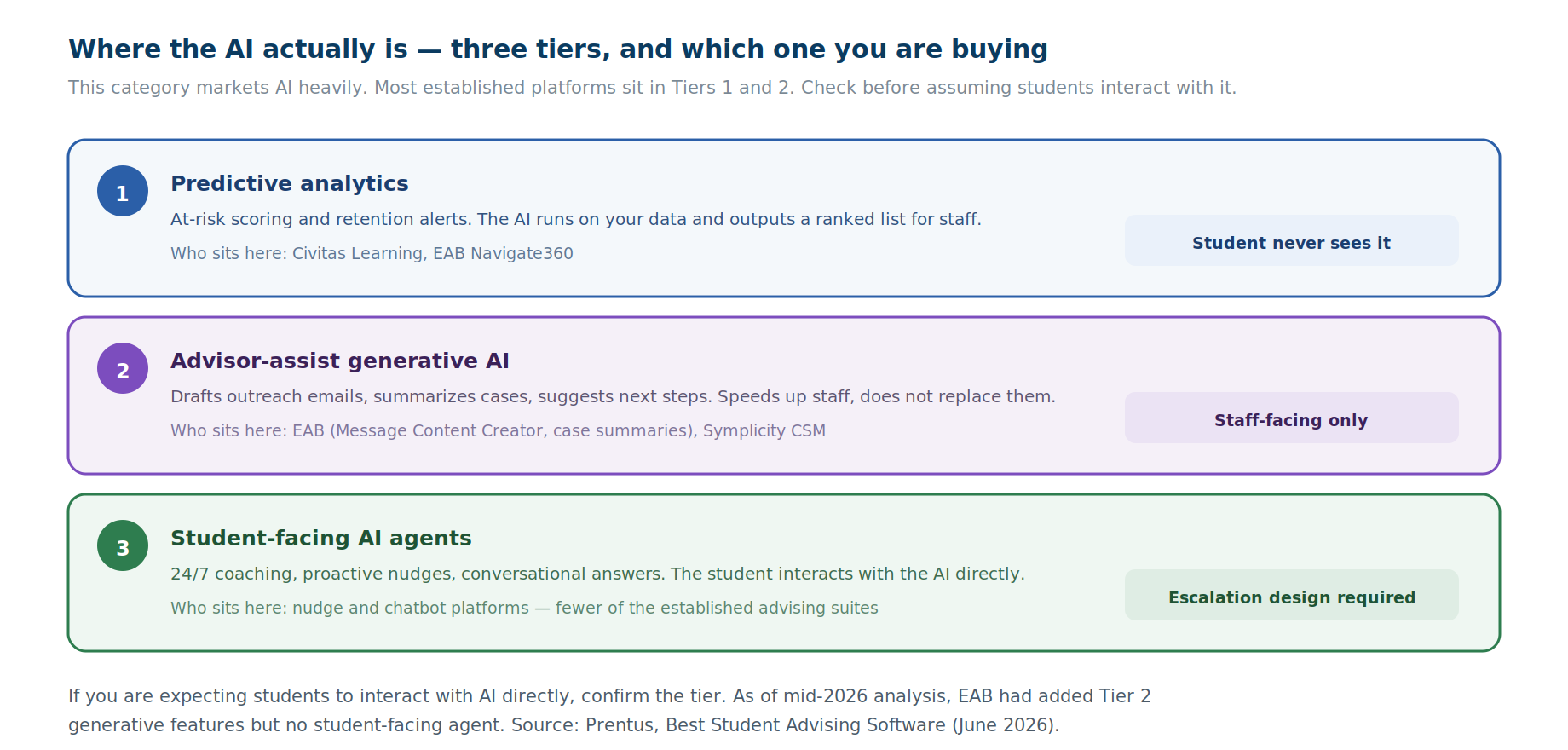
Where the AI actually is. Worth being precise, because this category markets AI heavily. A useful framing from Prentus splits it into three tiers: Tier 1 is predictive analytics — at-risk scoring and retention alerts, which is where Civitas and EAB sit. Tier 2 is advisor-assist generative AI — drafting outreach, case summaries, suggested next steps. Tier 3 is student-facing AI agents doing 24/7 coaching. Most of the established platforms in this category are Tier 1 and Tier 2; EAB has added generative drafting and case summaries but, as of that analysis, no student-facing agent. If you are expecting students to interact with AI directly, check which tier you are buying.
The honest limitations. Implementations here are long and resource-intensive — deep SIS integration for degree audits and enrollment data typically means months, not weeks. Navigate360 has documented real-time SIS sync limitations, and front-line users sometimes describe the interface as dated relative to newer SaaS. Smaller institutions may find the packaging heavy for their needs.
What it hands off to. A ranked list of students who need an advising conversation. Which is, again, need three.
Need 3: Flagged students who never actually meet anyone
The failure mode, and why this one is underrated. Needs one, two, four and five all end the same way: a list of students who should talk to someone. The intervention only works if the conversation happens.
There is a striking data point on this from EAB's own partner reporting. At William Paterson University, retention was higher among students flagged with an alert who attended an advising appointment than among flagged students who did not attend — and higher for students who scheduled and attended an appointment than the university's overall average retention rate. The same partner story quotes a professor who ran an appointment campaign to drive students to office hours describing it as a game changer for academic performance and persistence.
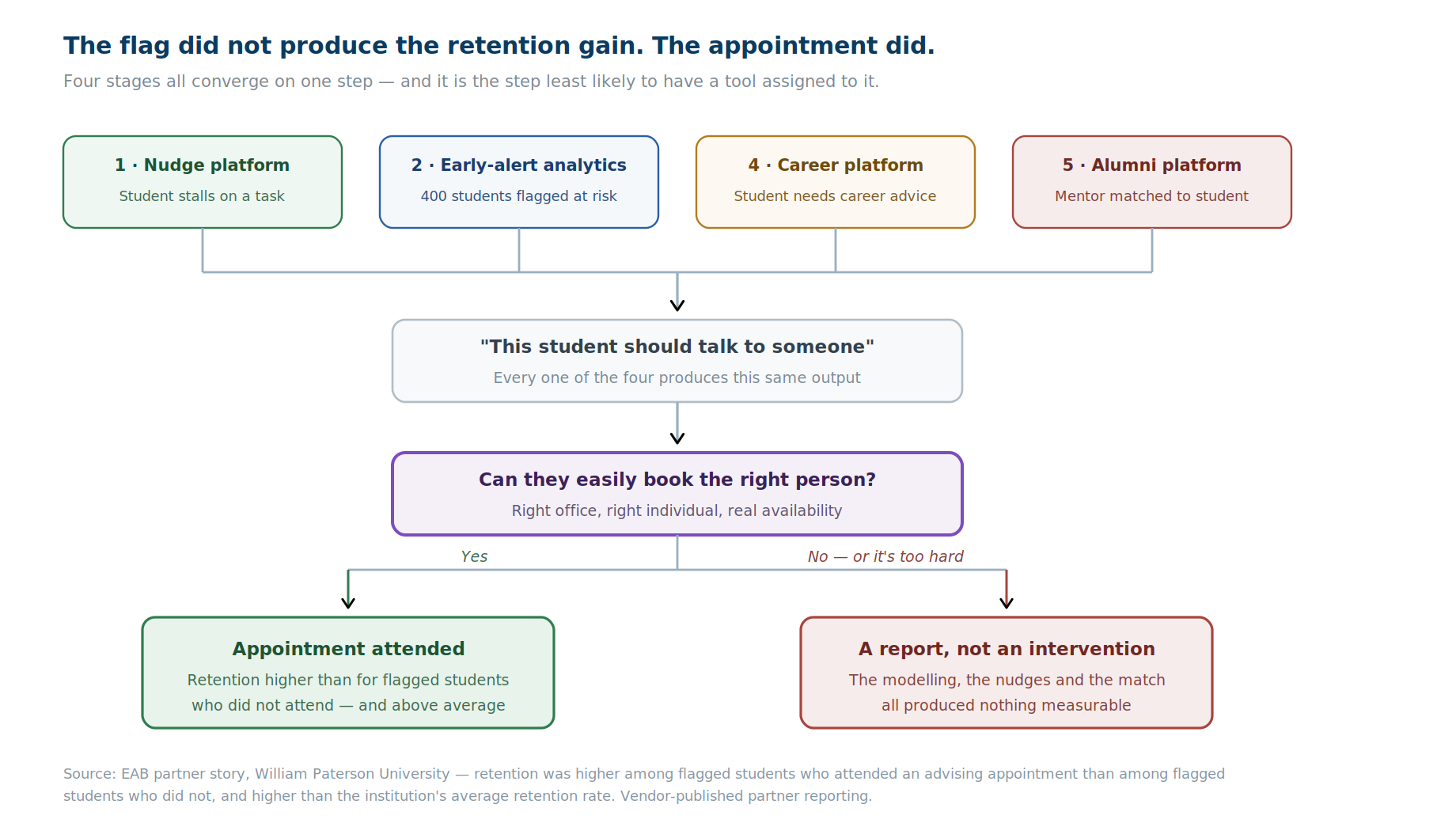
Read that carefully. The flag itself did not produce the retention gain. The appointment did. Every hour of predictive modelling is worth nothing if the student cannot easily find and book fifteen minutes with the right person — and "the right person" is doing a lot of work in that sentence, because it varies by major, by advisor caseload, by whether the issue is academic, financial, or personal.
The tool category: scheduling and routing. Distinct from the analytics that generate the list and from the CRM that stores it. The job is to take a student who needs help, work out which office and which individual should see them, and put a confirmed appointment in a real calendar.
The example: OnceHub. This is where it fits in the stack, and it is worth being clear about scope. It is not a student success management system: it has no SIS integration, no predictive risk scoring and no early-alert workflow. What OnceHub's academic services setup does is the booking layer:
- Routing forms direct students to the correct calendar based on their answers — service needed, department, program, or specific advisor — rather than asking an 18-year-old to work out the org chart.
- Booking hubs consolidate many calendars into one branded page, so a student can browse advisors, career staff or alumni mentors by expertise and availability and book in a few clicks.
- A scheduling chatbot answers questions on the site and offers live availability inside the conversation, so a student who arrives with a question leaves with an appointment.
- AI Phone Receptionist covers phone-first students and families, and takes scheduling volume off front-desk staff.
- Automated reminders by email or text, with easy rescheduling — which matters because a booked appointment is not an attended one.
- Room and resource sync, so in-person availability reflects actual room vacancies.
- Attendance and volume analytics by service, which tells you which offices are oversubscribed and where students are not showing up.
Why this earns its own category. Student success platforms include appointment scheduling, and for a single-office deployment that may be all you need. The case for a dedicated layer arrives when booking has to span offices with different rules — admissions, academic advising, financial aid, career services, disability services, alumni mentoring — each with its own availability logic, and when you want one consistent front door for students rather than six. It also arrives when your analytics platform is mid-implementation and you need the booking problem solved now rather than in nine months.
What it hands off to. The conversation itself, and the record of whether it happened. We cover this category properly in our guide to scheduling software for universities.
Need 4: Graduating without employability or outcomes data
The failure mode. A student completes a degree without ever having a career conversation, and the institution cannot report what happened to them afterwards — which increasingly matters for accreditation, performance funding and marketing.
The tool category: career services and outcomes platforms. These connect students to employers, run career advising workflows, and track placement outcomes.
The examples: Handshake as the dominant student-employer network, Symplicity CSM for career services case management, and newer entrants like Prentus positioning around verified placements and performance-funding readiness.
The structural distinction worth knowing. Career platforms are a fundamentally different implementation proposition from academic advising platforms. Academic advising tools need deep SIS integration for degree audits, course planning and enrollment data — months of work. Career platforms like Handshake and Prentus generally do not require SIS integration and can deploy in weeks via API. If you need something live this academic year, that difference is decisive.
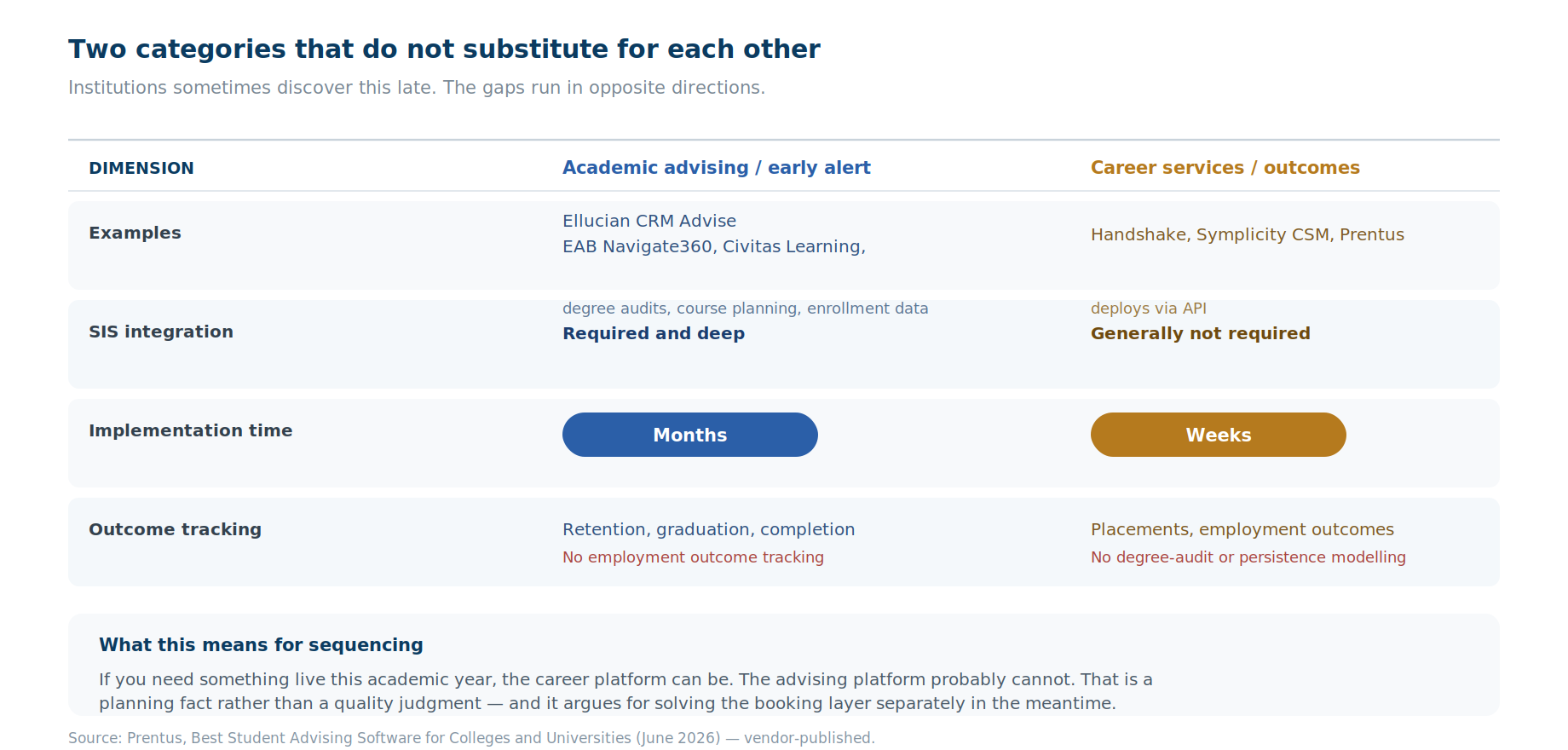
The corresponding gap runs the other way. Academic advising platforms are strong on retention, graduation and completion tracking but typically carry no career advising or employment outcome tracking at all. These two categories genuinely do not substitute for one another, and institutions sometimes discover that late.
What it hands off to. Two things. Appointments with career staff, which is need three again. And graduates whose outcomes you now know — which is the raw material for need five.
Need 5: Alumni who disengage, and no mentor supply for the next cohort
The failure mode. A graduate's relationship with the institution becomes a fundraising ask once a year. Meanwhile current students have no access to anyone who has actually done the job they are training for.
The tool category: alumni engagement and mentoring platforms. These maintain a searchable alumni community, match alumni to students or to each other, and manage mentoring programs — matching, communication, scheduling and progress tracking.
The examples: Gravyty, which reports 2,750+ institutions using its alumni mentoring platform with smart matching, searchable directories, and both flash and formal mentoring formats; and Chronus, which uses algorithmic matching, allows alumni to auto-fill profiles from LinkedIn, and keeps program data in a private environment restricted to designated administrators — a real consideration given student data obligations. Others in the category include MentorCity, Qooper and Together.
Why this is a student engagement tool, not just an advancement tool. This is the point most tool lists miss. Alumni mentoring produces benefits across philanthropy, marketing and student employability — a relationship documented in the higher education literature (Dollinger, Arkoudis & Marangell, 2019). A well-run mentoring program is simultaneously an alumni retention mechanism and a student career-readiness intervention. Institutions that silo it inside advancement get half the value.
How the loop closes. An engaged alumnus becomes a mentor. That mentor becomes the thing a current student most wants access to — and getting a student into a mentor's calendar is need three, which is exactly why OnceHub's booking hubs support browsing alumni by expertise. That mentor's story then becomes the most credible content you have for the next admitted cohort, feeding need one. The five stages are a circuit, not a queue.
How the five fit together
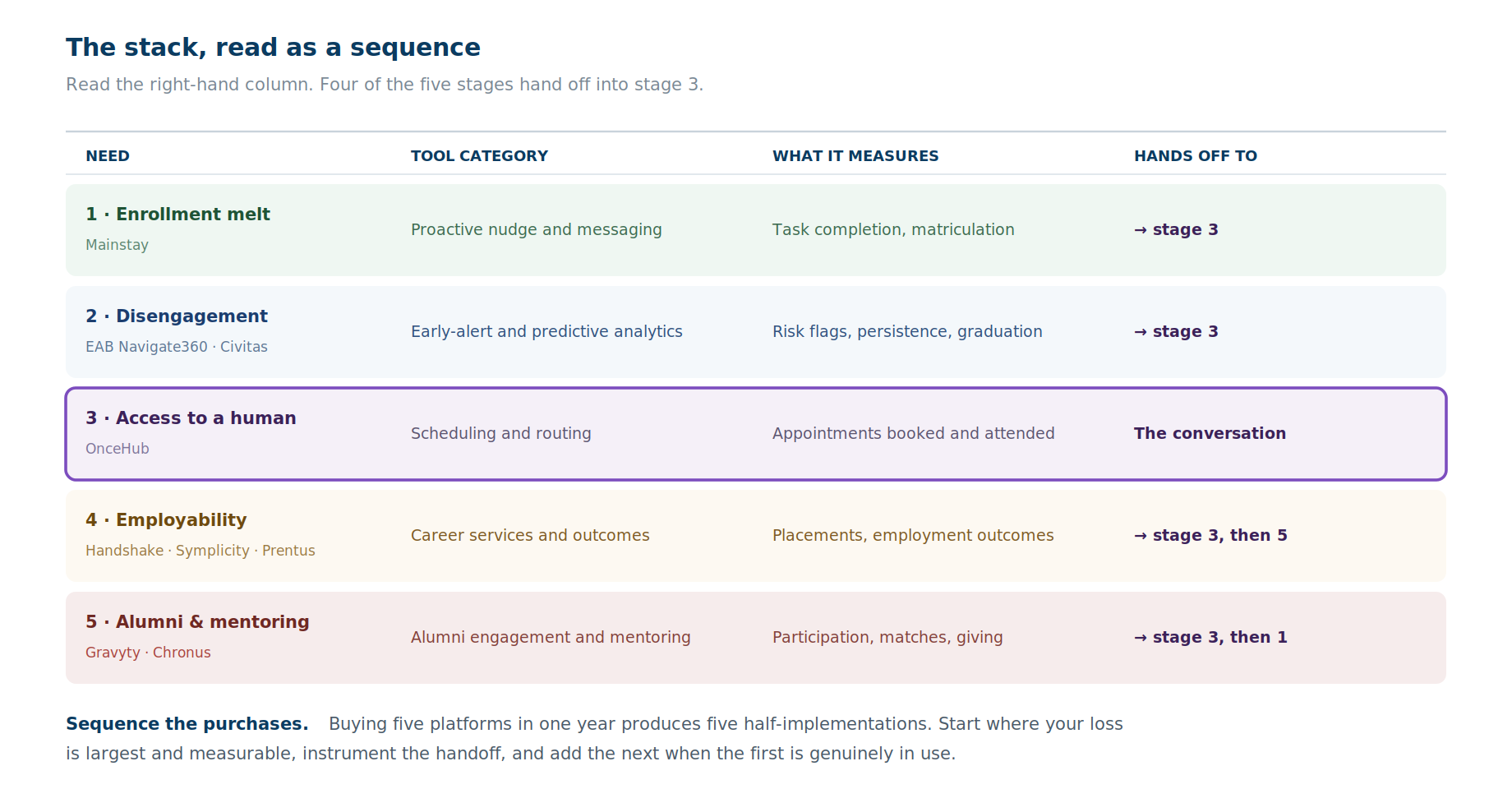
The handoffs matter more than the individual tools, so here is the stack read as a sequence.
|
Need |
Tool category |
What it measures |
Hands off to |
|
1. Enrollment melt |
Proactive nudge |
Task completion, matriculation |
Human help for stalled students → 3 |
|
2. Disengagement |
Early-alert analytics |
Risk flags, persistence, graduation |
A list of students needing a conversation → 3 |
|
3. Access to a human |
Scheduling and routing |
Appointments booked, attended, by service |
The conversation, and its record |
|
4. Employability |
Career services and outcomes |
Placements, employment outcomes |
Career appointments → 3; known outcomes → 5 |
|
5. Alumni and mentoring |
Alumni engagement and mentoring |
Alumni participation, mentor matches, giving |
Mentors for students → 3; stories for → 1 |
Read the right-hand column. Four of the five stages hand off into stage three. That is the argument for treating booking and routing as its own layer rather than assuming whichever platform you bought last will handle it.
What to get right regardless of which tools you buy
Sequence the purchases. Buying five platforms in one year produces five half-implementations. Start with the stage where your loss is largest and measurable — for most institutions that is melt or first-year attrition — and add the next when the first is actually in use.
Design the escalation path for distress before launch. Any tool touching student services will eventually receive a message from a student in crisis. Automated systems should recognize distress signals and hand off immediately to trained staff and published institutional resources, never attempt to counsel or assess. Agree that path with your counseling service as part of the specification, not as a later iteration. The same applies to eligibility decisions and anything requiring judgment about an individual's circumstances.
Get the three compliance regimes right. FERPA for student records, validated by your own compliance office rather than accepted from a vendor page. TCPA for SMS, with clean consent and opt-out handling before any campaign runs. And ADA Title II, where the WCAG 2.1 Level AA deadline now falls on April 26, 2027 for most public institutions — and which covers services delivered through third-party arrangements, meaning an embedded vendor tool is your accessibility obligation, not the vendor's. We cover that in more detail in our chatbot buyer's guide.
Measure outcomes, not activity. Message volume, containment rate and login counts describe whether a tool is being used. Task completion, appointment attendance, persistence, graduation and employment describe whether it worked. The William Paterson finding is a useful discipline here: the metric that mattered was not alerts issued, it was appointments attended.
Instrument the handoffs. Because the handoffs are where value leaks, they are also where you should be measuring. If your early-alert platform flags 400 students this term, the number worth reporting is how many of them sat down with someone.
Questions worth asking any vendor in this stack
The same eight questions apply whichever stage you are buying for, and the answers separate platforms faster than feature lists do.
- Which tier of AI is this, actually? Predictive scoring, staff-assist drafting, or something students interact with directly. Vendors describe all three as "AI-powered."
- What does implementation require from us, in staff weeks? Not the vendor's timeline — yours. Content build, data mapping, integration testing and training all land on your team.
- Which integrations exist today for our specific SIS and CRM versions, versus which would be built for us?
- What happens to a student who falls outside the configured path? Every automated system meets one. Where do they land?
- How does this hand off to a booked conversation with a named person? If the answer is an email address or a general enquiry form, that is the leak.
- What outcome data can you show from institutions like ours — and is it independently measured or self-reported partner data? Both are useful; they are not the same thing.
- Who owns the content after launch? Knowledge bases, message libraries and routing rules decay without an owner, and this is where deployments quietly stop working in year two.
- Can you produce a current WCAG 2.1 AA conformance report, tested with assistive technology rather than an automated scanner?
Conclusion
There is no single best AI tool for student engagement, because engagement is five different problems wearing one name. Nudge platforms get students through enrollment. Analytics platforms find the ones drifting away. Career platforms make the degree pay. Alumni platforms keep graduates close and turn them into mentors.
And running underneath all four is the unglamorous question of whether the student ever actually gets fifteen minutes with the right person — which is the stage most easily overlooked and, on the available evidence, the one that converts a flag into a retained student.
Start with your largest measurable loss, buy for that stage, instrument the handoff, and add the next tool when the first one is genuinely in use. If the stage you are stuck on is access — students who should be talking to an advisor, career counselor or alumni mentor and are not — that is a routing and booking problem, and OnceHub has a free tier that will let you test the flow against one department before committing to anything.
Frequently asked questions
What are the best AI tools for student engagement?
There is no single best tool, because engagement breaks into five distinct needs. Proactive nudge platforms like Mainstay address enrollment melt. Early-alert analytics like EAB Navigate360 and Civitas Learning identify disengaging students. Scheduling and routing tools like OnceHub get students in front of the right staff member. Career platforms like Handshake handle employability. Alumni platforms like Gravyty and Chronus manage mentoring and post-graduation engagement.
Do student engagement tools actually improve retention?
The evidence varies by category. Proactive nudging has genuine randomized controlled trial support: a 2017 study in AERA Open found a 3.3 percentage point enrollment increase and 21% reduction in summer melt at Georgia State. Early-alert platform outcomes are largely institution-reported rather than independently trialled, with vendor-cited graduation gains of 3–15%. Read the first as evidence and the second as directional.
What is the difference between a student success platform and scheduling software?
A student success platform pulls data from your SIS and LMS, scores risk and manages intervention workflows — it tells you which students need help. Scheduling software such as OnceHub routes a student to the correct advisor, department or service and books a confirmed appointment. Success platforms include basic scheduling; a dedicated layer becomes worthwhile when booking has to span multiple offices with different availability rules.
How long does it take to implement student engagement tools?
It depends heavily on category. Academic advising and early-alert platforms need deep SIS integration for degree audits and enrollment data, typically taking months. Career platforms often require no SIS integration and can deploy in weeks via API. Scheduling and nudge tools are generally faster still. Sequence your purchases accordingly rather than starting everything at once.
Should alumni mentoring sit with advancement or student success?
Both have a claim, which is why it is often under-exploited. Alumni mentoring produces philanthropy and alumni-retention benefits and simultaneously functions as a student employability intervention — a relationship documented in the higher education literature. Institutions that treat it purely as a fundraising function tend to capture only part of the value.
What compliance requirements apply to student engagement tools?
Three regimes for US institutions. FERPA governs student education records and should be validated by your own compliance office. TCPA governs SMS outreach, requiring clean consent and opt-out handling before campaigns launch. ADA Title II requires WCAG 2.1 Level AA, with an April 26, 2027 deadline for most public institutions, and it covers tools provided through third-party arrangements — so an embedded vendor tool is the institution's accessibility obligation.
Which stage should we invest in first?
The one where your loss is largest and you can measure it. For most institutions that is either summer melt or first-year attrition, both of which have established interventions and clear metrics. Whichever you pick, instrument the handoff — if a platform flags students who need a conversation, track how many conversations actually happened, because that is where the value tends to leak.
Sources
- Page, L. C., & Gehlbach, H. (2017). "How an Artificially Intelligent Virtual Assistant Helps Students Navigate the Road to College," AERA Open, Vol. 3, No. 4, pp. 1–12 — peer-reviewed randomized controlled trial at Georgia State University with approximately 7,000 admitted students; 3.3 percentage point enrollment increase and 21% reduction in summer melt; discloses platform cost of $7–$15 per student per year. https://files.eric.ed.gov/fulltext/EJ1194134.pdf
- Georgia State University Student Success Initiatives, Reduction of Summer Melt — institution's own account; Pounce delivered more than 200,000 answers in its first summer. https://success.gsu.edu/reduction-of-summer-melt/
- Mainstay, Tackling Summer Melt — vendor-published: fewer than 2% of 50,000+ student messages required human escalation. https://mainstay.com/blog/tackling-summer-melt/
- EAB, Improving Student Engagement and Retention with Navigate360 — vendor-published partner story (William Paterson University): higher retention among flagged students who attended an advising appointment than flagged students who did not, and higher than the institution's average retention rate. https://eab.com/why-eab/partner-stories/improving-student-engagement-and-retention-with-navigate360/
- EAB, Student Success Case Study Compendium — vendor-published: Virginia Commonwealth University retained an additional 65 students in one spring term via predictive-analytics campaigns across 12 subpopulations, worth $346,000 in tuition and fees. https://eab.com/why-eab/partner-stories/student-success-compendium/
- University of Hawaiʻi System News, New technology platforms approved for systemwide student support (June 2025) — $7.4 million five-year subscription to EAB Navigate360 and Edify across ten campuses; notes Georgia State's four-year graduation rate rising 13% since 2012 following EAB adoption. https://www.hawaii.edu/news/2025/06/18/new-technology-systemwide-student-support/
- Prentus, Best Student Advising Software (June 2026) — vendor-published: EAB Navigate360 deployed at 850+ institutions serving over 10 million students; the three-tier framing of AI in advising software; the SIS-integration distinction between academic advising platforms (months) and career platforms (weeks, via API); EAB-cited partner data of 3–15% graduation gains and 5:1 ROI. https://prentus.com/blog/best-student-advising-software-for-colleges-and-universities
- Gravyty, Alumni Mentoring Platform — vendor-published: 2,750+ institutions; smart matching, searchable directories, flash and formal mentoring, built-in scheduling and progress tracking. https://gravyty.com/products/alumni-mentoring-platform/
- Chronus, Alumni Mentoring — vendor-published: algorithmic matching, LinkedIn profile auto-fill, program data held in a private environment accessible only to designated administrators. https://chronus.com/software/mentoring-software/alumni-mentoring
- QuadC, How Online Mentoring Platforms Increase Alumni Mentorship (March 2026) — cites Dollinger, Arkoudis & Marangell (2019) on alumni mentoring benefits across philanthropy, marketing and student employability. https://www.quadc.io/blog/how-online-mentoring-platforms-increase-alumni-mentorship
- Civitas Learning, Student Impact Platform — vendor-published: institution-specific predictive models, embedded AI assistance, coordinated outreach. https://www.civitaslearning.com/platform/
- OnceHub, Academic Services — routing forms by service, department or advisor; booking hubs including alumni browsing by expertise; scheduling chatbot; ai phone receptionist; room sync; appointment volume and attendance analytics. https://www.oncehub.com/solutions/academic-services
Disclosure: OnceHub publishes this guide. OnceHub is a scheduling and routing platform and appears here as the example for one of the five needs — getting students in front of the right staff member. It is not a student success management system, has no SIS integration and does not perform predictive risk scoring, and the guide scopes it accordingly. Platforms named for the other four needs are described from published documentation and are not ranked.