


The strongest chatbots for higher education do one of four distinct jobs: answer high-volume questions from your own institutional content, run proactive nudge campaigns that move students through enrollment tasks, triage and route students to the right office, or qualify and book the appointment that results. Very few do all four well, and the category's best evidence tested a system built before generative AI existed.
Most guides to this category rank vendors. That is the less useful exercise, because the platforms are not really competing for the same job — a proactive SMS nudge system and a source-grounded knowledge assistant solve different problems, and an institution that buys one expecting the other will conclude the technology does not work.
This guide separates the four jobs, walks through what the research actually shows and where it stops, covers the three compliance regimes that apply to US institutions, and sets out what to verify before you shortlist.
A note on scope: this guide covers conversational tools for higher education across four jobs — knowledge and deflection, proactive engagement, triage and routing, and conversational booking. For a comparison of standalone scheduling platforms, see our guide to scheduling software for universities.
Quick answer
- Four jobs, four product types. Knowledge and deflection (answering questions from your content), proactive engagement (outbound nudges that drive task completion), triage and routing (getting students to the right human), and conversational booking (confirming the appointment inside the conversation).
- Conversational booking is the one most often missing. A student asks a question, gets a grounded answer, and books confirmed time on the correct advisor's or department's calendar without leaving the chat. OnceHub's web chatbot does this; most conversational platforms hand the student off at this point and stop.
- Higher-ed specialists include Mainstay, Gravyty's Ivy.ai and Ocelot, Mongoose Cadence, Element451 and CollegeVine. General enterprise platforms — Salesforce, ServiceNow, Kore.ai, Microsoft and Google — are configurable but not purpose-built for enrollment workflows.
- The evidence base is real but dated. Georgia State's "Pounce" randomized controlled trial produced a 3.3 percentage point enrollment gain and a 21% reduction in summer melt — using a rule-based SMS system launched in 2016, well before large language models.
- Three compliance regimes apply: FERPA for student records, TCPA for SMS outreach, and ADA Title II with a WCAG 2.1 Level AA standard now due April 26, 2027 for most public institutions.
- The criterion buyers miss: a third-party chatbot embedded on a public university site falls under your Title II obligation, not the vendor's.
The four jobs, and what separates the platforms that do each one:
|
Job |
What success looks like |
Example platforms |
What decides it |
|
Knowledge and deflection |
Fewer repetitive calls and emails reaching overloaded offices |
Gravyty (Ivy.ai, Ocelot), CustomGPT.ai and similar source-grounded platforms, OnceHub's web chatbot |
Whether answers are grounded in your approved content, with citations |
|
Proactive engagement |
Students complete enrollment and retention tasks on time |
Mainstay, Mongoose Cadence |
Timing, personalization and SMS deliverability |
|
Triage and routing |
Students reach the correct office first time |
Element451, CollegeVine, enterprise stacks |
Depth of SIS and CRM integration |
|
Conversational booking |
A confirmed appointment on the right calendar, from the same conversation |
OnceHub's web chatbot |
Whether it books, or only hands off |
What these chatbots actually do
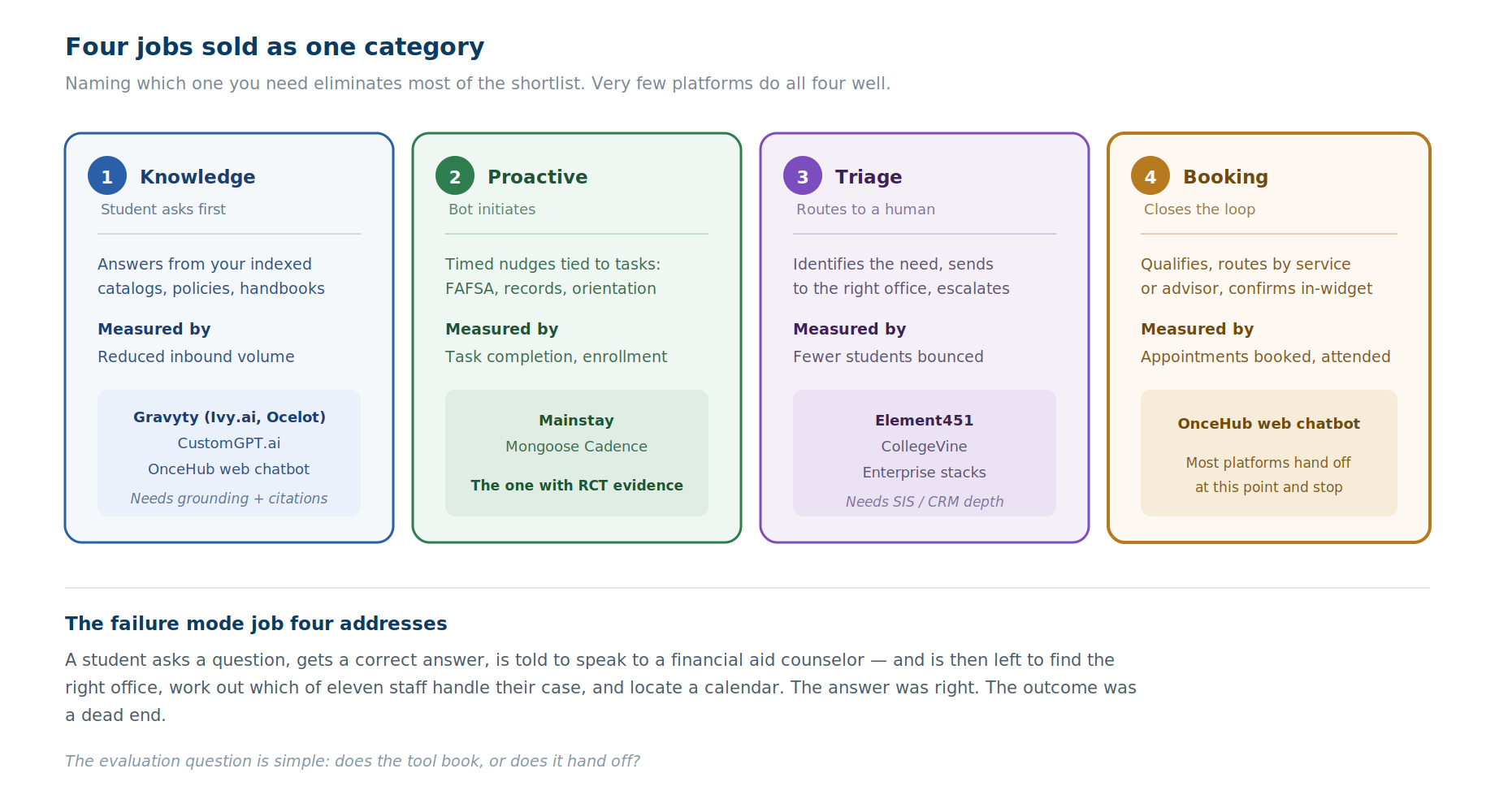
Four jobs get sold as one category. Naming which one you need eliminates most of the shortlist.
Knowledge and deflection. The chatbot answers questions using your own indexed content — course catalogs, financial aid policies, registration deadlines, handbooks, PDFs. Success is measured in reduced inbound volume to overloaded offices. Institutions have reported material call reduction from this; Temple University's deployment of Ivy.ai has been cited as cutting calls by around half, though that figure comes from vendor-side reporting rather than an independent audit.
OnceHub's web chatbot covers this job in a narrower form — trained on your published content and documentation via sitemap, individual URLs or pasted text for material you have not published, deployed as an embed or a standalone branded chatbot page, and answering with a booking action attached rather than only a link. One setting worth knowing for higher education: you can control whether the bot may complement its answers with public internet knowledge or must stay strictly within your own sources. For policy, aid and eligibility answers, strict is the right setting.
Proactive engagement. The chatbot initiates contact rather than waiting for it, sending timed, personalized nudges tied to specific tasks — verify your FAFSA, submit immunization records, register for orientation, accept your loan. This is the category with the strongest research behind it, and it is a genuinely different product from a website widget.
Triage and routing. The chatbot identifies what a student needs and connects them to the right office, advisor or resource, escalating to a human when the question exceeds what it should handle. This is less glamorous than the other two and often the most immediately valuable, because it addresses the actual failure mode in student services: students bouncing between departments. Routing depth varies widely between platforms, and the difference between single-step and multi-step branching logic is worth understanding before you shortlist — we broke that down in our comparison of Calendly routing forms versus OnceHub.
Conversational booking. The failure mode this addresses is specific and extremely common. A student asks a question, gets a correct answer, is told they should speak to a financial aid counselor — and is then left to find the right office, work out which staff member handles their case, and locate a calendar. The answer was right. The outcome was a dead end.
Conversational booking closes that loop inside the same conversation: a short set of qualification questions, routing by service, department, program or advisor, assignment logic such as round-robin or booking owner, and a confirmed appointment in the widget before the student leaves. The distinction that matters when you evaluate is simple — does the tool book, or does it hand off? Most conversational platforms in higher education hand off.
The same booking layer applies well beyond admissions — academic advising, financial aid, disability services, faculty office hours and alumni mentoring all have their own availability rules and their own routing logic. We cover how institutions set that up across offices in our guides to admissions and student counseling scheduling and scheduling for academic services.
The evidence, and where it stops
This category has something rare in edtech: a genuine randomized controlled trial, published in a peer-reviewed journal, with meaningful effect sizes.
In 2016, Georgia State University partnered with AdmitHub (now Mainstay) to launch "Pounce," a text-based virtual assistant, as an RCT supervised by external researchers Lindsay C. Page and Hunter Gehlbach. Roughly 7,000 newly admitted students were split into treatment and control groups. The results, published in AERA Open in 2017, found that students committed to GSU who had access to Pounce were 3.3 percentage points more likely to enroll, translating to a 21% reduction in summer melt. Georgia State's own account reports a four percentage point overall decrease in confirmed freshmen who failed to enroll, and notes Pounce delivered more than 200,000 answers in its first summer.
Two details from that study are more useful to a buyer than the headline numbers.
First, escalation volume was very low. Of the 50,000-plus messages students sent, Mainstay reports fewer than 2% required a human, with contemporaneous reporting at the time putting it under 1%. Either way, the staffing model held.
Second, and unusually for this category, the research paper disclosed cost: the AdmitHub platform ran between $7 and $15 per student per year, plus internal staff time to build the messaging system. Nearly every vendor in this space quotes "contact us," so a real per-student figure — even a decade old — is a useful anchor for what this class of tool has historically cost.
The caveat nobody puts in the brochure
.png?width=1840&height=980&name=pounce-rct-evidence-gap%20(1).png)
Pounce was a rule-based, knowledge-base-driven SMS system built in 2016. It predates GPT-3 by four years. The gold-standard evidence in this category was generated by technology fundamentally unlike what is being sold in 2026.
That does not invalidate the finding. What it establishes is that proactive, well-timed, task-specific nudging works — which is a claim about communication design, not about language models. It applies to any concrete enrollment task, including getting an advising or aid appointment onto a calendar before a deadline passes. It says nothing about whether a generative chatbot answering open-ended questions improves outcomes, and it certainly says nothing about hallucination risk in financial aid guidance.
Research is catching up. Georgia State's National Institute for Student Success launched new RCTs in 2024 through its TEACH ME study, running in math courses at GSU and the University of Central Florida. Until results like those land, treat generative capability as promising rather than proven, and weight your evaluation toward the mechanism the evidence actually supports: timely, specific, personalized outreach on tasks students must complete.
The main platforms
Grouped by primary job rather than ranked. Note one consolidation that trips up older comparison articles: Ivy.ai and Ocelot are both now part of Gravyty, so a shortlist naming them as separate independent vendors is out of date.
Higher-education specialists
Mainstay (formerly AdmitHub) is the proactive-engagement platform with the strongest research pedigree, built around behavioral nudging by SMS with human-AI collaboration. Best fit where the problem is task completion — summer melt, FAFSA verification, registration, retention — rather than website question volume. Pricing is institution-based and quoted directly.
Gravyty (Ivy.ai and Ocelot) covers campus-wide support automation and student engagement, with Ivy.ai historically focused on high-volume question deflection across departments and Ocelot known for financial aid and student engagement workflows. Multilingual support is deep — Ivy.ai advertises coverage across 100+ languages.
Mongoose Cadence is a specialized SMS engagement platform for higher education spanning student, alumni and donor communication, with live-agent handoff and integrations across SIS, LMS, CRM and ITSM systems. Strongest where texting is the primary channel and human handoff needs to be seamless.
Element451 is an AI-first enrollment CRM rather than a chatbot bolted onto one, deploying multiple specialized agents across recruitment and admissions touchpoints. Appropriate when you are replacing or upgrading the CRM itself, not just adding a conversational layer.
CollegeVine takes a similar multi-agent approach oriented toward recruitment and admissions outreach.
Source-grounded knowledge platforms
CustomGPT.ai and similar retrieval-focused platforms index approved institutional content — catalogs, handbooks, policies, PDFs — and answer with citations back to source. Worth evaluating when the core requirement is making sprawling published content findable and the answers need to be traceable to an approved document. Less suited to proactive outbound or enrollment workflow automation.
Conversational booking and routing
OnceHub's web chatbot (the Web-Based Chatbots product) is built around the fourth job: ending the conversation with a confirmed appointment rather than a referral. It trains on your published content via sitemap, individual URLs or pasted text, with a setting controlling whether it may draw on public internet knowledge or must answer strictly from your sources. It then screens conversationally — qualification handled in natural language rather than through a structured form — and routes the enquiry to the correct calendar by service, department, program or advisor, with assignment logic including round-robin and booking-owner rules. The student books confirmed time inside the widget.
It deploys as an embed on your site or as a standalone branded chatbot page you can link from an email or a program page, with targeting by page, location, campaign or prior visits. When a conversation needs a person, it routes to live chat if an agent on the relevant team is online and falls back to scheduling when none is, with timeout handling in between; staff can monitor and take over an AI conversation in progress. A phone channel runs the same qualification and booking logic for phone-first students and families.
Stated plainly: it does not integrate with SIS platforms, so it cannot answer questions about an individual student's record, holds or registration status, and it does not run outbound enrollment nudge campaigns. Those are jobs two and three above, and they belong to other platforms on this list.
Pricing is published by tier rather than quoted on request: the conversational layer sits on the Engage plan at $39 per seat per month billed annually ($47 month-to-month), with lower tiers covering booking and routing without the chatbot. Whether that is good value for your institution is your call — but you can model it without a sales call.
General enterprise platforms
.png?width=1840&height=1080&name=higher-ed-chatbot-landscape%20(1).png)
Salesforce Education Cloud, ServiceNow, Kore.ai, LivePerson, and the Microsoft and Google conversational stacks are capable and scale well, but are not purpose-built for enrollment. Kore.ai, for instance, plugs into CRMs but has historically lacked connectors to campus systems like LMS and SIS platforms. Expect meaningful configuration work, and expect to build the enrollment-specific logic yourself.
Vendor capabilities, ownership and pricing in this category change frequently, and most available comparisons are published by vendors competing in it. Verify against current documentation before shortlisting.
Compliance: three regimes, one that buyers miss
.png?width=1840&height=960&name=higher-ed-chatbot-compliance%20(1).png)
This is where higher education differs most sharply from a commercial chatbot purchase.
FERPA. Any system touching student records carries FERPA obligations. Education-specific platforms generally have FERPA-aligned data handling built in. General-purpose platforms can usually be configured to comply — through data governance policies, agreements and access controls — but that configuration needs validating by your own compliance office rather than accepted on the strength of a vendor's marketing page.
TCPA. SMS is the highest-performing channel in this category and the most regulated. Consent capture and opt-out handling need to be clean before a nudge campaign launches, not retrofitted after.
ADA Title II — the one that gets missed. In April 2024 the Department of Justice finalized a rule requiring public entities, including public colleges and universities, to meet WCAG 2.1 Level AA. On April 20, 2026 the DOJ issued an Interim Final Rule extending the compliance dates by one year: April 26, 2027 for entities serving populations of 50,000 or more — which, because population is calculated at state level, effectively covers nearly all public universities — and April 26, 2028 for those under 50,000.
Three things matter here.
The extension moved the dates and nothing else. The standard, the scope and the ongoing obligation to provide accessible digital services are unchanged. Some articles still cite the superseded April 2026 deadline, so check dates on anything you read on this.
The rule covers services provided directly by the institution or through third-party arrangements. In practice, that means an embedded vendor chatbot on your public-facing site is within your Title II scope. If it is not keyboard navigable, not screen-reader compatible, or fails contrast requirements, that is your compliance exposure, not your vendor's.
And notably, the DOJ cited among its reasons for the extension the limits of current technology — generative AI specifically included — to automate accessibility remediation at scale. The regulator has explicitly declined to treat AI as an accessibility shortcut.
What to ask vendors: for a current VPAT or accessibility conformance report against WCAG 2.1 AA, tested with assistive technology rather than an automated scanner alone. Ask every vendor on your shortlist, including us.
Student services is not admissions
Admissions chatbots handle a bounded, largely factual domain: deadlines, requirements, program information, application status. Student services is broader and includes conversations where getting it wrong carries real consequences.
Design the escalation path first, not last. Three categories should reach a qualified human by default rather than by exception:
- Anything involving student distress or safety. A chatbot should recognize signals of crisis and hand off immediately to trained staff and published institutional resources. It should not attempt to counsel, assess or reassure. This is a duty-of-care matter and belongs in the specification, agreed with your counseling service, before launch — not in a later iteration.
- Eligibility and consequence decisions. Financial aid eligibility, academic standing, visa implications for international students, disciplinary matters. A confident wrong answer here can cost a student money or status.
- Anything requiring judgment about an individual's circumstances. Program fit, appeals, hardship, accommodations.
The realistic design goal is a system that absorbs the routine volume — where is my form, when is the deadline, how do I register — so advisors have time for the conversations that actually need them. The Georgia State data supports exactly this shape: the vast majority of messages resolved without a human, and the small remainder reached staff who had capacity because the rest had been handled.
This applies to booking tools as much as to answering tools, ours included. A chatbot that qualifies and books is still a chatbot a distressed student can type into at 2am, and crisis routing has to be configured explicitly rather than assumed — the tool will not infer it. Write that path into the configuration before launch, whichever vendor you choose.
Integration requirements
A chatbot that cannot see student data answers generically, which in higher education means answering unhelpfully. The integrations that matter most:
- Your SIS — Banner, PeopleSoft, Workday Student — for enrollment status, holds, registration and financial records.
- Your enrollment CRM — Slate, TargetX, Element451, CRM Recruit — for applicant stage and communication history.
- Your LMS, where student-success and course-level use cases are in scope.
- Your ticketing or ITSM system, if the chatbot is deflecting service desk volume.
- Your calendar and CRM stack, if the chatbot is booking rather than handing off — including whether routing decisions can read CRM data at the point of booking rather than only writing a record to it afterwards.
Ask whether connectors already exist for your specific versions, or whether they would be built for you. That distinction usually decides the implementation timeline.
Evaluation checklist
- Which of the four jobs is your actual problem? Deflection, proactive engagement, triage and routing, or conversational booking.
- Is the answer grounded in your approved content, with citations back to source? Ungrounded generative answers on policy and aid questions are a liability. Check whether you can restrict the bot to your own sources only.
- When the chatbot identifies a student who needs a person, does it book confirmed time on that person's calendar, or hand off? This is the difference between a correct answer and a completed outcome.
- Can bookings route by department, program or advisor caseload across offices with different availability rules? A single shared calendar link does not survive contact with a multi-office campus.
- What is the documented escalation path, and who signed off on the crisis-handling design?
- Does it have a current WCAG 2.1 AA conformance report, tested with assistive technology?
- Has your compliance office validated the FERPA posture — not just read the vendor's page?
- Which SIS and CRM connectors exist today for your versions?
- What languages, and is the knowledge base translated or only the interface?
- How is success measured? Deflection rate and containment describe activity. Task completion, appointments attended, enrollment and persistence describe outcomes.
- What does it cost per student per year, all in, including staff time to build and maintain content?
- Who owns and maintains the knowledge base after launch? This is where deployments quietly decay.
What these platforms do not do
Two gaps worth planning around.
They do not replace advisors. Every credible vendor in this space says so, and the research supports the division of labor rather than substitution. Budget for the human capacity the automation is meant to free up, rather than treating the tool as a headcount saving.
Most do not, on their own, manage the appointments they generate. A chatbot that successfully identifies a student who needs to see a financial aid counselor, an admissions officer or an academic advisor still has to get that meeting onto a specific person's calendar — routed by department, program or advisor caseload, across offices with different availability rules. Some of the enrollment CRMs handle a version of this; most conversational platforms hand off and stop. If that handoff is where your process breaks, it is a booking and routing problem — see the conversational booking section above.
Conclusion
The useful question is not which chatbot is best. It is which of the four jobs your institution actually needs done, and whether the evidence supports the mechanism you are buying.
What the research demonstrates is that timely, specific, personalized outreach on concrete enrollment tasks measurably improves whether students make it to their first class. That is a claim about communication design, and it held with 2016 technology. What is not yet demonstrated is whether open-ended generative answering improves outcomes, which argues for grounding answers in approved content, escalating anything consequential, and measuring task completion rather than chat volume.
And decide which job you are buying. If students are getting correct answers and still not reaching anyone, the gap is booking, not conversation — and that is a different product decision from the one most of this category is selling. You can see how that flow works, and test it against your own enquiry pages, on the web chatbot page or on the free plan. If what you actually need is a standalone booking platform rather than a conversational one, our guide to scheduling software for universities compares that category directly.
Then get the compliance work right — FERPA validated internally, TCPA clean before any campaign, and a WCAG 2.1 AA conformance report in hand well ahead of April 2027, because an embedded vendor chatbot is your accessibility obligation, not theirs.
Frequently asked questions
What are the best chatbots for university admissions?
The higher-education specialists most commonly shortlisted are Mainstay for proactive enrollment nudging, Gravyty's Ivy.ai and Ocelot for campus-wide question deflection, Mongoose Cadence for SMS-led engagement, and Element451 for AI-first enrollment CRM. Which is best depends on whether your problem is inbound question volume, task completion, or routing students to the right office. If the gap is booking rather than answering, OnceHub's web chatbot qualifies the enquiry and books confirmed time on the right calendar in the same conversation.
Which chatbot can book appointments for an admissions office?
OnceHub's web chatbot is built for this specifically. It answers questions from your published content, screens the enquiry conversationally, then routes by service, department, program or advisor — with round-robin or booking-owner assignment — and confirms the appointment inside the chat widget. Most higher-education conversational platforms escalate or hand the student off at this point rather than completing the booking, so it is worth asking each vendor directly which they do.
What is the best chatbot for student services?
Student services needs a different specification from admissions, because the question range is wider and the consequences of a wrong answer are higher. Prioritize grounded answers restricted to your approved content, and a documented escalation path that routes distress, eligibility and individual-circumstance questions to a qualified human by default. For the advising, financial aid and support appointments that follow, OnceHub's web chatbot books confirmed time on the right staff member's calendar rather than handing the student a directory.
Do chatbots actually improve enrollment?
There is real evidence for one specific mechanism. A randomized controlled trial at Georgia State University, published in AERA Open in 2017, found students with access to the "Pounce" text assistant were 3.3 percentage points more likely to enroll, a 21% reduction in summer melt. Importantly, that system was rule-based and launched in 2016, so the finding supports well-timed proactive nudging rather than generative AI specifically.
Are university chatbots FERPA compliant?
Education-specific platforms generally build FERPA-aligned data handling in, and general-purpose platforms can usually be configured to comply through data governance policies, agreements and access controls. Either way, the configuration should be validated by your own compliance office rather than accepted on a vendor's assurance, since the obligation sits with the institution.
Does ADA accessibility apply to a third-party chatbot on our website?
Yes, for public institutions. The DOJ's ADA Title II rule covers services provided directly or through third-party arrangements, so an embedded vendor chatbot falls within your institution's scope. The WCAG 2.1 Level AA compliance deadline is April 26, 2027 for entities serving populations of 50,000 or more, and April 26, 2028 for smaller ones. Ask every vendor on your shortlist for a current conformance report.
How much do higher education chatbots cost?
Most vendors quote institution-specific pricing rather than publishing rates. The one public benchmark comes from the Georgia State research paper, which disclosed the AdmitHub platform at $7 to $15 per student per year in 2016, plus internal staff time. Treat that as a historical anchor rather than a current quote, and model staff time to build and maintain content, which is routinely underestimated. A minority publish rates — OnceHub's are listed publicly by tier — which at least lets you model the conversational layer without a sales call.
Should a chatbot handle student mental health questions?
No. A chatbot should recognize signals of distress and hand off immediately to trained staff and published institutional resources rather than attempting to counsel or assess. This escalation path should be specified and agreed with your counseling service before launch, not added later. The same applies to eligibility decisions and anything requiring judgment about an individual student's circumstances.
What is the difference between a chatbot and scheduling software for universities?
A chatbot answers questions, runs outbound messaging campaigns and triages requests. Scheduling software books confirmed appointments against real staff availability, routing students to the right advisor or department. Some platforms combine the two — OnceHub's web chatbot answers from your published content and books the resulting appointment in one flow, while SIS-integrated platforms handle student-record questions and outbound campaigns.
Sources
- Page, L. C., & Gehlbach, H. (2017). "How an Artificially Intelligent Virtual Assistant Helps Students Navigate the Road to College," AERA Open, Vol. 3, No. 4, pp. 1–12 — peer-reviewed randomized controlled trial at Georgia State University with approximately 7,000 admitted students; GSU-committed treatment students were 3.3 percentage points more likely to enroll, a 21% reduction in summer melt; paper discloses platform cost of $7–$15 per student per year. https://files.eric.ed.gov/fulltext/EJ1194134.pdf
- Georgia State University Student Success Initiatives, Reduction of Summer Melt — institution's own account: four percentage point overall decrease in confirmed freshmen not enrolling; Pounce delivered more than 200,000 answers in its first summer. https://success.gsu.edu/reduction-of-summer-melt/
- Mainstay, Tackling Summer Melt — vendor-published: fewer than 2% of the 50,000+ student messages required escalation to a human; detail on the 14 enrollment barriers the campaign was designed around. https://mainstay.com/blog/tackling-summer-melt/
- Jackson Lewis, DOJ Extends Public Entities' Compliance Deadline for ADA-Related Website Accessibility (April 2026) — legal analysis of the Interim Final Rule (91 Fed. Reg. 20902) extending ADA Title II compliance to April 26, 2027 and April 26, 2028; confirms the rule applies to services provided directly or through third-party arrangements. https://www.jacksonlewis.com/insights/doj-extends-public-entities-compliance-deadline-ada-related-website-accessibility-hhss-may-2026-deadline-still-looms
- UPCEA, DOJ Extends Accessibility Deadline to April 2027 (April 2026) — higher-education association analysis confirming that because population is calculated at state level, the 50,000+ threshold effectively covers nearly all public universities. https://upcea.edu/doj-extends-accessibility-deadline-to-april-2027-policy-matters-april-2026/
- EdTech Magazine, A Guide to the ADA Title II Accessibility Rule (April 2026) — notes the DOJ cited the limits of current technology, including generative AI, to automate accessibility remediation at scale among its reasons for the extension. https://edtechmagazine.com/higher/article/2025/06/guide-ada-title-ii-accessibility-rule-perfcon
- National Institute for Student Success at Georgia State, Chatbot Launch (October 2024) — new randomized controlled trials under the TEACH ME study launched in math courses at Georgia State and the University of Central Florida. https://niss.gsu.edu/2024/10/08/chatbot-launch/
- Gravyty, Element451 Alternatives for Higher Education (April 2026) — vendor-published: platform positioning detail for Mainstay, Mongoose Cadence and Kore.ai, including Kore.ai's lack of LMS and SIS connectors. https://gravyty.com/blog/element451-alternatives-for-higher-education/
- Thoughtly, Best AI Voice Agents for Student Enrollment in 2026 (July 2026) — vendor-published: FERPA posture differences between education-specific and general-purpose platforms; the SIS and enrollment CRM integrations that matter most. https://thoughtly.com/blog/best-ai-voice-agents-for-student-enrollment-in-2026
- OnceHub product and help documentation — vendor-published (ours): knowledge source management for chatbot training via sitemap, URL and text sources, including the setting controlling whether answers may draw on public internet knowledge; conversational screening and routing; live chat handoff with agent-availability logic and scheduling fallback; monitoring and takeover of in-progress conversations; embed and standalone chatbot page deployment.
A note on sourcing: most available comparisons in this category are published by vendors competing in it, and are labelled as vendor-published above where used — including our own product documentation, which is held to the same visible standard. The enrollment-impact figures in this guide come from a peer-reviewed RCT and the institution's own reporting rather than from vendor case studies. Where vendor-reported outcomes are cited — such as call-reduction figures — we have said so explicitly, because those have not been independently audited.
Disclosure: OnceHub publishes this guide. OnceHub's web chatbot handles two of the four jobs described here: grounded question answering from your published content, and conversational qualification, routing and booking. It does not integrate with SIS platforms, so it cannot answer questions about an individual student's record, and it does not run outbound enrollment nudge campaigns. Platforms are grouped by primary job and are not ranked.