

A yoga business has two booking problems, and only one of them is a receptionist problem. Group class booking — memberships, class packs, waitlists, capacity limits — belongs to studio management software. An AI receptionist handles the other half: the phone calls that arrive while you are teaching, and the private sessions, intro consultations and corporate enquiries that never make it onto a class schedule at all.
Most guides in this category blur those two together and recommend an AI receptionist as though it could run your Tuesday 6pm vinyasa waitlist. It cannot, and a studio that buys one expecting that will conclude the technology is useless.
This guide separates the two, covers what an AI receptionist genuinely does for a yoga instructor or studio, what your yoga booking software should be doing instead, and how to evaluate the phone layer without overbuying.
A note on scope: this guide is about the phone and enquiry layer for yoga businesses. For the wider coaching and wellness scheduling category, see our guide to scheduling software for coaches, and for a comparison of AI answering vendors in that market, our guide to AI call answering services for coaches.
Quick answer
- Two booking problems. Class booking (recurring group schedules, memberships, class packs, waitlists, capacity, workshops) versus session booking (private one-to-one sessions, intro consultations, teacher training enquiries, corporate and event bookings) plus inbound phone enquiries.
- Studio management software owns class booking. Mindbody, Momence, Walla, WellnessLiving, Arketa, Punchpass, OfferingTree and similar platforms handle schedules, packs, memberships and payments. An AI receptionist does none of this.
- An AI receptionist owns the phone. It answers while you are teaching, asks your qualifying questions, books a private session or consultation against live availability, or captures a transcribed message.
- The deciding question: does the tool book the session on the call, or only take a message? A message at 7pm on a Thursday is a callback task for Friday morning, by which point the caller has usually booked with another studio.
- Pricing transparency is poor across this category. Several studio platforms require a demo before quoting. A minority of scheduling and phone tools publish rates by tier, which at least lets you model the phone layer without a sales call.
Yoga has two booking problems, not one
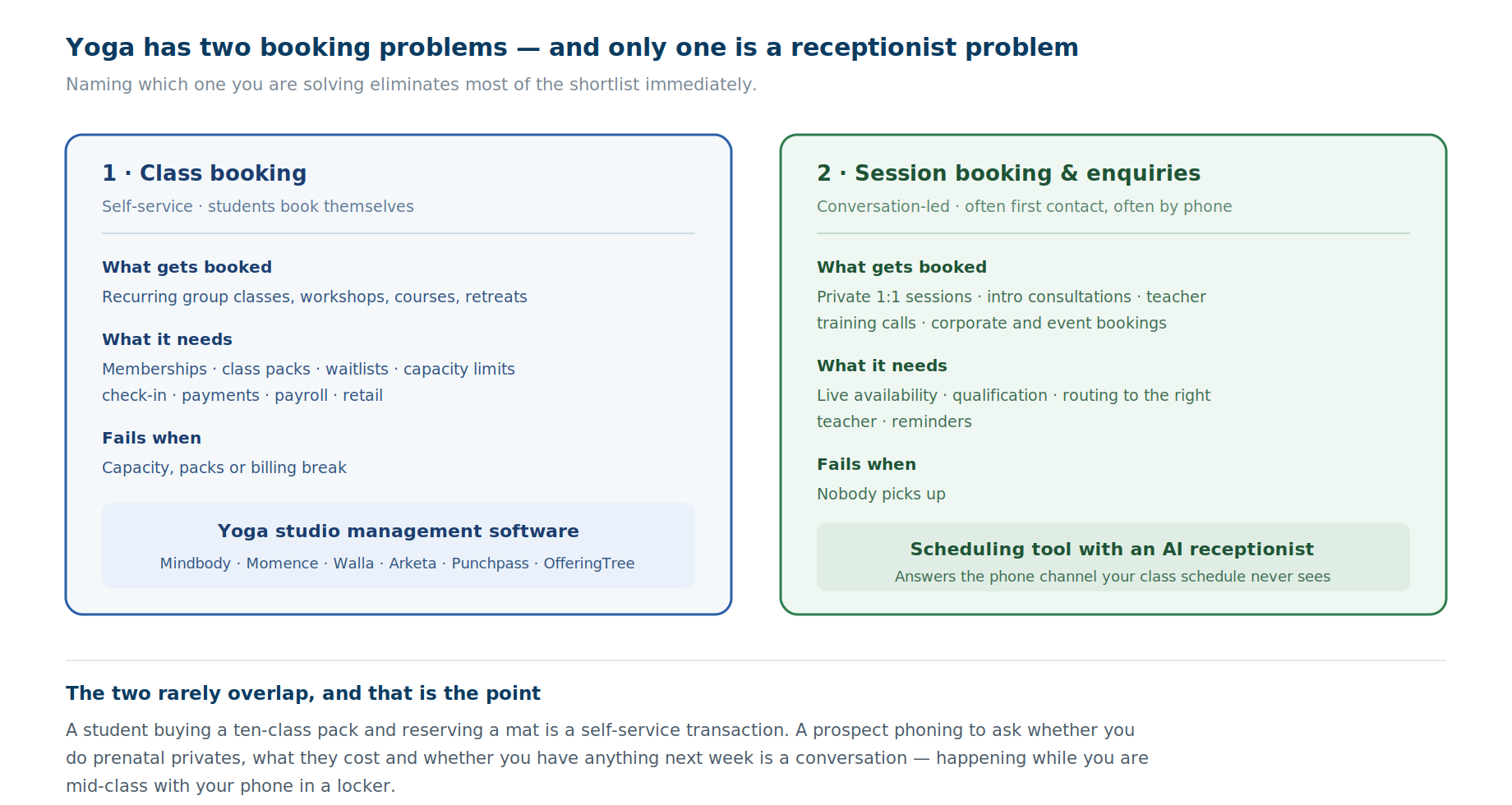
Naming which one you are trying to solve eliminates most of the shortlist immediately.
|
Class booking |
Session booking and enquiries |
|
|
What gets booked |
Recurring group classes, workshops, courses, retreats |
Private one-to-one sessions, intro consultations, teacher training calls, corporate and event bookings |
|
What it needs |
Memberships, class packs, waitlists, capacity limits, check-in, payroll, retail |
Live calendar availability, qualification, routing to the right teacher, reminders |
|
Who books |
Students, self-service, usually in an app |
Prospects, often by phone, often first contact |
|
Right tool |
Yoga studio management software |
Scheduling tool with an AI receptionist on the phone channel |
|
Fails when |
Capacity, packs or billing break |
Nobody picks up |
The two rarely overlap, and that is the point. A student buying a ten-class pack and reserving a mat for Thursday is a self-service transaction your studio software handles well. A prospective client phoning to ask whether you do prenatal privates, what they cost, and whether you have anything next week is a conversation — and it is happening while you are mid-class with your phone in a locker.
What an AI receptionist actually does for a yoga business
It answers while you are teaching. This is the specific failure mode, and it is sharper for yoga instructors than for most professions. You are unreachable in 60 to 90 minute blocks, several times a day, by design — you cannot glance at your phone mid-savasana. Those blocks are also when people call, because the times a studio is busiest teaching are the times prospective students are thinking about yoga.
It qualifies before booking. A short set of questions you configure: private session or class enquiry, experience level, injuries or pregnancy, preferred days, in-studio or online. The answers arrive with the booking, so a first private session does not start with fifteen minutes of intake.
It books against live availability. The distinction that matters most in this category is whether the system confirms an appointment during the call or simply captures details for you to action later. A confirmed booking captures the caller's intent at its peak. A message restarts the problem with extra steps, and after hours that gap stretches to the next morning or the next Monday.
It takes a transcribed message when booking is not right. Not every call should end in an appointment. Existing students asking about a class time, suppliers, and people who need a human all need a clean fallback.
What it does not do. No class packs, no memberships, no waitlists, no capacity management, no check-in, no retail, no payroll. If a caller wants to join Thursday's 6pm class, an AI receptionist should point them to your booking system, not try to be it. Anyone selling you a phone agent as a replacement for studio software is overselling.
What your yoga studio software should handle instead
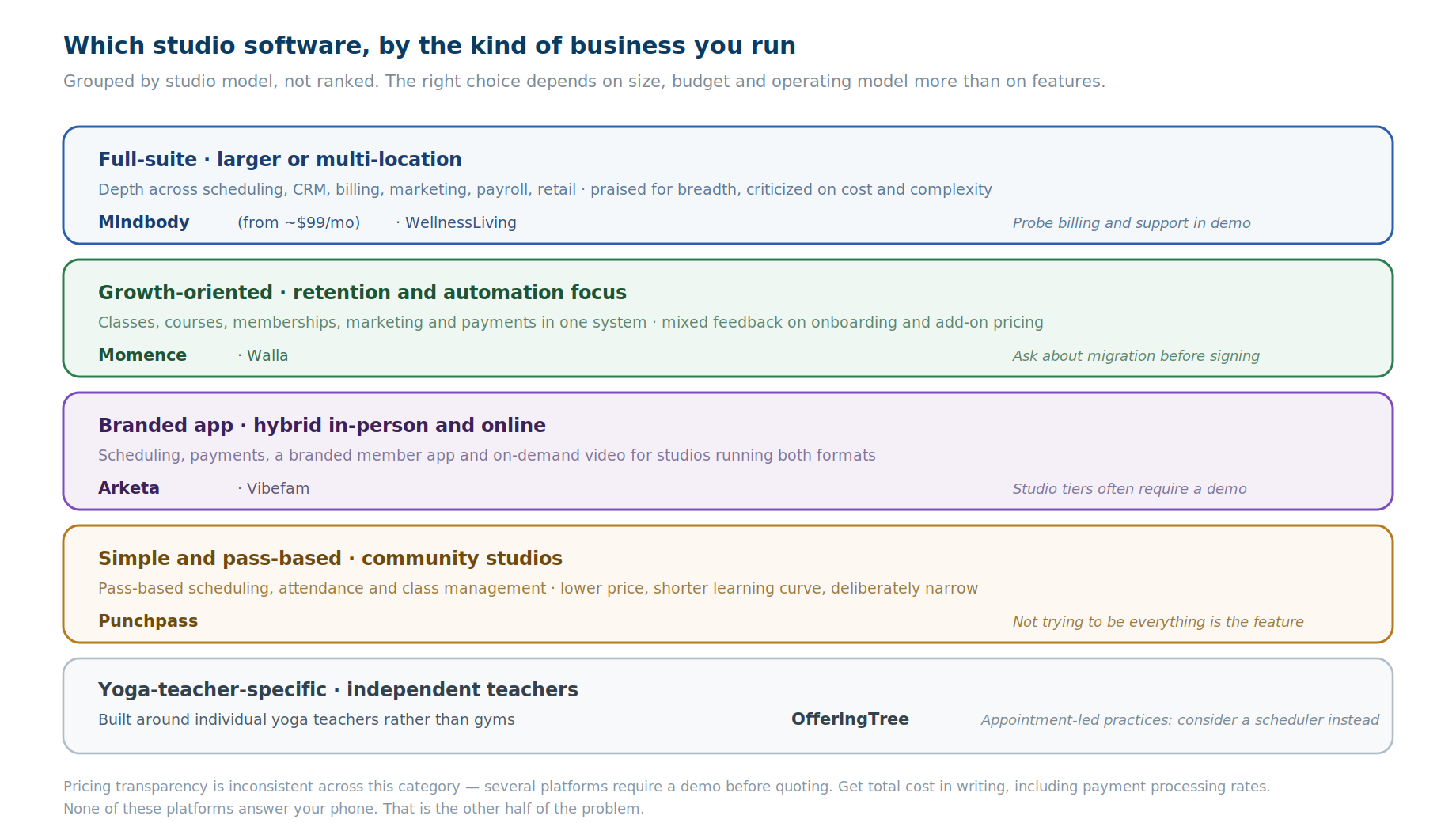
The yoga booking software market is crowded and genuinely differentiated by studio model, so the shortlist depends on what kind of business you run.
Full-suite platforms for larger or multi-location studios. Mindbody is the long-established option, with plans starting around $99 per month and depth across scheduling, CRM, billing and marketing. WellnessLiving offers a similarly deep operational toolset. Both are frequently praised for breadth and criticized by smaller operators for cost and complexity relative to need.
Growth-oriented modern platforms. Momence covers classes, courses, memberships, marketing and payments in one system and is often recommended as the strongest all-round pick for a modern studio, with automation and retention tooling as its distinguishing strength. Walla sits in similar territory. Both attract mixed feedback specifically around onboarding, migration and add-on pricing rather than day-to-day function.
Studio-owner platforms with branded apps. Arketa combines scheduling, payments, a branded member app and on-demand video, built for studio owners running hybrid in-person and online offerings. Vibefam targets boutique studios wanting booking, packages, lead management and a branded app.
Simple, pass-based tools. Punchpass has a loyal following largely because it does not try to be everything — pass-based scheduling, attendance and class management, at a lower price and with a shorter learning curve. For a community-focused studio that does not want another dashboard, that restraint is the feature.
Yoga-teacher-specific platforms. OfferingTree is built around independent yoga teachers rather than gyms, and is regularly named as the most complete all-in-one option for that specific model.
Appointment-led practices. If your business is mostly private sessions and yoga therapy rather than group classes, appointment schedulers may serve you better than class-management software.
One practical note: pricing transparency in this category is inconsistent. Several platforms require a demo before quoting, and at least one publishes individual-teacher pricing while gating studio tiers behind a sales conversation. Get total cost in writing, including payment processing rates.
The calls a yoga business actually misses
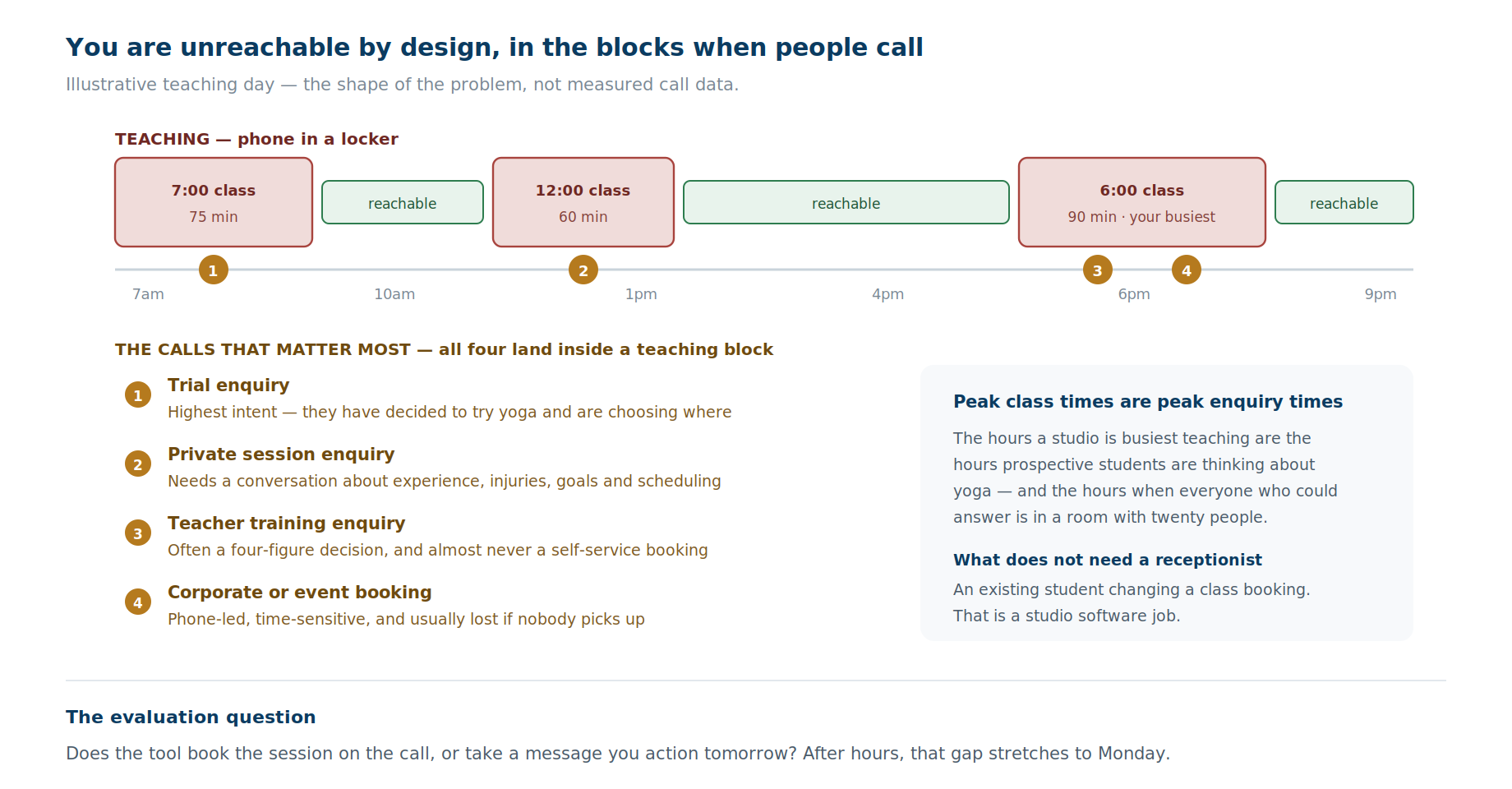
Worth being specific about which calls matter, because not all of them justify a tool.
Trial and intro enquiries. The highest-intent call a yoga business receives is someone who has decided to try yoga and is choosing where. They are calling two or three studios. Whoever answers, or books them, usually wins.
Private session enquiries. Higher value per booking than a drop-in class and almost always requiring a conversation about experience, injuries, goals and scheduling. These rarely convert through a class schedule page.
Teacher training enquiries. The highest-value enquiry most studios get, often a four-figure decision, and almost never a self-service booking. These callers expect a conversation.
Corporate and event bookings. Office classes, retreats, private group sessions. Usually phone-led, usually time-sensitive, and usually lost if nobody picks up.
Evenings and weekends. Peak class times are peak enquiry times, which is precisely when everyone who could answer is teaching.
What does not need an AI receptionist: existing students changing a class booking. That is a studio software job, and routing it to a phone agent adds a step.
How to choose an AI receptionist for a yoga practice
- Does it book, or only take a message? The single biggest determinant of whether the tool produces revenue or admin.
- Does it work alongside your studio software, or try to replace it? A phone agent that claims to manage memberships and waitlists is either overselling or duplicating what you already pay for.
- Can it treat different enquiry types differently? A private session request, a class question and a teacher training enquiry should not all end the same way.
- Can it capture what you need before a first private session? Injuries, pregnancy, experience level, goals. This is genuinely useful intake, not a data-collection exercise.
- What happens to calls outside its configured scope? Every automated system meets one. A clean transcribed message is fine; a dead end is not.
- Is pricing published? Model the full year including any per-minute or overage charges, not just the headline rate.
- How long from signing up to answering real calls? Software-based tools are usually live in hours or days; script-based human services take longer.
- Does it handle time zones? Only relevant if you teach online across regions, but painful if it does not and you do.
A note on terminology: this category gets searched as "AI receptionist," "virtual receptionist" and "AI phone agent," and vendors use all three for overlapping products. The label matters less than the two questions above — does it book, and does it stay in its lane alongside your studio software.
What to configure before you switch it on
Most disappointing deployments in this category are configuration failures rather than product failures. For a yoga business, four decisions do most of the work.
Your qualification questions. Two or three, not eight. Private or class, experience level, and anything you genuinely need to know before a first one-to-one — injuries, pregnancy, mobility limitations. Resist the temptation to collect everything; each extra question costs completions.
Your routing rules. Decide in advance where each enquiry type lands. A private session request should reach your own calendar. A teacher training enquiry should reach whoever runs the programme. A class question should get your booking link rather than an attempt to process it.
Your boundaries. Write down explicitly what the agent must not answer. Whether a style is appropriate during pregnancy, whether a practice is safe with a specific injury, anything shading into medical advice, and any complaint. These get captured and routed to a person, never answered.
Your fallback. What happens when a caller wants something outside all of the above. A clean transcribed message with a callback commitment is fine. Silence is not.
Why OnceHub is the best pick
Scoping this honestly matters, because the boundary is the whole point of this article. OnceHub is a scheduling platform, not yoga studio software. It does not manage class packs, memberships, waitlists, capacity or check-in, and it will not replace Mindbody, Momence or Punchpass.
What its AI Phone Receptionist does is the phone and private-session layer: it answers on a dedicated number while you are teaching, works through the qualifying questions you configure, checks live calendar availability, and confirms the booking during the original call, with a transcribed message as the fallback. Routing can send different enquiry types to different outcomes — a private session to your own calendar, a teacher training enquiry to whoever handles those, a general class question to a message. For studios with several teachers offering privates, a booking hub lets a prospective student browse teachers by specialty and book directly.
Pricing is published by tier rather than quoted on request, and there is a free plan covering single-teacher scheduling, which is enough to test the booking flow before paying for the phone channel.
Common mistakes
- Buying a phone agent to solve a class booking problem. If students cannot easily book Thursday's class, that is a studio software problem and no receptionist will fix it.
- Buying studio software to solve a phone problem. The reverse error. Class management platforms are not built to answer calls during a 90-minute class.
- Letting it answer questions it should not. Injury advice, whether a style is safe during pregnancy, medical suitability — these need a qualified human. Configure the agent to capture the question and route it, not answer it.
- Skipping the fallback design. Decide what happens when a caller wants something outside scope, before launch rather than after.
- Comparing headline prices across different models. Per-minute, per-seat and flat subscription pricing are not comparable. Model a realistic month.
- Not testing it as a caller. Phone your own number and go through the flow as a prospective student would. It takes ten minutes and finds most problems.
Conclusion
An AI receptionist is not a yoga booking system, and the guides that present it as one are setting studios up for disappointment. Group classes, memberships and packs belong to studio management software, and that market is mature and genuinely good.
What the phone layer solves is narrower and, for a lot of instructors, more valuable per booking: the trial enquiry, the private session, the teacher training question and the corporate booking that arrive by phone while you are unreachable in a room full of students. If those calls are currently going to voicemail, the fix is a tool that answers and books rather than one that answers and takes a message.
Work out which of your two booking problems is actually costing you, buy for that one, and keep the other where it belongs.
Frequently asked questions
Can an AI receptionist book yoga classes?
Not group classes, and you should be sceptical of any that claim to. Class booking requires memberships, class packs, waitlists, capacity limits and check-in, which belong to yoga studio management software such as Mindbody, Momence, Punchpass or OfferingTree. An AI receptionist books private sessions and consultations, and should point class enquiries to your existing booking system.
What is the best booking software for a yoga studio?
It depends on your model rather than on a single ranking. Larger and multi-location studios tend toward Mindbody or WellnessLiving; growth-focused studios toward Momence or Walla; studios wanting a branded app toward Arketa or Vibefam; simplicity-focused studios toward Punchpass; and independent yoga teachers toward OfferingTree. Get total cost in writing, since several platforms require a demo before quoting.
Do yoga instructors need an AI receptionist?
It depends on how much of your business arrives by phone and how often you are unreachable. If most bookings are self-service class reservations, probably not. If you sell private sessions, teacher training or corporate classes, and you teach in 60 to 90 minute blocks when you cannot answer, the calls you are missing are the highest-value ones you receive; in that case, you require an AI receptionist like OnceHub.
How much does an AI receptionist cost for a small studio?
Pricing models vary enough that headline rates are not comparable: some charge per minute, some per seat, some a flat subscription. Model a realistic month of call volume including any overage. A minority of providers publish rates by tier — OnceHub's are listed publicly and include a free plan for single-teacher scheduling — which at least lets you estimate cost without a sales call.
Will an AI receptionist replace my studio management software?
No, and it should not try. The two solve different problems: studio software runs class schedules, memberships, packs, payments and attendance; an AI receptionist handles inbound calls, qualification and private session booking. Most yoga businesses that need both run both, with the phone layer handling what the class schedule never sees.
What should an AI receptionist not answer for a yoga business?
Anything requiring qualified judgment — whether a style is appropriate during pregnancy, whether a practice is safe with a specific injury, or any question that shades into medical advice. Configure the agent to capture the question and route it to a teacher rather than answer it. The same applies to complaints and anything involving a distressed caller.
Can it handle both my private sessions and my class enquiries?
It can handle them differently, which is the useful version. Routing lets a private session request book directly against your calendar, a teacher training enquiry go to whoever handles those, and a general class question receive the booking link for your studio software or a transcribed message. What it should not do is attempt to process the class booking itself.
Sources
- Kisi, The 19 Best Gym Management Software for 2026 — third-party compiled: Mindbody plans starting around $99 per month; Arketa platform scope covering scheduling, payments, branded mobile apps, marketing automation and on-demand content. https://www.getkisi.com/blog/best-gym-management-software-compared
- Yogitimes, Best Yoga Business Software for Teachers and Studios (June 2026) — editorial review: OfferingTree positioned as the most complete all-in-one option for yoga teachers specifically; Punchpass's deliberate simplicity; Momence's strength in growth and retention automation; WellnessLiving's operational depth at higher business complexity. https://www.yogitimes.com/best-yoga-business-software
- Yoga Studio Insider, Best Yoga Booking Software for United States Studios in 2026 (June 2026) — editorial comparison drawing on Capterra, G2, GetApp and Software Advice review signals; Momence positioned as strongest all-round pick for modern studios, with the caveat that the right choice depends on studio size, budget and operating model. https://yogastudioinsider.com/best-yoga-booking-software-for-united-states-studios-in-2026/
- Studio Software Advice, Best Yoga Studio Software (May 2026) — notes inconsistent pricing transparency across the category: several platforms require a demo before quoting, and at least one publishes individual pricing while gating studio tiers. https://studiosoftwareadvice.com/best-yoga-studio-software-in-portland-2026/
- Vibefam, Best Yoga Studio Software: What Reddit Recommends in 2026 (July 2026) — vendor-published: aggregates operator discussion identifying two recurring failure patterns, around operations and billing integrity on established platforms and around onboarding, migration and add-on pricing on newer ones. https://vibefam.com/yoga-studio-software-reddit-2026/
- OnceHub product documentation and pricing — vendor-published (ours): AI Phone Receptionist answering on a dedicated number, configurable qualification, live availability checking and in-call booking confirmation with transcribed message fallback; routing across booking destinations; booking hubs; published plan tiers including a free plan.
Disclosure: OnceHub publishes this guide. OnceHub is a scheduling platform with an AI phone channel, not yoga studio management software — it does not handle class packs, memberships, waitlists, capacity or check-in — and it is scoped in this article to the phone and private-session layer only. Yoga studio platforms named are described from published reviews and documentation and are not ranked.