

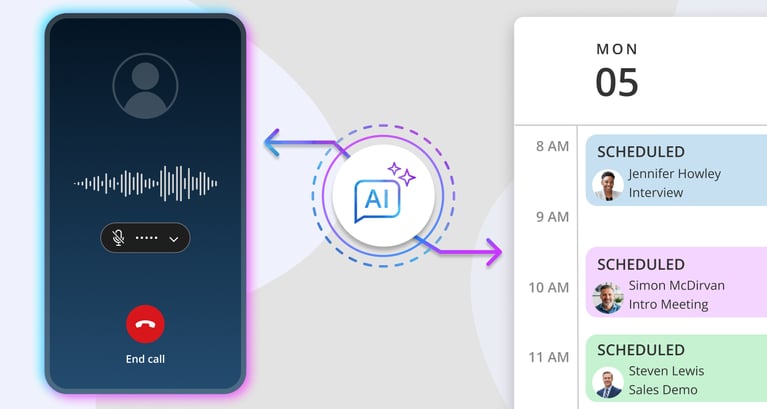
You work hard to get the phone to ring. You pay for ads, you post on social media, and you build your reputation.
So when a potential client finally calls, and you can't pick up because you are busy with another customer, it hurts. You aren't just missing a call; you are missing revenue.
If you are looking for a solution, you have probably noticed a problem: most "AI voice agents" are built for massive enterprises. They are complex, expensive, and require an engineering degree to set up.
But you don't run a Fortune 500 call center. You run a small business.
You don't need a robot that can discuss the weather or answer 5,000 different trivia questions. You need a system that answers the phone, helps the customer, and puts a meeting on your calendar.
In this guide, we will cut through the hype. We aren't looking for the "smartest" AI. We are looking for the best AI voice agent for small businesses, the one that actually drives results without the headache.
How Do We Define the "Best" AI Voice Agent?
Understanding the difference between a "Trained Agent" and a "Narrow Agent" is key to finding the right fit for you.
- Custom-Trained Agents (The Generalists): These are powerful tools that you teach to understand your specific business. You can train them to answer complex technical questions, explain your product catalog, or handle billing issues. The trade-off? They offer incredible flexibility but require significant time to build, test, and maintain.
- Purpose Built Agents (The Specialists): These are pre-built to perform a single, specific job—such as scheduling appointments, out of the box. The trade-off? They won't answer niche FAQs, but they require almost zero setup and start working immediately.
For this guide, we define "best" for the average SMB based on speed-to-value.
While a custom agent is excellent for businesses with unique support needs, most service businesses (clinics, consultants, agencies) achieve the highest immediate ROI by ensuring every call is answered and every lead is booked.
To ensure fairness, we need to set the rules. Here are the specific criteria we used to judge what makes an agent actually useful for a business like yours.
Also read: What Is an AI Voice Agent? The Complete Business Guide
What are the Core Criteria We Used to Evaluate AI Voice Agents for SMBs?
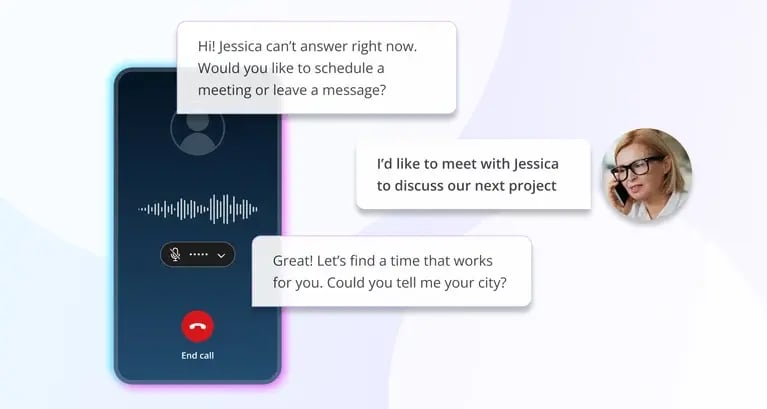
If you Google "AI voice agent," you will find hundreds of tools. Some are glorified chatbots; others are massive platforms designed for airlines and banks.
To find the right tool for a small business, we had to ignore the flashiness and focus on utility. We didn't care if the AI could write a poem or tell a joke. We cared about one thing: Does it help you grow your business?
Here are the five non-negotiable criteria we used.
Now that we know what to look for, let’s talk about why we are so focused on that second point: Scheduling.
Why Scheduling is the Most Important AI Voice Use Case for Small Businesses
“Two‑thirds of small and medium businesses rate inbound phone calls as a good or excellent source of leads, making calls the single most valued lead type they receive.” - Nextiva
When a customer emails you, they are browsing. When they call you, they are buying.
Inbound calls are your highest-intent channel. That person has a problem, money to spend, and wants a solution right now.
But here is the reality: Time kills deals.
If that high-intent caller hits a voicemail greeting, their interest drops to zero. Even if you are diligent and call them back an hour later, they have likely already moved on to the next business on Google.
Callbacks simply don't scale. You cannot spend your entire day chasing people who called you yesterday, playing endless rounds of phone tag.
This is why we prioritize scheduling above all else.
A friendly robot that answers FAQs is nice, but it doesn't pay the bills. An agent that turns a conversation into a confirmed appointment on your calendar is a revenue engine.
Simply put: If your AI voice agent cannot book a meeting on the spot, it is failing the most important test.
To know more about the best, read the blog: The Best Voicemail Alternative
So, if the goal isn't just to talk, but to book, which tool actually delivers? There is one standout winner for small businesses.
OnceHub’s Phone Booking: The Best AI Voice Agent for Small Businesses That Rely on Scheduling
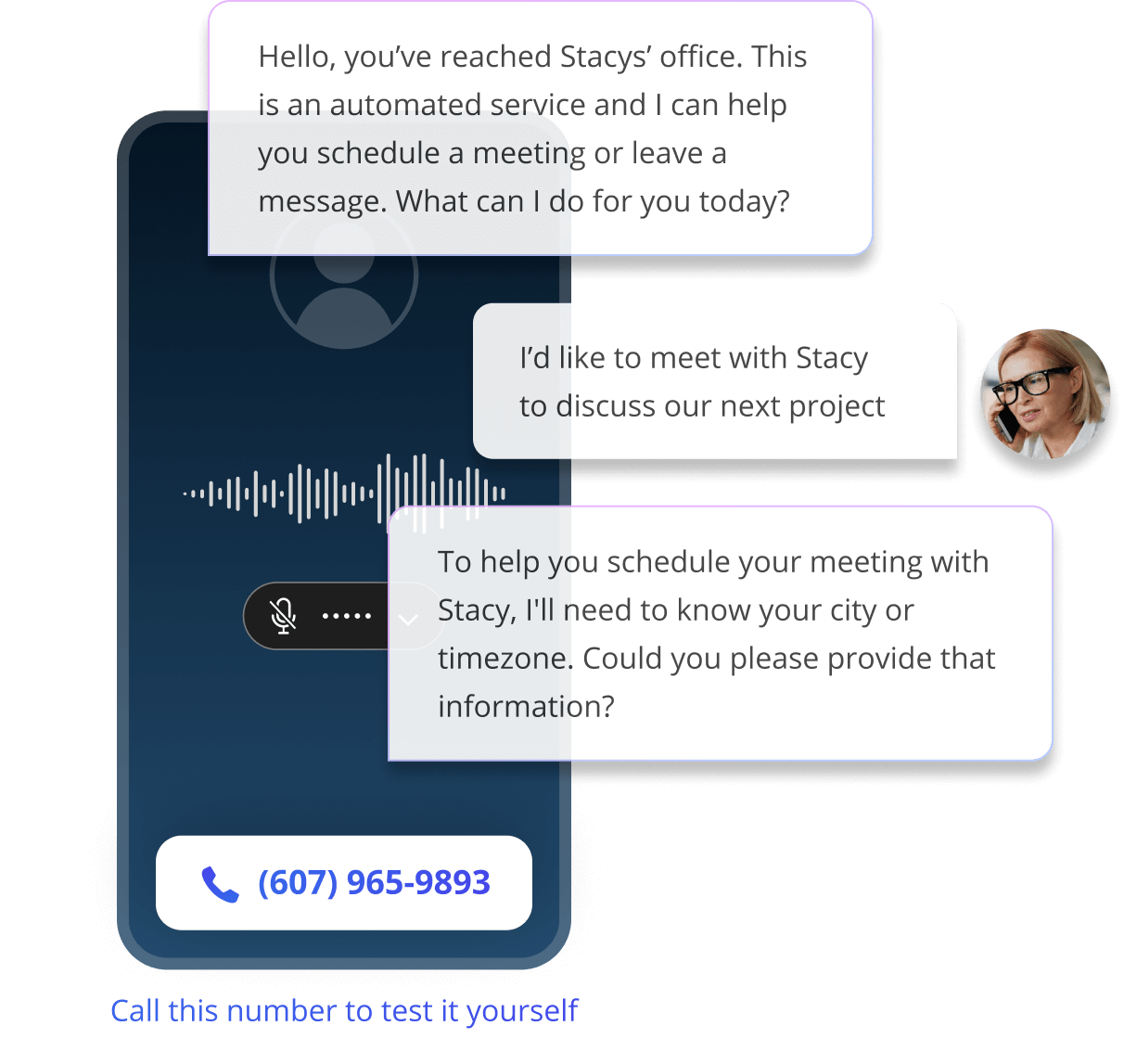
If you skipped to this section, here is the short version: OnceHub is the best choice for small businesses because it is purpose-built for one job, putting meetings on your calendar.
Most AI agents are generalists. They try to be customer support, tech support, and sales assistants all at once. Because they try to do everything, they require a complex setup and constant "training" to get it right.
OnceHub is different. It is a specialized scheduling agent.
Why is OnceHub the best for SMBs?
For a small business, "best" means "least friction."
With other tools, you have to build the brain from scratch. You have to write scripts, define "intents," and teach the AI how your business works.
With OnceHub, the "brain" is already built. It inherits the logic directly from your existing booking page.
- No Training: You don't need to teach it your hours; it reads your calendar.
- No Scripting: You don't need to write dialogue; it already knows how to negotiate a time.
- No Prompt Tuning: You don't need to be an engineer to make it sound human.
What OnceHub Actually Does
It doesn't just route calls. It handles the entire appointment lifecycle over the phone.
- Answers Instantly: It answers every call 24/7 with zero hold time.
- Books in Real-Time: It accesses your live availability (and your team’s) to find a slot that works for both parties.
- Recovers Missed Opportunities: If a call drops or you miss a lead, the system can proactively reach out via SMS or email to secure the booking.
Also read: How the IVR-to-Phone-Booking Workflow Works
The "Secret Sauce": Inherited Scheduling Logic
This is the technical differentiator that matters most.
Most general-purpose voice agents are blind to the complexities of your team's schedule. Because they lack deep integration, they view availability in binary terms, open or closedwhich often leads to accidental double-bookings or scheduling meetings with the wrong staff member.
OnceHub’s voice agent respects the powerful scheduling rules you already use:
- Round Robin: It ensures calls are distributed fairly among your sales team.
- Pooled Availability: It combines everyone’s calendar to offer the caller the maximum number of open slots.
- Panel Meetings: It can even coordinate a time when three team members are available for a complex consultation.
Ideal SMB Use Cases
.png?width=1540&height=700&name=features_of_phone_booking%20(1).png)
While AI voice technology is versatile, it delivers the highest return on investment for service-based industries where the calendar is the primary engine of revenue.
This solution is optimized for "high-touch" businesses where a missed call often translates to a missed high-value opportunity.
- Financial Advisors & Wealth Management: Trust is built on responsiveness. When a high-net-worth individual calls to discuss their portfolio or inquire about services, sending them to voicemail is a risk. An AI agent ensures you capture that intent instantly, booking a consultation while their interest is highest.
- Healthcare & Private Practices: Patient experience begins the moment they pick up the phone. An automated booking agent efficiently manages patient intake and scheduling, reducing administrative burden and enabling medical staff to focus on care rather than calendar management.
- Legal Services: In legal matters, clients often call in moments of distress or urgency. Immediate responsiveness is a competitive advantage. The agent serves as the first point of contact, ensuring potential clients feel heard and securing a consultation time before they call a competitor.
- Consultants & Agencies: Your time is your inventory. An AI agent automatically turns inbound inquiries into qualified discovery calls, protecting your billable hours by eliminating the back-and-forth friction of manual scheduling.
Now, you might be thinking, "Why not just get a more generic AI that can do everything?" Let's talk about why "more" is actually "less" for a small business.
Why Many "AI Voice Agents" Are Overkill for Small Businesses?
Many business owners are understandably drawn to the versatility of general-purpose AI. The prospect of a system capable of handling any task, from complex troubleshooting to creative writing, is compelling.
However, it is critical to distinguish between a turnkey solution and a developer platform.
Most broad-scope AI voice agents fall into the latter category. They provide the raw infrastructure, the building blocks of intelligence, but rely on the user to construct the workflow. While this infinite flexibility is a strategic asset for enterprise organizations with dedicated IT teams, it often presents a significant operational hurdle for small businesses.
The Hidden Costs of "Flexible" Tools
When you sign up for these "do-it-all" platforms, you often inherit three massive problems that kill your ROI:
- You Have to Train It: You can't just turn it on. You have to upload documents, write "system prompts," and manually teach the AI how to handle your specific business logic. If you forget to teach it something, it fails.
- You Have to Define "Intents": You must predict every possible way a customer might phrase a question. You have to build complex flowcharts: "If they say X, go to step 3. If they say Y, go to step 4."
- Maintenance Is on You: If the AI starts hallucinating (making things up) or a software update breaks your workflow, you are responsible for fixing it.
Complexity is the Enemy of Reliability
The more complex a system is, the more likely it is to break.
A general AI agent tasked with handling billing, support, sales, and scheduling simultaneously is prone to confusion. It might promise a refund it can't give or book a time you don't have.
For 90% of small businesses, this complexity works against you. You don't need a custom-coded "digital employee" that takes three weeks to set up. You need a reliable tool that answers the phone and books the meeting, straight out of the box.
That said, we aren't saying these advanced tools are useless. There are specific scenarios where you actually DO need that level of power.
When a More Advanced AI Voice Agent Might Be the Right Choice
We aren't saying those complex, build-it-yourself platforms are useless. Far from it. They are highly effective when you have the resources to manage them.
There are two specific scenarios where a simple scheduling agent like OnceHub might not be enough, and you actually do need a heavy-duty, custom-built AI.
1. You Need Deep, Technical Customer Support
If your callers are asking highly specific, complex questions like "Why is the third light on my router blinking red?" or "How do I reset the pressure valve on my Model X boiler?" you need a Generative AI agent trained on your entire technical manual. A scheduling agent isn't designed to troubleshoot hardware; it’s designed to book the technician who can.
2. You Have a Dedicated IT Team
The biggest barrier to these advanced tools is maintenance. If you have a developer or CTO with the time to script conversations, monitor API logs, and retrain the model weekly, the "Lego kit" approach might work for you. But if you are the owner, the head of sales, and the IT guy? Stay away. You will spend more time fixing the bot than running your business.
The Bottom Line:
- Use Advanced/Custom Agents if you need a "digital support engineer" to resolve complex issues over the phone.
- Use Specialized Booking Agents if you need a "digital receptionist" to fill your calendar with paying clients.
We have reviewed the criteria, use cases, and risks. It’s time to make a decision.
Final Verdict: Which AI Voice Agent Is Best for Small Businesses?
We started this guide with a simple premise: small businesses don't need "smarter" robots; they need more revenue.
When you strip away the marketing hype and look at what actually moves the needle for a service-based business, the answer becomes clear.
- If you need a research assistant or a coding buddy, get ChatGPT or Claude.
- If you need a complex customer service center for a Fortune 500 airline, get a custom enterprise platform.
- But if you are a small business that relies on appointments to make money, the best choice is OnceHub.
Why? Because it passes the "SMB Test" where others fail:
- It focuses on the outcome: It doesn't just chat; it books.
- It respects your time: There is no training, no prompting, and no scripting. It works with the calendar logic you already have.
- It pays for itself: By recovering just a few missed calls a month, it generates more revenue than it costs.
For most small business owners, the goal isn't to adopt AI for the sake of AI. The goal is to stop missing calls, stop playing phone tag, and start filling your calendar.
Conclusion
The era of the "busy signal" is over.
For decades, small businesses have accepted missed calls as a cost of doing business. You are in a meeting, on a job site, or just plain busy when the phone rings out, and the potential client goes elsewhere.
That is no longer a problem you have to live with.
AI voice agents have democratized 24/7 coverage, previously available only to large corporations. But remember: the technology is only as good as the result it delivers. A bot that just takes a message is barely better than voicemail.
You need an agent that acts like your best employee, one that knows your schedule, treats your clients with respect, and closes the appointment while you are sleeping.
Ready to stop missing revenue? Get started with OnceHub’s AI phone booking today and turn your missed calls into confirmed appointments instantly.
Frequently Asked Questions (FAQ)
1. Why shouldn't I just use a "do-it-all" AI agent?
As we mentioned in the "Lego Kit" analogy, generalist agents often require you to build the logic yourself. While they can do anything, they usually require weeks of setup, scriptwriting, and "intent definition" to work correctly. If your primary goal is to book meetings, a generalist tool adds unnecessary complexity and failure points compared with a specialized booking agent.
2. You said OnceHub requires "no training." How does it know my business?
It works by inheriting the logic you have already built. Instead of you writing a script that says, "If they ask for Tuesday, check the calendar," OnceHub connects directly to your existing Booking Page settings. It reads your real-time availability, your buffer times, and your workload rules instantly. It "knows" your business because it reads your calendar, not because you spent weeks teaching it.
3. What happens if a caller asks a question that isn't about scheduling?
This is a common fear. If a caller asks a complex technical question (e.g., "How do I fix my boiler?"), A scheduling agent won't try to hallucinate an answer. Instead, it acts like a good receptionist: it acknowledges the question and can offer to take a message or route the call to a specific technical department. The goal is to capture the lead, not to pretend to be an engineer.
4. Can the AI really handle "phone tag" for me?
Yes. This is the "Outbound Recovery" feature we highlighted. If a potential client calls and hangs up, or if you have a list of past leads, the agent can proactively call them back to secure an appointment. It turns the passive process of "waiting for the phone to ring" into an active revenue-generating workflow.
5. How does this compare to just hiring a virtual assistant (VA)?
A VA is human and versatile, but they have limits: they sleep, take breaks, and can handle only one call at a time. If three customers call your ad campaign at once, a VA misses two of them. An AI voice agent scales infinitely; it can have 50 simultaneous conversations at 2:00 AM, ensuring you never miss a high-intent caller due to capacity.