


The best travel chatbots combine live booking-system integration, grounding in your own content, genuine multilingual handling, and clean human handoff. Conversational polish on its own does not book anything.
Most travel chatbot shortlists get built the wrong way round. Buyers start with conversational quality — how natural does it sound, how good is the language model — and end up with a bot that talks beautifully and cannot see a single available room, seat, or advisor calendar. Conversation is the cheapest part of a travel chatbot in 2026. Connection to your actual systems is the expensive part, and it is the part that decides whether the thing books anything.
This guide covers the ten features that separate a working travel chatbot from a well-spoken FAQ page, what to demand in a demo, and which features matter for which kind of travel business.
Quick answer: the ten features that matter
- Live inventory or booking-system integration — a Property Management System (PMS), Global Distribution System (GDS), Central Reservation System (CRS), or booking engine. Without it, the bot can inform but never book.
- Knowledge grounding on your own content — answers drawn from your policies and rates, not the open web.
- Genuine multilingual handling, not just a translated interface.
- Context retention across the conversation and, ideally, across sessions.
- Clean human handoff that checks whether an agent is actually available before promising one.
- Consultation booking inside the conversation for high-consideration trips.
- Omnichannel reach, with WhatsApp as the priority channel in most markets.
- Defined disruption behavior — what it does during irregular operations, and how it holds up under load.
- Compliance and payment-data handling appropriate to your jurisdiction.
- Analytics tied to bookings, not to chat volume.
The single most useful question in any demo: show me this running against our real booking system, with our real inventory. Most other differences are secondary by comparison.
First, decide which kind of travel chatbot you are buying
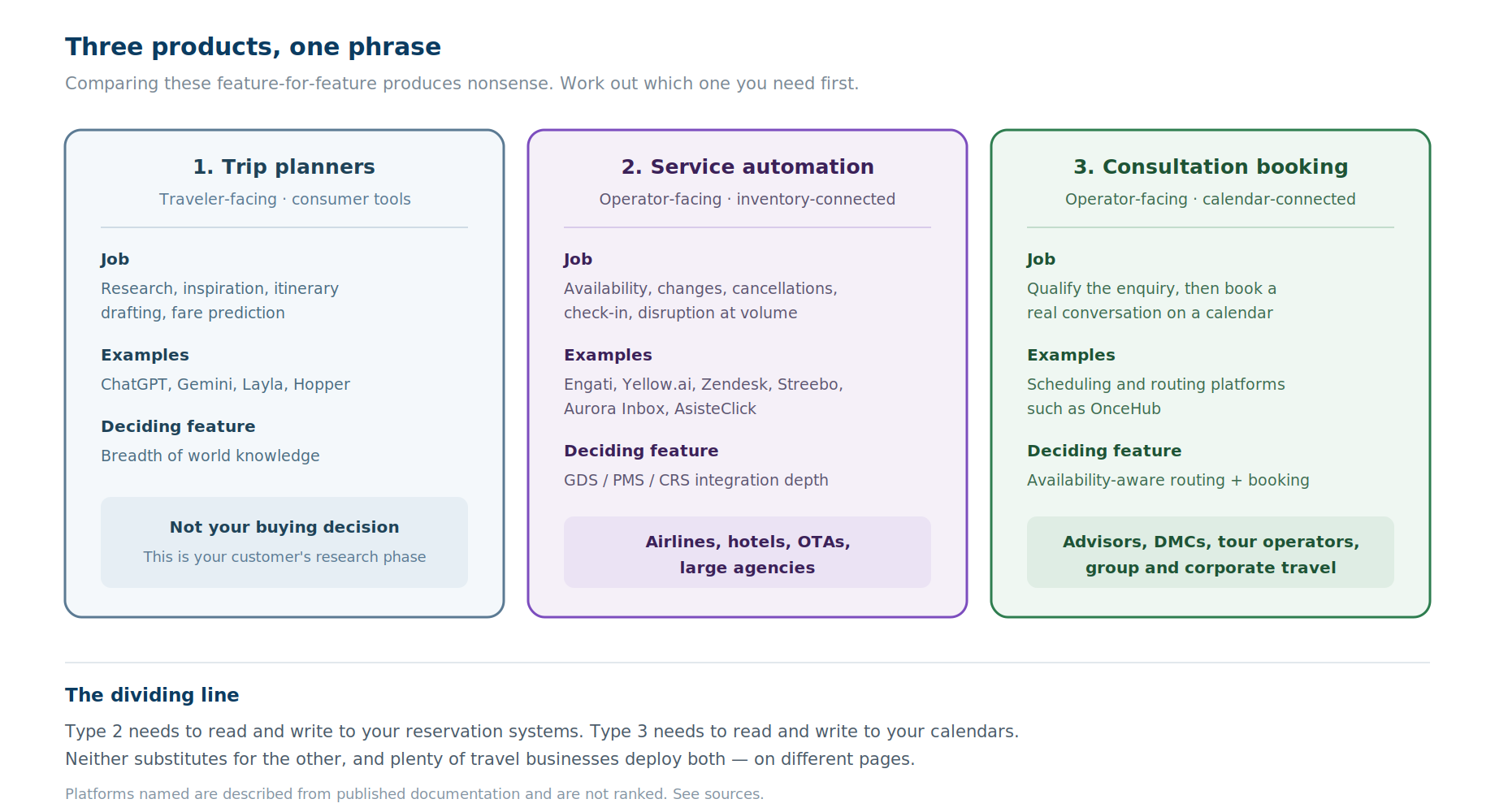
Three genuinely different products get sold under the same phrase, and comparing them feature-for-feature produces nonsense. Work out which one you need before you look at a single feature list.
Traveler-facing trip planners. General assistants and itinerary generators — ChatGPT, Gemini, and purpose-built apps like Layla or Hopper — that help someone research a destination, brainstorm an itinerary, or predict fare movements. Statista data reported in early 2026 put the share of travelers worldwide who have used AI tools to plan a trip at roughly 40%. These are consumer tools. If you run a travel business, they are your customer's research phase, not your product decision.
Operator-facing service automation. Bots deployed by airlines, hotels, OTAs and large agencies to handle inbound service at volume: availability questions, booking changes, cancellations, check-in, disruption. This is the category most "travel chatbot" vendor lists are actually describing — Engati, Yellow.ai, Zendesk, Streebo, and hotel-specific platforms like Aurora Inbox and AsisteClick. Success here is almost entirely determined by integration depth.
Consultation-booking bots. For travel businesses where the sale does not close in a chat widget at all — advisors, luxury and honeymoon specialists, DMCs, group and corporate travel, tour operators — the job of the bot is to qualify the enquiry and get a real conversation on the calendar. This is a scheduling and routing problem rather than an inventory problem, and it is served by a different class of tool entirely.
That third category is underserved and worth taking seriously. In Internova Travel Group's 2026 travel index, built from a survey of 4,000 travelers alongside analysis of millions of bookings, more than 60% of respondents said they expected to use a travel advisor as their primary booking channel in 2026, particularly for international and high-investment itineraries. When the conversion event is a consultation, the bot's job is to book the consultation.
The three categories side by side:
|
Category |
Primary job |
Example platforms |
Features that decide it |
|---|---|---|---|
|
Traveler-facing trip planners |
Research, inspiration, itinerary drafting, fare prediction |
ChatGPT, Gemini, Layla, Hopper |
Breadth of world knowledge — not a business purchase |
|
Operator-facing service automation |
Availability, changes, cancellations, check-in and disruption at volume |
Engati, Yellow.ai, Zendesk, Streebo, Aurora Inbox, AsisteClick |
Integration depth above all, plus features 2, 3, 7, 8 and 9 below |
|
Consultation-booking bots |
Qualify the enquiry, then book a real conversation on a calendar |
Scheduling and routing platforms such as OnceHub |
Availability-aware routing and in-widget booking — features 2, 4, 5, 6 and 10 below |
Platforms are grouped by the job they do, not ranked. If your shortlist spans two rows, you are comparing products that were never substitutes.
The ten features, in priority order
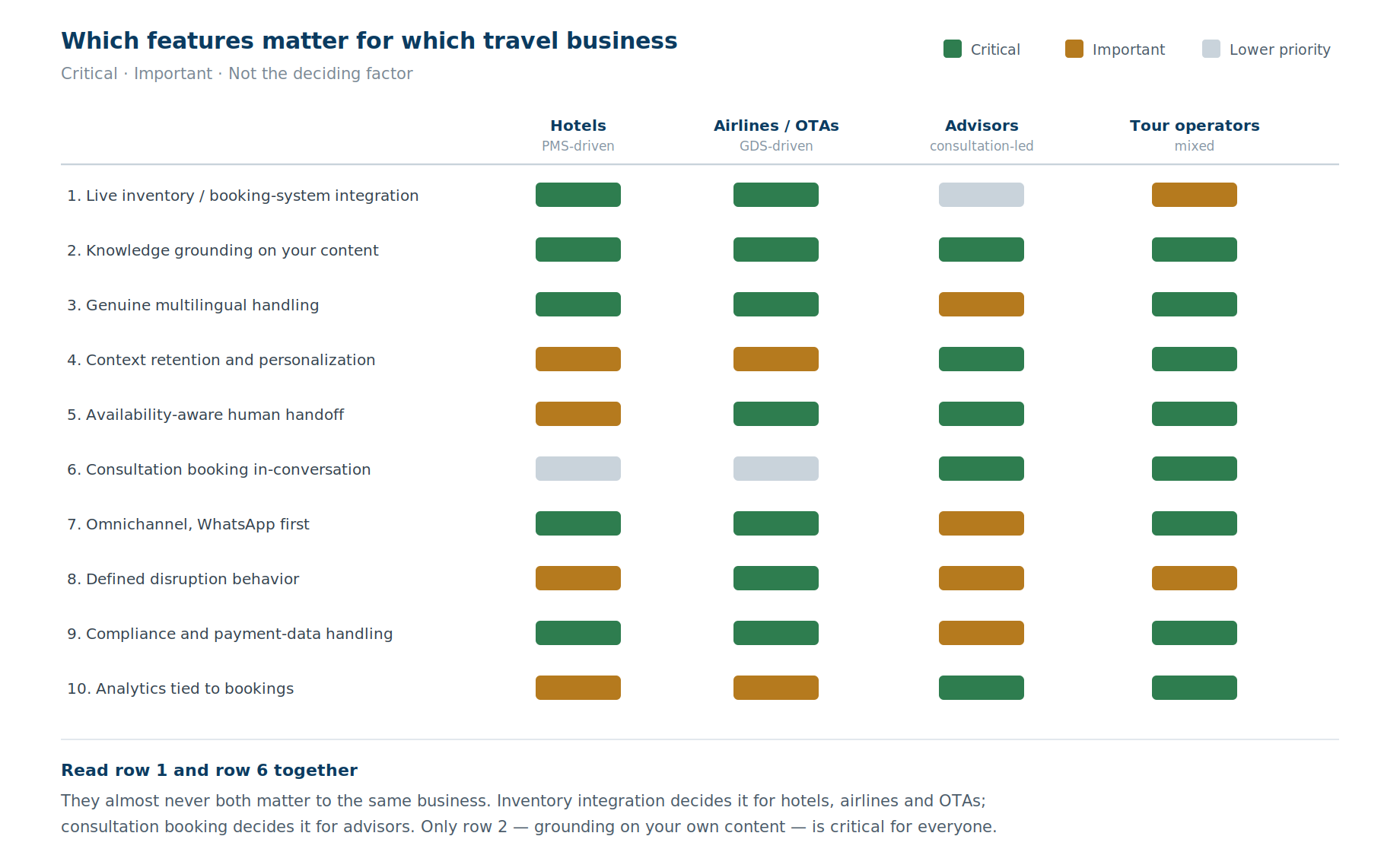
1. Live inventory or booking-system integration
This is the feature that fails most often and gets checked least carefully, because the word "integration" does an enormous amount of work on vendor websites.
A 2026 practitioner guide from eesel AI puts the problem plainly: integration on a vendor's site rarely means your GDS, your PNR format, or your booking engine — and a bot that cannot read a real itinerary can only answer FAQs, never rebook, which is exactly the moment a traveler needs it. Their recommendation is the right one: make the demo run on your exact system, or get a written connector plan before signing.
The hotel side has the same logic in simpler form. Aurora Inbox, a WhatsApp-first hotel chatbot vendor, notes that without a PMS connection carrying real availability, the agent cannot book — it can only inform.
What to verify: which specific systems, via API or middleware, read-only or read-write, and whether the connector already exists or would be built for you.
2. Knowledge grounding on your own content
A travel bot answering from general model knowledge can confidently invent your cancellation policy. Retrieval against your own documented content — rate rules, policies, property details, visa guidance, FAQs — is what makes answers trustworthy enough to publish.
Aurora Inbox lists a poor knowledge base as one of the most common implementation failures: without rules, menus and FAQs actually loaded, the AI does not answer accurately. Grounding is not a premium feature in 2026; treat its absence as a strong red flag.
3. Genuine multilingual handling
Travel is the sector where language and speed decide sales more directly than price does. A prospective guest messaging at 2am their time, in their own language, will book elsewhere long before a front desk replies the next morning in a different one.
Coverage varies widely and is worth checking as a number rather than a claim. Among vendors publishing figures, Engati's travel bot supports 54 languages and Aurora Inbox advertises more than 40. Ask specifically whether the bot detects and switches language mid-conversation, and whether your knowledge base is available in each language or only the interface.
4. Context retention and personalization
Personalization in travel means the bot remembers what was said three messages ago and reflects known traveler attributes — party size, dates, budget band, loyalty tier, past trips — rather than restarting from zero at each turn.
There is now peer-reviewed support for this mattering commercially rather than just experientially. A March 2026 study in Tourism and Hospitality, based on 607 tourists surveyed at major destinations in Vietnam, found that AI chatbot adoption significantly strengthened the link between booking intention and actual booking behavior — narrowing the well-documented gap between travelers who intend to book and those who do. The mechanism the authors point to is real-time support reducing hesitation at the decision point.
5. Clean human handoff, with availability logic
Most handoff features are worse than advertised in one specific way: they offer a human without first checking whether a human exists. A bot that says "connecting you to an agent" into an empty queue at 11pm has manufactured a worse experience than a straightforward "we'll reply in the morning."
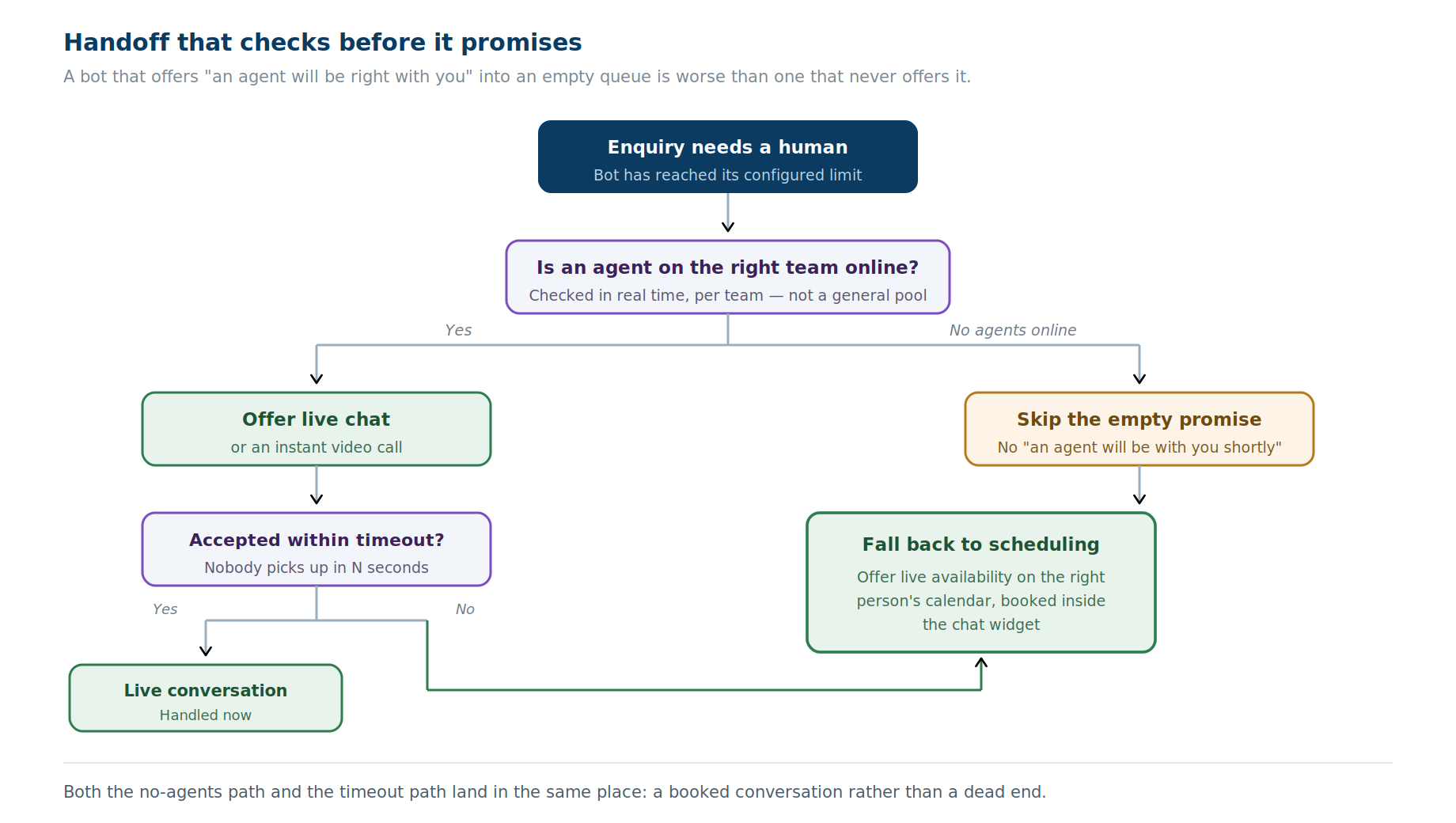
The mechanics worth insisting on are conditional. The bot should check agent availability before offering live chat, route to a specific team rather than a general pool, apply a timeout when nobody accepts, and have a defined fallback — a booking, a callback, a message — for the no-agents-online case.
6. Consultation booking inside the conversation
For high-consideration travel, this is a primary conversion feature, distinct from inventory booking. A multi-generation trip or a bespoke honeymoon is not going to be transacted in a widget. What the widget can do is capture a qualified enquiry while intent is live and put a named advisor's time on the calendar.
This is where OnceHub fits. OnceHub's web chatbot is purpose-built for the consultation layer of travel sales — conversational screening, availability-aware routing, and in-widget calendar booking — rather than for reading live GDS or PMS inventory.
In practice it answers visitor questions using AI trained on your own content, screens the enquiry conversationally, and then offers the right next step based on real-time availability: a live chat with an available agent, an instant video call with a specific team, or a booked meeting on an advisor's calendar without the visitor leaving the chat widget. Its handoff logic is the conditional kind described above — route to live chat when an agent is online, fall back to scheduling when none is, with timeout handling in between. The screening and routing mechanics are the same ones covered in our guide to what scheduling software does and how to choose it.
For an advisory practice, a DMC, or a tour operator whose sales cycle runs through consultations, that is the relevant automation. For an airline handling irregular operations, it is not.
Advisors are adopting this class of tooling quickly. A TRAVELSAVERS Canada survey published in December 2025 found generative AI usage among affiliated advisors had more than doubled in a year, from 20% to 50%.
See it on your own enquiry pages. OnceHub's web chatbot screens travel enquiries and books consultations against live advisor availability. Start free →
7. Omnichannel reach, WhatsApp first
Travelers do not stay on one channel, and in most non-US markets the default channel is WhatsApp rather than web chat. Vendor platforms increasingly span web, WhatsApp, Messenger, Instagram and voice, with a shared inbox so conversations remain visible across channels.
What to verify: whether channels share one conversation history and one knowledge base, or whether each is configured separately. The second arrangement doubles your maintenance and produces contradictory answers.
8. Defined disruption behavior
This is the feature nobody demos and everybody eventually needs. eesel AI frames it well: a travel bot's real exam is irregular operations, when contact volumes can spike dramatically within minutes, and a tool that performs well in a calm demo can fall over when a storm grounds a hub.
Worth noting that disruption handling is also where travelers most value humans. Yodl's 2026 travel advisor trends report cites 85% of luxury travelers viewing advisors as crucial specifically for securing seamless experiences and handling disruptions. The realistic design goal is a bot that absorbs the routine volume during a disruption so your humans can work the genuinely broken itineraries — not a bot that handles the disruption itself.
What to ask: how does it behave under a 10x volume spike, what does it do with a caller whose booking it cannot find, and what is the escalation path when the answer is "this needs a person now."
9. Compliance and payment-data handling
Travel bots routinely touch passport details, dates of birth, payment cards and, for some trips, health information. Where the bot stores conversation data, how long it retains it, whether payment capture happens inside the chat or via a redirect to a compliant processor, and which regulations the vendor attests to are procurement questions, not technical footnotes.
10. Analytics tied to bookings
Chat volume, containment rate and CSAT describe bot activity. They do not tell you whether the bot made money. Insist on reporting that connects conversations to bookings or booked consultations, split by channel and language, so you can see which segments the bot actually converts and which it merely occupies.
Red flags
Recurring failure patterns across 2026 implementation guides:
- No connection to real availability. The bot can only inform — and travelers notice quickly.
- An empty or stale knowledge base. Grounding infrastructure with nothing loaded into it produces confident wrong answers.
- Undefined tone. A boutique property and a corporate travel desk need different registers; if nobody specifies it, you get neither.
- No human escalation path. Serious complaints, safety situations and unusual requests need to reach a person by design, not by luck.
- No measurement. Without conversion tracking you cannot tell a working deployment from an expensive one.
- A demo on the vendor's sandbox. If it has not run against your systems, you have not seen it work.
Where a scheduling chatbot fits, and where it does not
Worth stating directly, because the categories get conflated in vendor marketing.
A scheduling and routing chatbot is the right tool when your sale closes in a conversation rather than a cart: travel advisors and luxury specialists, DMCs, group and incentive travel, corporate travel desks, tour operators selling bespoke itineraries, and any operator whose enquiries need qualifying before they reach a human. The measurable outcome is qualified consultations booked, and the relevant features are grounding, conversational screening, availability-aware routing and in-widget booking.
It is the wrong tool when your inbound volume is service rather than sales: flight changes, room availability, cancellations, check-in, loyalty queries, and anything requiring the bot to read or write to a reservation. That work needs inventory integration, and a scheduling tool will not provide it regardless of how good its conversation is.
Plenty of travel businesses need both, deployed at different points — an inventory-connected bot on the service pages, a consultation-booking bot on the enquiry and package pages.
Evaluation checklist
Work through these before comparing prices:
- Which of the three chatbot categories do we actually need, and are we accidentally shortlisting across two?
- Does the vendor have an existing connector to our specific Property Management System (PMS), Global Distribution System (GDS), Central Reservation System (CRS) or booking engine — or a written plan to build one?
- Will the demo run against our real inventory and our real content?
- How many languages, and does the knowledge base exist in each one?
- Does it check agent availability before offering a human, and what is the fallback when nobody is online?
- Can it book a consultation on a specific person's calendar without the visitor leaving the conversation?
- Which channels share a single conversation history and knowledge base?
- What happens during a 10x disruption spike?
- Where is conversation data stored, for how long, and how is payment data handled?
- Does reporting connect conversations to bookings, or only to chat volume?
- What is the implementation timeline, and who does the configuration work?
Conclusion
The best travel chatbot in 2026 is not the most articulate one. It is the one wired into the systems that hold your availability, grounded in your own documented content, honest about when it needs a human, and measured against bookings rather than conversations.
Which features you prioritize depends entirely on which job you are automating. If travelers contact you to change bookings and ask about availability, integration depth is the whole decision. If they contact you to plan something expensive and complicated, the deciding feature is whether the bot can qualify the enquiry and get a real conversation on the calendar while intent is still live — which is the job OnceHub's web chatbot is built for, and where its free plan is enough to test the flow against your own enquiry pages.
Frequently asked questions
What are the best features to look for in a travel chatbot?
The highest-priority features are live integration with your booking system or PMS, knowledge grounding on your own content, genuine multilingual handling, context retention across the conversation, availability-aware human handoff, and analytics tied to bookings rather than chat volume. Integration is the one that most often fails in practice, so verify it against your actual systems during the demo.
Can travel chatbots handle complex travel inquiries effectively?
They handle routine and multi-variable enquiries well, and struggle with high-stakes complexity. A bot connected to live inventory can manage availability questions, simple changes and multi-part requests reliably. Genuinely broken itineraries, disputes and disruption rebooking still need a human, which is why a defined escalation path matters as much as conversational quality.
How do travel chatbots personalize travel recommendations?
By combining what the traveler says in the conversation with what the business already knows about them — party size, dates, budget band, loyalty tier, past bookings — and retrieving from its own content rather than general knowledge. A 2026 peer-reviewed study of 607 tourists found chatbot adoption strengthened the link between booking intention and actual booking, attributing the effect to real-time support reducing hesitation.
How can travel chatbots improve the booking experience for customers?
Mainly by removing waiting. A bot answers at any hour in the traveler's language, checks real availability rather than promising a callback, and either completes the booking or puts a named person's time on the calendar before the traveler moves on. For high-consideration trips, booking the consultation during the original conversation is the meaningful improvement.
Are there reliable travel virtual assistant services for travel agents?
Yes, though agents need a different tool from airlines and OTAs. Advisory practices generally want conversational screening plus consultation booking rather than inventory integration, since the sale closes on a call. Advisor adoption is rising quickly — one December 2025 survey found generative AI use among affiliated advisors doubling from 20% to 50% in a year.
What are the best hotel chatbots available today?
Hotel-specific platforms differentiate on PMS integration and WhatsApp coverage rather than on conversation quality. The deciding question is whether the bot connects to your property management system with real-time availability; without that it can answer questions but cannot book a room. Multilingual depth matters more in hospitality than in most sectors.
What are the best AI tools for voice booking?
Voice booking splits along the same lines as chat. Inventory-connected voice agents deployed by airlines and hotels handle changes and availability, while consultation-booking phone agents answer, qualify and schedule a meeting for advisory businesses. Verify the same things you would for chat: system integration, knowledge grounding, and what happens when a caller needs a person.
Sources
- Internova Travel Group 2026 travel index, reported by Luxury Travel Advisor (January 2026) — more than 60% of respondents expect to use a travel advisor as their primary booking channel in 2026, particularly for international and high-investment itineraries; based on a survey of 4,000 travelers and analysis of millions of bookings. https://www.luxurytraveladvisor.com/your-business/rising-travel-costs-reshape-how-americans-travel-2026
- Nguyen et al., "Can AI Chatbot Adoption Bridge the Gap Between Intention and Behavior in Tourism Service E-Booking," Tourism and Hospitality (MDPI), published 2 March 2026 — peer-reviewed; 607 tourists surveyed at major destinations in Vietnam; chatbot adoption significantly strengthened the intention–behavior link in e-booking. https://www.mdpi.com/2673-5768/7/3/68
- eesel AI, AI Chatbot for Travel: A Practical 2026 Guide (July 2026) — vendor-published practitioner guide: GDS/PNR integration is the most underestimated blocker; irregular operations are the real test of a travel bot. https://www.eesel.ai/blog/ai-chatbot-for-travel
- Aurora Inbox, WhatsApp Chatbot for Hotels and Accommodation (2026) — vendor-published: without PMS integration carrying real availability the agent can inform but not book; lists common implementation failures including weak knowledge bases and undefined escalation. https://www.aurorainbox.com/en/2026/02/17/chatbot-hotels-accommodation/
- Cloudtech, Best AI Chatbots for Travel & Hospitality in 2026 (July 2026) — vendor-compiled: Engati's travel bot supports 54 languages; travel-specific integration (GDS, OTA, PMS, CRM) identified as the common selection mistake. https://cloudtech.com/feeds/blog/best-ai-chatbot-travel-hospitality
- TRAVELSAVERS Canada advisor survey (December 2025) — generative AI usage among affiliated advisors more than doubled year over year, from 20% to 50%. https://www.travelsavers.com/article-preview?arttl=travel-advisors-project-strong-sales-growth-for-2026-as-majority-embrace-fees-reveals-new-travelsavers-canada-survey
- Yodl, 2026 Travel Advisor Trends (December 2025) — vendor-published: 85% of luxury travelers view advisors as crucial for seamless experiences and disruption handling. https://yodl.travel/insights/travel-advisor-trends-2026/
- Statista data on AI trip planning, reported by Travala (February 2026) — approximately 40% of travelers worldwide have used AI-based tools to plan a trip. https://www.travala.com/blog/how-many-travelers-use-ai-for-booking-key-insights-for-2026/
- OnceHub product documentation and pricing — web chatbot capabilities including AI answers trained on your content, availability-based live chat routing with scheduling fallback, instant calls, and in-widget booking. https://www.oncehub.com/product/web-based-chatbots https://www.oncehub.com/pricing
Several sources above are vendor-published and are labelled as such inline; they are used for feature and implementation detail rather than for market-wide claims. Language counts, integration coverage and pricing change frequently — verify against each vendor's current documentation. We have deliberately excluded widely circulated figures claiming travel chatbots resolve a fixed percentage of all enquiries, as the versions in circulation trace to vendor case studies rather than independent measurement.
Disclosure: OnceHub publishes this guide. OnceHub's web chatbot is a scheduling and routing product, not an inventory-connected travel chatbot, and the article scopes it accordingly. Other platforms named are described from their published documentation and are not ranked.