

Travel management software centralizes four jobs that otherwise sprawl across spreadsheets and inboxes: booking trips, controlling spend, enforcing travel policy, and knowing where your people are. The 2026 buying case has shifted — companies are not taking many more trips, but each one costs meaningfully more.
Most guides to this category open with how much business travel is growing. That framing is now slightly wrong, and the difference matters for what you should buy. Trip volume is close to flat. Cost per trip is not. A platform chosen to handle more bookings solves a problem most companies do not have; a platform chosen to control what each trip costs solves the one they do.
This guide covers what travel management software actually does, how the main platforms group by company size and buying style, how the pricing models differ, and what to check before you shortlist.
A note on scope: this guide is for companies that send employees on trips. If you sell travel — an agency, advisory practice, tour operator or hotel — the tooling question is different, and our guide to what to look for in a travel chatbot covers that side.
Quick answer
- What it is: software that combines trip booking, expense capture, policy enforcement, approvals, traveler tracking and reporting in one system.
- Not the same as a TMC. A travel management company supplies human agents and usually charges per transaction. Travel management software is self-service with automated policy enforcement, sold by subscription — or bundled free with a corporate card.
- The main platforms cluster into four groups: enterprise programs (SAP Concur, Egencia, CWT, BCD Travel), all-in-one mid-market platforms (Navan, Perk, Spotnana), finance-led card-first tools (Brex, Ramp, TravelBank, Zoho Expense) and lightweight SMB options (Engine, Booking.com for Business).
- Pricing runs five different ways: free with a corporate card, per user per month, per booking, annual membership, or custom enterprise contract. Comparing headline numbers across those models is meaningless.
- The deciding question: is your problem booking friction, spend leakage, policy compliance, or duty of care? Most platforms are genuinely good at two of those and adequate at the rest.
What travel management software actually does
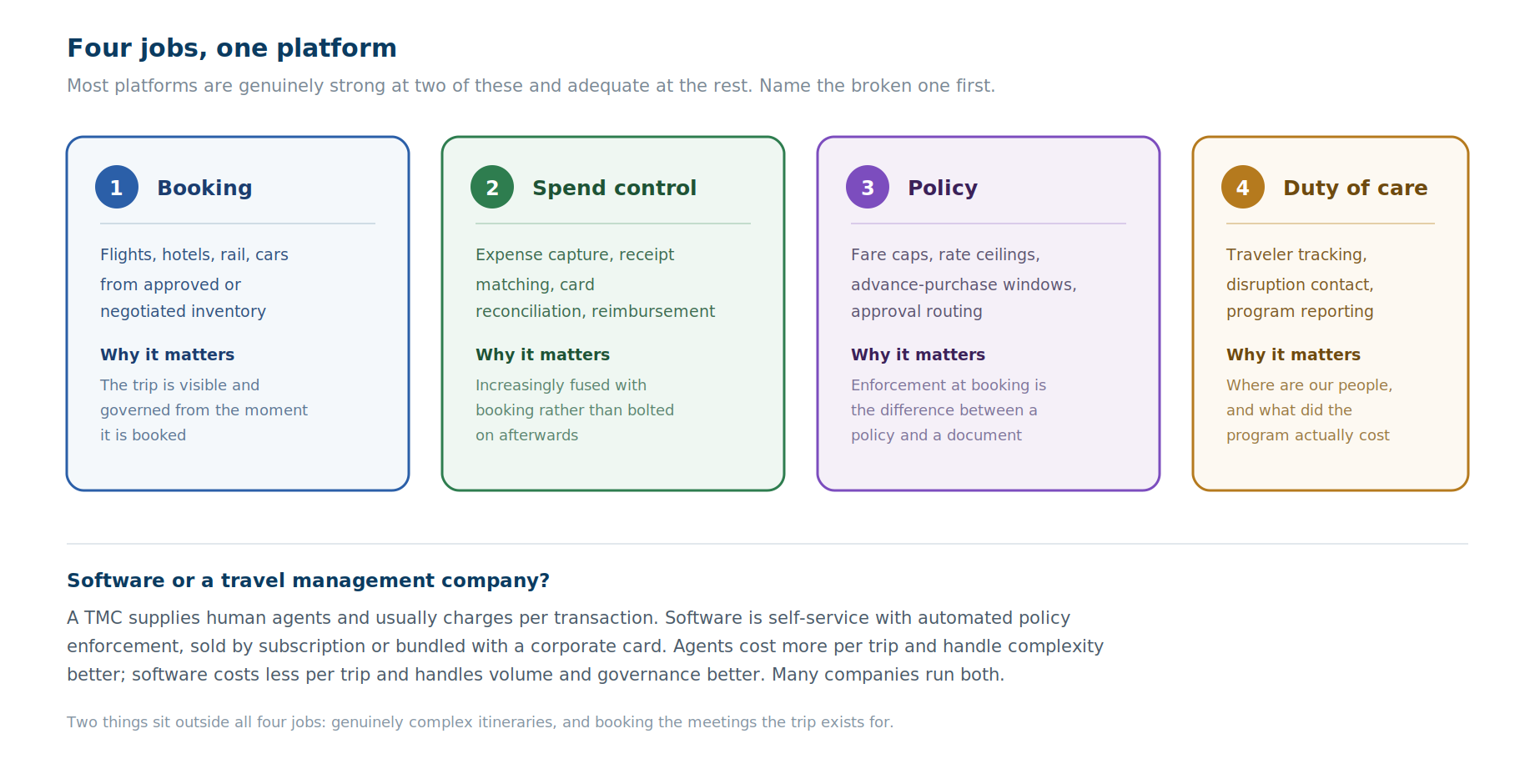
Strip away the feature lists and the category does four things.
Booking. A self-service interface where employees book flights, hotels, rail and cars from inventory the company has negotiated or approved, rather than from a consumer site. The point is not convenience alone — it is that the booking is visible and governed from the moment it happens.
Spend control. Expense capture, receipt matching, card reconciliation and reimbursement. In 2026 this is increasingly fused with the booking side rather than bolted on, which is why several platforms in the category began as expense or corporate card products and moved into travel.
Policy and approvals. Rules applied at the point of booking — fare class caps, hotel rate ceilings, advance-purchase windows, approval routing above a threshold. Enforcement at booking is the difference between a policy and a document.
Duty of care and reporting. Knowing which employees are where, being able to reach them during a disruption, and being able to answer what the program cost and where it leaked.
Software or a travel management company?
Worth settling early, because the two get compared as if they were the same purchase. A travel management company (TMC) supplies human agents who book and support travel, typically charging per transaction. Travel management software is a self-service platform with automated policy enforcement, sold on subscription or bundled with a card product.
The line has blurred — several software platforms now offer 24/7 human support, and several TMCs have credible software — but the underlying trade is unchanged: agents cost more per trip and handle complexity better; software costs less per trip and handles volume and governance better.
Why the 2026 buying case is different
Here is the number that should shape your shortlist, and it is not the one most articles in this category quote.
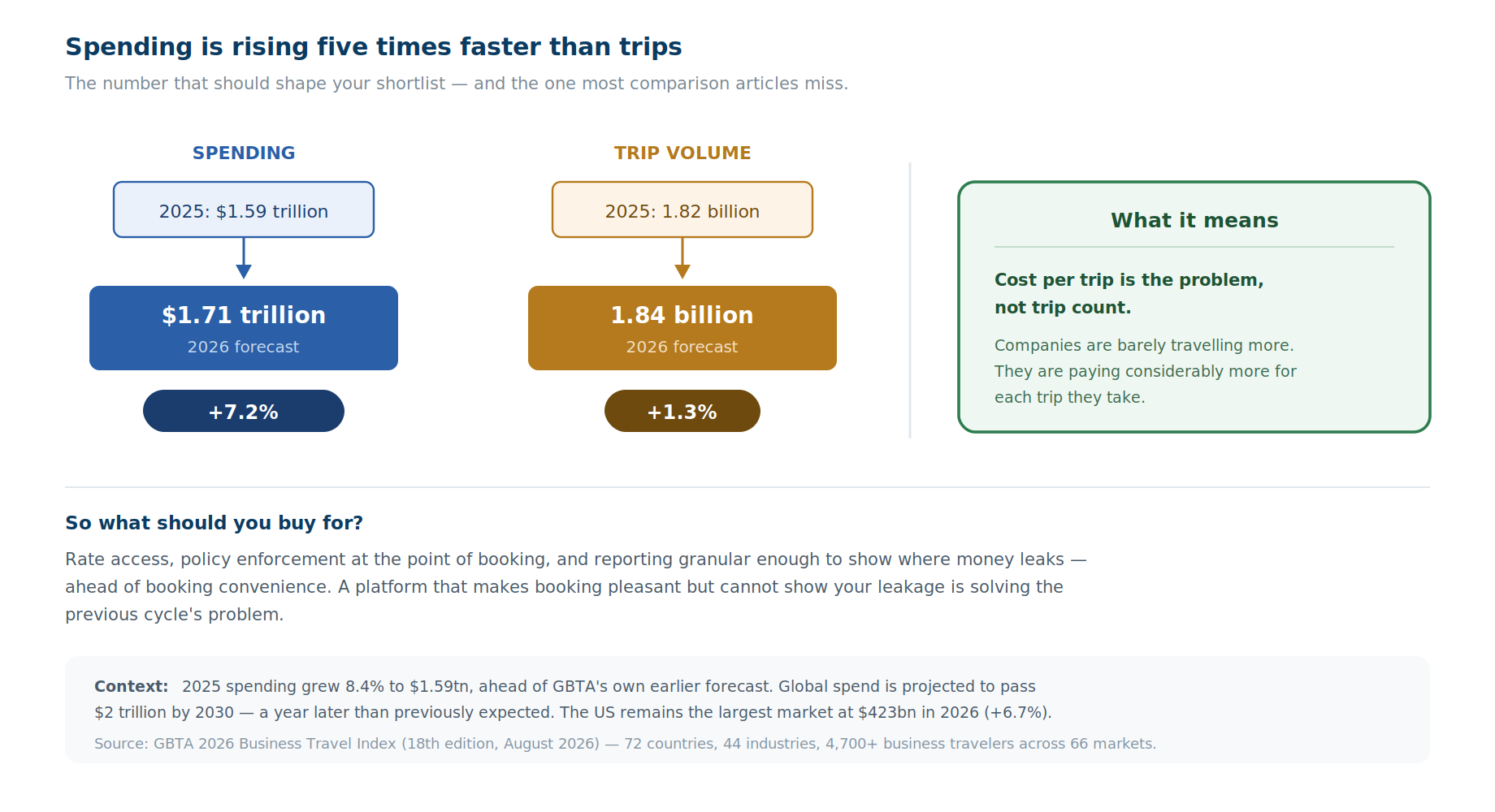
The 2026 GBTA Business Travel Index — the 18th edition, covering 72 countries and 44 industries, with survey input from more than 4,700 business travelers across 66 markets — forecasts global business travel spending of $1.71 trillion in 2026, up 7.2%. In the same report, and for the first time, GBTA projected trip volume: approximately 1.84 billion trips, up just 1.3% from an estimated 1.82 billion in 2025.
Read those two together. Spending is rising more than five times faster than the number of trips. Companies are not travelling much more; they are paying considerably more per trip, driven by transportation and accommodation prices rather than by appetite. GBTA CEO Suzanne Neufang framed it as companies being "increasingly more selective and productivity-focused" rather than stepping back from travel.
For context on the base: 2025 spending grew 8.4% to $1.59 trillion, ahead of GBTA's own earlier forecast, and the association projects the market to pass $2 trillion by 2030 — a year later than it previously expected. The United States remains the largest single market, with domestic and international outbound spending projected at $423 billion in 2026, up 6.7%.
What this means for buying. If cost per trip is the pressure rather than trip count, the features that matter move down the list from booking convenience toward rate access, policy enforcement at the point of sale, and reporting granular enough to show where money actually goes. A platform that makes booking pleasant but cannot show you your leakage is solving last cycle's problem.
The main travel management software platforms
Grouped by the kind of buyer they fit rather than ranked, because the category has no single best tool — the enterprise answer and the twelve-person-startup answer are genuinely different products.
Enterprise travel programs
SAP Concur is the incumbent for large, complex programs, and the one most often already embedded in a finance stack. Strengths are compliance workflows, audit depth and integration with SAP's wider financial estate. The trade-off is implementation effort and an interface that reflects its age relative to newer entrants.
Egencia, now part of American Express Global Business Travel, targets multinationals with negotiated-rate programs, duty-of-care requirements and traveler tracking as standard. It integrates with Concur for expense, and pricing is custom — typically for organizations of 500+ employees or with substantial annual travel volume. There is no self-serve signup, so procurement and implementation run on an enterprise timeline.
CWT and BCD Travel are established global TMCs with software layers, appropriate where you want an agent-supported program at scale rather than a purely self-service tool.
All-in-one mid-market platforms
Navan (formerly TripActions) combines booking, expense and corporate cards on one platform with a consumer-grade interface, and is now a public company. It is the common shortlist entry for companies that want travel and expense unified without an enterprise procurement cycle.
Perk — rebranded from TravelPerk in November 2025 — unites travel and spend management and has moved deliberately beyond booking. The company acquired Chicago TMC AmTrav and Swiss expense platform Yokoy, raised a $200 million Series E, and now runs dual headquarters in Boston and London with 1,800+ employees serving over 10,000 companies. Worth knowing the name change: many comparison articles still list it as TravelPerk.
Spotnana is travel-as-a-service infrastructure rather than a front-end product for most buyers — notable because other platforms are built on top of it, Brex's global travel capability among them. Relevant if you are evaluating what sits underneath a vendor's booking experience.
Finance-led, card-first platforms
These began as spend or corporate card products and added travel, which shows in what they optimize for.
Brex offers consumer-grade booking on web and mobile with 24/7 support, corporate cards, bill pay and expense on one platform. Per its own materials, its global travel capability is built on Spotnana. Generally positioned for growth companies under about 1,000 employees.
Ramp integrates travel booking, expense management and corporate cards, with automated features like rebooking hotels when refundable rates drop and surfacing cheaper comparable fares at booking. Ramp's own published pricing lists an unlimited free tier with Ramp Plus at $15 per user per month. Ramp is candid in its own comparison that it is not a full-service TMC and is best suited to domestic travel, with thinner support for employees based outside the US.
TravelBank and Zoho Expense sit in similar territory — expense-first platforms with integrated booking, policy enforcement and reporting, generally attractive on price for smaller and mid-market teams.
Lightweight and SMB options
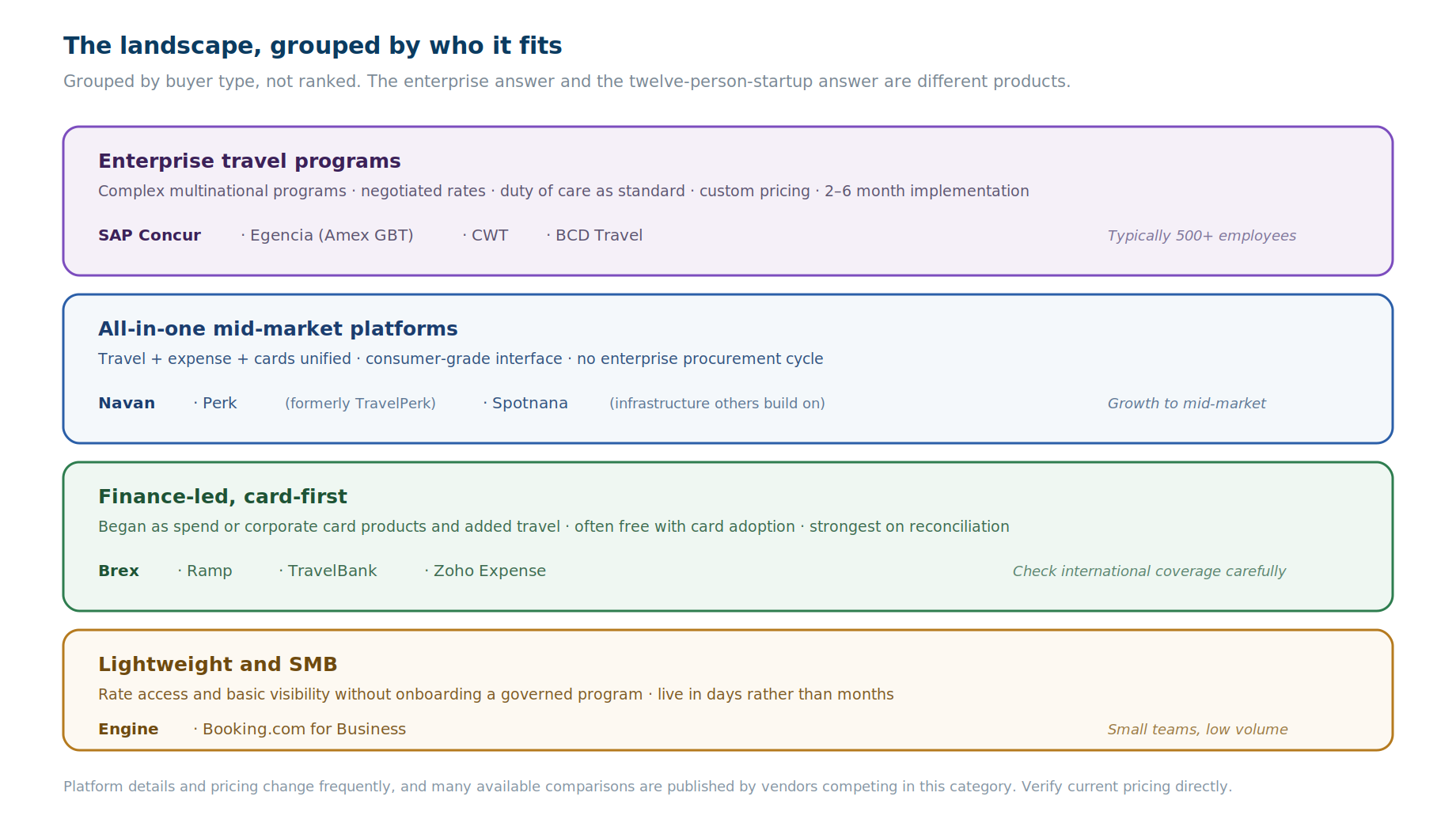
Engine runs a membership model, with annual fees reported starting around $450 per company and no booking fees, aimed at teams that mainly need hotel rate access rather than a governed program.
Booking.com for Business is the low-friction option for small teams that want negotiated-ish rates and basic trip visibility without onboarding a platform.
Platform details and pricing in this category change frequently, and several of the comparison sources available are published by vendors competing in it. Verify against each vendor's current pricing page before shortlisting.
How the pricing models differ
This is where most comparisons go wrong. Five distinct models are in play, and a headline number from one tells you nothing about another.
|
Model |
How you pay |
Typically used by |
What to watch |
|
Free with corporate card |
No software fee; provider earns on card interchange |
Ramp, Brex, BILL Spend & Expense |
Requires adopting their card; travel depth may be thinner than dedicated tools |
|
Per user per month |
Subscription per active traveler or seat |
Ramp Plus, Zoho Expense, mid-market tiers |
Whether "user" means every employee or only those who travel |
|
Per booking |
Transaction fee on each trip booked |
TMCs and agent-supported models |
Adds up fast on high-volume, low-value trips |
|
Annual membership |
Flat company fee, no booking fees |
Engine |
Whether inventory and rate access justify the flat fee |
|
Custom enterprise |
Negotiated annual contract |
Concur, Egencia, CWT, BCD |
Implementation cost and timeline, often 2–6 months |
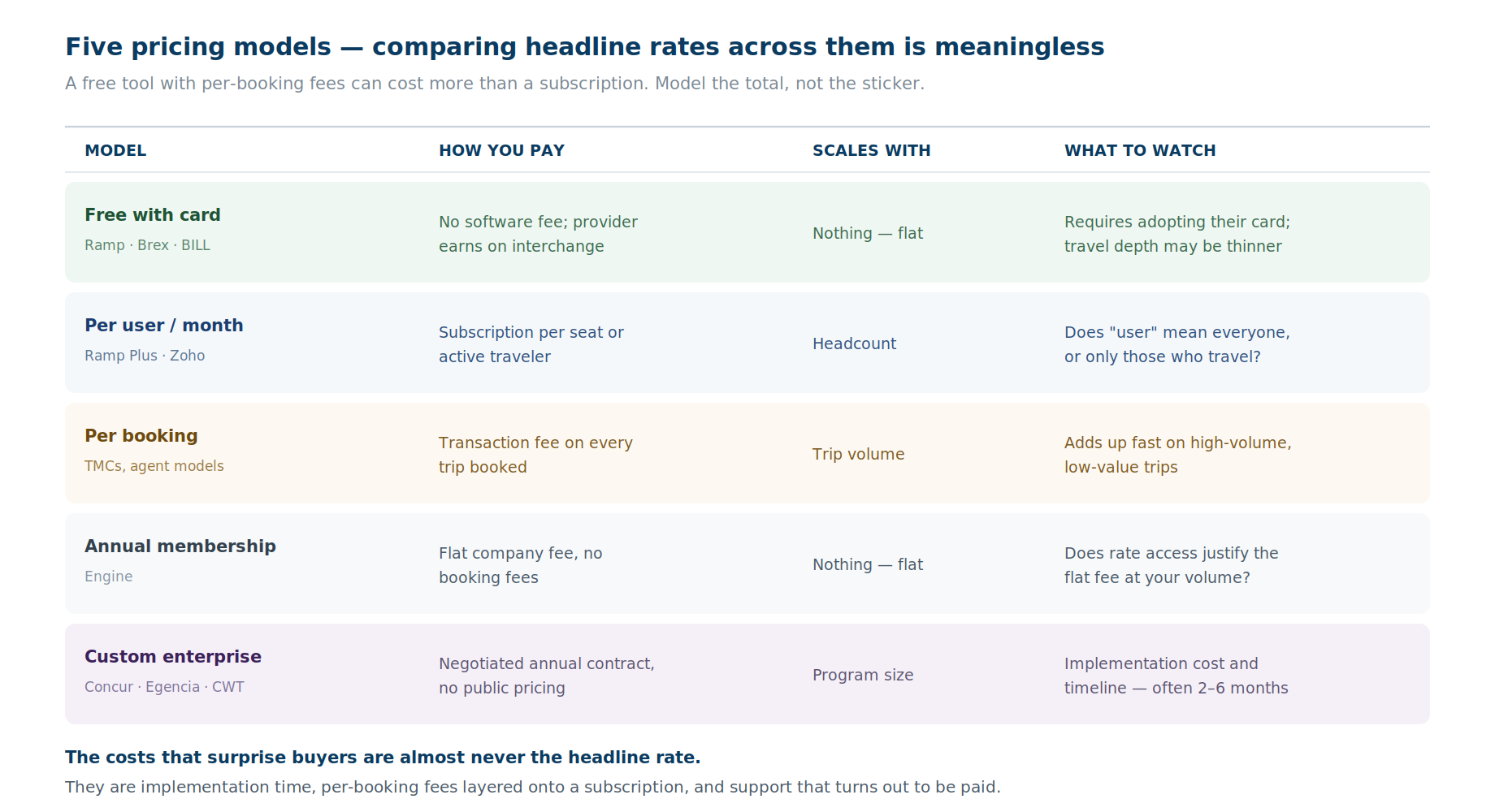
Read the right-hand column before the pricing column. The costs that surprise buyers in this category are almost never the headline rate — they are implementation time, per-booking fees layered on a subscription, and support that turns out to be paid.
One genuine saving worth quantifying in your own numbers: negotiated corporate rates are commonly cited as running 15% to 25% below consumer pricing, a figure published by businesstravel.com, itself a platform in the category. Whether you realize that depends on your travel mix and volume, so treat it as a hypothesis to test against two or three real recent trips rather than a promise.
What to look for
Work through these in order. The first one that produces a firm answer usually narrows the field fast.
- Which of the four jobs is actually broken? Booking friction, spend leakage, policy compliance, or duty of care. Buying for all four at once is how companies end up over-tooled.
- Does policy enforce at booking, or report after it? Post-hoc reporting tells you what went wrong; enforcement prevents it.
- How does it handle your travel mix? Several strong platforms are meaningfully weaker on international, multi-leg or international-to-international itineraries. Ask directly.
- What is the support model, and is it included? 24/7 human support during a disruption is the feature that gets judged hardest and priced most quietly.
- Does it fit the finance stack you already run? A travel tool that does not reconcile cleanly against your card and accounting systems creates work rather than removing it.
- What is the real implementation timeline? Enterprise platforms commonly run two to six months. Self-serve tools can be live in days. That gap matters more than most feature differences.
- Can employees actually be tracked and reached? If duty of care is a genuine obligation for you, verify how traveler location is sourced and how alerts reach people.
- What does reporting show at the trip level? Program-level dashboards are common; per-trip cost breakdowns that survive an audit are less so.
On AI features
Every platform in this category now markets AI, and the honest position is that adoption is early. A GBTA poll from October 2025, cited in a 2026 SMB comparison from businesstravel.com, found 33% of travel buyers and 49% of suppliers and TMC professionals experimenting with autonomous or agentic AI — experimentation, not deployment at scale. Treat agentic booking claims as worth testing in a trial rather than as a differentiator you can rely on in year one.
What travel management software does not do
Two gaps come up often enough to plan around.
It does not resolve complex trips like an agent does. Self-service platforms are strong on governance and volume and weaker on genuinely awkward itineraries. Several vendors say so themselves — Ramp's own comparison recommends pairing with a TMC for complex international travel. If a meaningful share of your travel is complicated, budget for human support rather than assuming software absorbs it.
It does not book the meetings the trip exists for. This is the quieter one. A travel management platform books the flight, the hotel and the car, and reports what they cost. The meetings that justify the trip — the client visits, the partner conversations, the on-site sessions — get arranged separately, usually over email, usually across time zones, and usually by the person travelling. The itinerary and the calendar live in different systems, and the coordination between them stays manual.
For teams where that gap is the real friction — sales organizations planning multi-stop client trips, consultants coordinating on-site days, anyone booking meetings with external parties who cannot see their calendar — a scheduling and routing tool covers it. OnceHub is one option, and it is worth being clear about the scope: it is not travel management software, has no flight or hotel inventory, and does not touch expense or policy. What it does is let external parties book confirmed time against real availability, with time zones resolved automatically, which is the part of trip planning that no travel platform handles.
Neither gap is a reason to avoid the category. Both are reasons to know what you are still buying separately.
Common mistakes when buying
- Comparing pricing models instead of total cost. A free tool with per-booking fees can cost more than a subscription.
- Buying for headcount rather than travel volume. A 400-person company where 12 people travel has a small-team problem.
- Underestimating implementation. The enterprise platform you pick in Q1 may not be live until Q3.
- Skipping the disruption test. Ask what happens at 2am when a flight cancels, and who answers.
- Ignoring adoption. A governed platform employees route around produces worse visibility than no platform, because you now believe your data is complete.
- Treating duty of care as a checkbox. If it is a legal obligation in your jurisdiction, it deserves its own evaluation rather than a feature-list tick.
Conclusion
The category is mature enough that most platforms will book a trip competently. What separates them is which of the four jobs they were built around — booking, spend, policy, or duty of care — and what pricing model they use to charge for it.
The 2026 data suggests where to focus. With spending rising 7.2% against 1.3% trip growth, the platforms that earn their fee are the ones that control what each trip costs and show you where the money went, not the ones with the smoothest booking flow. Start by naming which of the four jobs is actually broken, match that to the right group of platforms, and then compare total cost rather than headline pricing.
And whatever you choose, note what stays outside it: complex itineraries still benefit from human agents, and the meetings your trips exist for still need booking somewhere — whether that is a scheduling tool like OnceHub or a person with a spreadsheet.
Frequently asked questions
What is travel management software?
Travel management software is a platform that centralizes corporate travel: booking flights, hotels and cars from approved inventory, capturing expenses, enforcing travel policy at the point of booking, routing approvals, tracking traveler location for duty of care, and reporting on program spend. It replaces the combination of consumer booking sites, spreadsheets and email approvals most companies start with.
What is the difference between travel management software and a TMC?
A travel management company supplies human agents who book and support trips, typically charging a fee per transaction. Travel management software is a self-service platform that enforces policy automatically, sold by subscription or bundled with a corporate card. Agents handle complex itineraries better; software handles volume, governance and reporting better. Many companies use both.
How much does travel management software cost?
It depends entirely on the pricing model. Some platforms are free if you adopt their corporate card and earn on interchange instead. Others charge per user per month, per booking, or a flat annual membership. Enterprise platforms are custom-quoted and add implementation cost that often runs two to six months. Compare total cost across a year of your actual travel rather than headline rates.
Which travel management software is best for a small business?
Small teams generally do better with self-serve tools that go live in days than with enterprise platforms requiring procurement cycles. Card-first platforms with free tiers and membership-based hotel booking tools are common starting points. The practical constraint for SMBs is often not price but onboarding: enterprise vendors typically sell through annual negotiated contracts with no public pricing or self-serve signup.
Do I need travel management software if only a few employees travel?
Often not immediately. The case strengthens when you cannot answer basic questions — what did travel cost last quarter, is policy being followed, where are our people right now. If a handful of trips a year are booked on consumer sites and reconciled manually, the overhead of a platform may exceed the benefit. Volume and governance need, not headcount, is the trigger.
What features matter most in travel management software?
Policy enforcement at the point of booking, expense capture that reconciles against your card and accounting systems, support that is genuinely available during disruptions, traveler tracking if duty of care applies to you, and trip-level reporting rather than only program-level dashboards. Booking interface quality matters for adoption but is rarely the deciding factor.
Is business travel still growing in 2026?
Spending is, considerably faster than trip volume. GBTA's 2026 Business Travel Index forecasts $1.71 trillion in global business travel spending, up 7.2%, against approximately 1.84 billion trips, up only 1.3%. The gap reflects rising transportation and accommodation prices rather than more travel, which is why cost control has moved ahead of booking capacity as a buying priority.
Sources
- GBTA 2026 Business Travel Index (BTI) Annual Global Report and Forecast, released August 2026 — global business travel spending forecast at $1.71 trillion for 2026 (up 7.2%); first-ever volume projection of approximately 1.84 billion trips (up 1.3% from an estimated 1.82 billion in 2025); 2025 spending grew 8.4% to $1.59 trillion; spending projected to pass $2 trillion by 2030. 18th edition, developed with Rockport Analytics, covering 72 countries and 44 industries with survey input from 4,700+ business travelers across 66 markets. https://gbta.org/global-business-travel-spending-to-hit-record-1-71-trillion-in-2026-while-trips-reach-1-84-billion-says-gbta-forecast/
- Business Travel News, GBTA Projects 2026 Spending Growth as Business Travel Volume Lags (August 2026) — US domestic and international outbound business travel spending projected at $423 billion in 2026, up 6.7%, the world's largest single market. https://www.businesstravelnews.com/Intelligence/GBTA-Projects-2026-Spending-Growth-as-Business-Travel-Volume-Lags
- Perk press release, TravelPerk rebrands to Perk (4 November 2025) — name change, dual Boston and London headquarters, unified travel and spend platform. Corroborated by Business Travel News Europe and Skift, which add the AmTrav and Yokoy acquisitions, $200 million Series E, 1,800+ employees and 10,000+ customers. https://www.perk.com/press-release/travelperk-rebrands-to-perk-the-intelligent-platform-powering-real-work/
- Ramp, Travel Management Tools (July 2026) — vendor-published: Ramp's own pricing (unlimited free tier, Ramp Plus $15/user/month), automated hotel price-drop rebooking and flight savings features, and its own stated limitations on complex international travel and non-US employees. https://ramp.com/blog/travel-management-tools
- Brex, Best Business Travel Management Software Platforms (April 2026) — vendor-published: positioning for companies under approximately 1,000 employees; global travel capability built on Spotnana. https://www.brex.com/spend-trends/corporate-travel-management/best-business-travel-management-software-platforms
- Tekpon, Best Corporate Travel Management Software (March 2026) — third-party compiled: Engine membership pricing from around $450 per company annually; Egencia custom pricing and typical 500+ employee threshold. https://tekpon.com/insights/saas-operations/strategy/best-corporate-travel-management-software/
- businesstravel.com, Best Business Travel Management Software for Small & Mid-Sized Businesses in 2026 (April 2026) — vendor-published: negotiated corporate rates commonly 15%–25% below consumer pricing; cites a GBTA October 2025 poll finding 33% of travel buyers and 49% of suppliers and TMC professionals experimenting with autonomous or agentic AI. https://www.businesstravel.com/blog/best-business-travel-management-software-for-small-and-mid-sized-businesses-in-2026
- Gartner Peer Insights, Corporate Travel Management Software — practitioner reviews and category definitions used for cross-checking platform positioning. https://www.gartner.com/reviews/market/corporate-travel-management-software
A note on sourcing: a large share of the "best travel management software" articles available are published by vendors competing in this category, and they are labelled as vendor-published above where used. Market-level figures in this guide come from GBTA, the industry's trade association, rather than from vendor estimates. We have used GBTA's current 2026 index rather than the $1.5 trillion figure still circulating in many comparison articles, which reflects an earlier forecast.
Disclosure: OnceHub publishes this guide. OnceHub is a scheduling and routing platform, not travel management software — it has no travel inventory and no expense or policy functionality — and it is mentioned only in the specific context of meeting coordination, which travel platforms do not cover. Platforms named are grouped by buyer fit and are not ranked.