

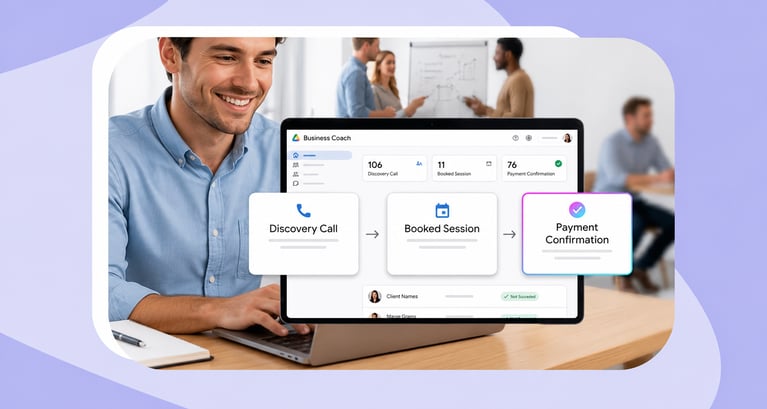
Starting an online coaching business takes three phases. Define your niche and offer by naming a specific problem you solve for a specific audience. Set up a minimal tech stack: a domain, a scheduling and intake system, video, and payments. Then acquire your first clients through your existing network rather than through a website you have not built yet.
The barrier to entry has genuinely changed. You no longer need an office, a marketing budget, or a course to sell. You need a laptop, defined expertise, and about four pieces of software.
According to the 2025 ICF Global Coaching Study, conducted by PwC across 127 countries, the coaching profession generated $5.34 billion over the past year, with 122,974 practitioners worldwide, a 15% increase in practitioner numbers since 2023. That growth cuts both ways. Demand is real, and so is competition.
Most advice for new coaches gets the order wrong. It tells you to build a website, film a course, and design a logo before you have spoken to a single paying client. That sequence is expensive, slow, and it delays the only thing that validates your business: someone paying you to solve their problem.
Here is the order that actually works.
Phase 1: The strategy
Everything later depends on getting two decisions right here: who you help, and what they get.
Choose a niche narrow enough to be uncomfortable
Do not be a life coach. Be a career transition coach for mid-level engineers.
The formula worth writing down: I help [specific audience] achieve [specific result] without [specific pain point].
The instinct to stay broad comes from a fear of turning people away. In practice, broad positioning turns everyone away, because nobody reads "life coach" and thinks that person understands my exact situation. A narrow niche is not a smaller market. It is a market where you can be the obvious choice rather than one of 122,974 options.
Test yours against one question: could a prospect repeat your positioning to a friend accurately after hearing it once? If not, it is still too vague.
Sell a result, not hours
Stop selling sessions. Sell a 90-day outcome.
Structure it plainly. Month one does this. Month two does that. Month three delivers the result. A prospect buying "twelve hours of coaching" is comparing your hourly rate against every other coach. A prospect buying "a signed offer in a new industry within 90 days" is comparing your programme against the cost of staying stuck.
This also protects you later. When you get better and faster, hourly pricing punishes you for it.
Price to validate, then raise
A practical starting point for a first 12-week programme is $1,000 to $1,500. For example, one coach began at $1,200 to land initial clients quickly, then leveraged three strong testimonials to comfortably raise her rate to $2,000 for subsequent cohorts. That is high enough to filter out people who were never going to commit, and low enough that you can raise it once you have three testimonials. Do not start at $200. Underpricing tends to attract the clients who need the most hand-holding, and you will resent the work by week four.
One detail from the same ICF research that new coaches should notice: 59% of coaches expect revenue growth in the coming year, and they expect it to come from more clients and more sessions rather than higher fees. Volume before price increases is the normal path.
Phase 2: The tech layer
Here is where most new coaches lose two months and several hundred dollars.
The trap is buying fifteen subscriptions. A course platform, a CRM, an email marketing suite, a funnel builder, a community tool, a project tracker. You do not need any of that before your first client. You need four things.
Tool 1: A domain and a single page
Buy a professional domain. Use a one-page site builder, or in the very early days, point people at a well-written LinkedIn profile.
That is the entire requirement. A five-page website with a blog and an about page is a project you can do in month four, funded by client revenue, rather than a project that delays month one.
Tool 2: Scheduling and intake
This is the one that earns its place, and the one most new coaches get wrong by treating it as a calendar link.
The mistake: you paste a generic booking link in your bio, and it works. Calls get booked. Then you spend four hours a week on discovery calls with people who cannot afford the programme, are not ready to start, or need something you do not offer. Your calendar is full, and your revenue is not.
The fix is asking questions before offering a time, not after. Ask what they are trying to change, what their timeline looks like, and whether they are ready to invest in working with someone. Then let the answers decide what happens next.
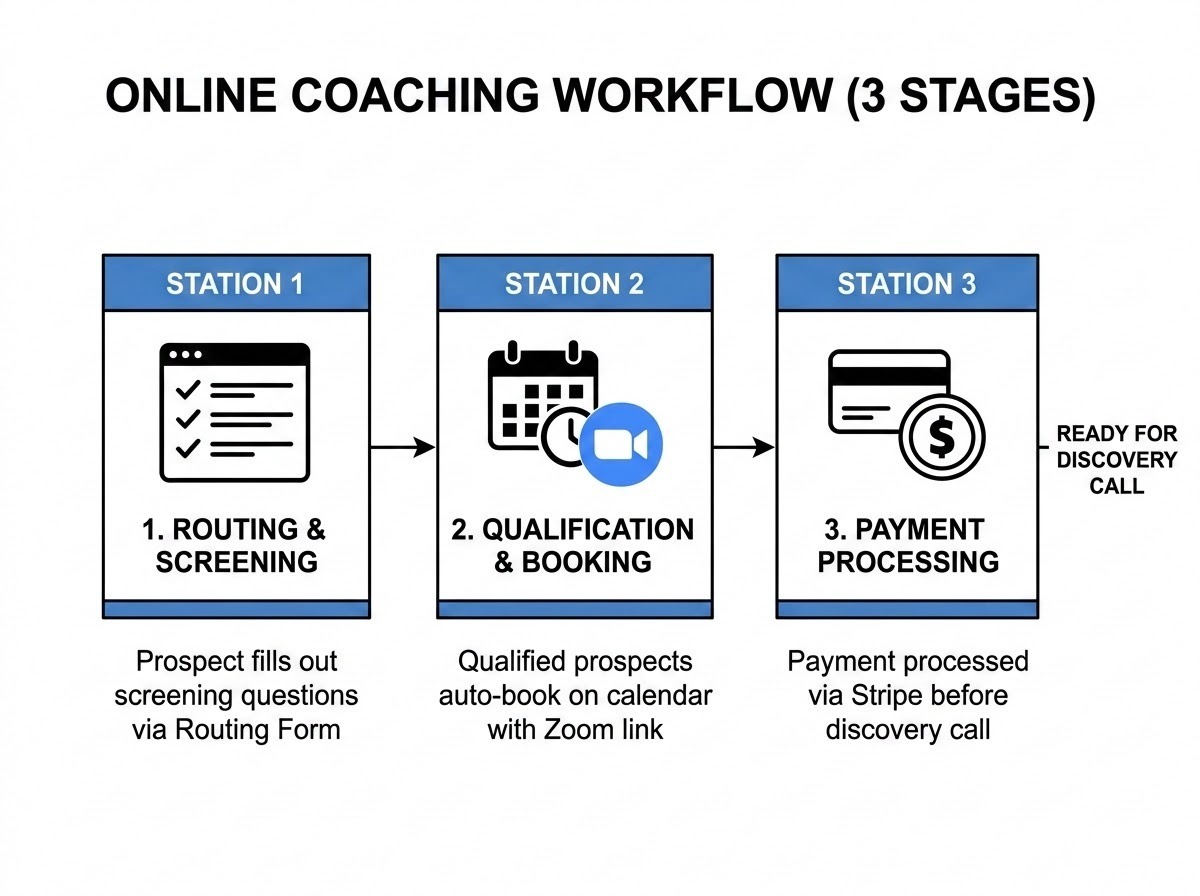
That is what Routing Forms do in OnceHub. You build a short set of screening questions with branching logic, so a strong-fit prospect goes straight to your discovery call calendar, and someone who is not ready gets redirected to a resource instead of a calendar slot. Nobody is rejected. They are just routed somewhere more useful than a call that was never going to convert. There is a longer explanation of how screening forms evolved from static submission boxes into qualification layers in our guide to smart forms.
For inbound phone inquiries, a missed discovery call can be caught the same way using OnceHub's AI Phone Agent to qualify callers and schedule them automatically.
Three other things matter here more than they sound:
Time zones: If you coach internationally, you will do mental arithmetic constantly, and eventually you will get it wrong. Automatic time zone conversion removes the whole category of error.
Availability rules: Buffers between sessions, daily limits, minimum notice. Set these at the start rather than after you have burned out. A booking calendar with proper buffers is the difference between a full week and an unmanageable one.
Where the booking is written: When availability is checked, and the booking is written in the same system, there is no window where two people can be offered the same slot. It sounds like a technical footnote until it happens with a paying client. Learn more on our Scheduling Engine product page or read our guide to double booking.
Being straight about cost: OnceHub's free Basic tier covers one user and one booking link, which is enough to take bookings from day one. Routing Forms sit on the paid Route plan at $19 to $23 per seat monthly. If you are a pre-first-client, start free and upgrade when discovery call volume justifies screening.
Tool 3: Video
Connect Zoom or Google Meet to your scheduling tool so a unique meeting link generates automatically at booking. Manual link creation is a small task that becomes a daily annoyance.
One practical note: Zoom's free plan caps meetings at 40 minutes, which is awkward if your sessions run 50 or 60. Google Meet's free tier allows longer one-to-one calls. Check the limit against your actual session length before committing.
Tool 4: Payments
Stripe is the default for good reason. No setup fee, no monthly fee, and a standard US rate of 2.9% plus $0.30 per successful card charge. You pay only when you get paid.
Two things new coaches miss. First, for larger invoices, ACH bank debit costs 0.8% capped at $5, so a $1,200 programme fee costs $5 to collect by bank transfer versus about $35 by card. Worth offering. Second, international cards add 1.5% and currency conversion adds another 1%, which matters if your clients are global.
You can also collect payment through your scheduling tool for paid consultations, which removes a separate invoicing step.
The fifth thing, once you have clients
A dedicated channel for between-session support. Slack, WhatsApp, or Voxer. Do not set this up before you have someone to talk to, and do set boundaries on response times when you do.
Phase 3: Getting your first clients
This is the phase people delay longest, usually by finding more things to build. The work here is conversations, not setup.
Validate before you build
Get three beta clients before you build anything expensive.
Charge them a reduced rate in exchange for detailed feedback and a testimonial. You will learn what your programme actually needs in week two of delivering it, and that lesson is worth more than a video course you designed in advance and then have to rebuild.
The hand-raiser post
Your first clients almost certainly already know you. The problem is announcing it without sounding like a pitch.
The structure that works: name the problem you solve, describe who has it, share one specific insight that proves you understand it, then invite people to raise a hand rather than book a call. Something like "if this sounds familiar, comment or message me and I will send you a short breakdown of how I would approach it."
The distinction matters. Asking someone to book a 45-minute call with a stranger is a big ask. Asking them to type one word is not, and the conversation that follows is warmer than any cold booking.
Running the discovery call
Once they book through your link, the call itself has a simple structure.
Where are they now? Where do they want to be? What is stopping them? Then present your programme as the bridge between the second and third answers.
Most new coaches talk too much on this call. The ratio should be roughly 70% listening. If you have screened properly beforehand, you already know the basics, which means you can spend the call going deeper rather than collecting facts you could have gathered in a form.
Phase 4: Systems and scaling
This phase starts once your calendar fills up, which is a better problem than the last one but still a problem.
Testimonials are the currency
Ask at the moment of visible progress, not at the end of the engagement. The end is when people are busy moving on. The moment they say "I did not think that would work" is when the testimonial is honest and specific.
Ask for the specific result rather than a general compliment. "She was great" persuades nobody. "I moved from ops to product management in eleven weeks" persuades everyone in that situation.
From one-to-one to one-to-many
Once your calendar is full, you have three options: raise prices, work more hours, or serve more people per hour.
Group coaching is the usual next step (for a deeper dive, see our Scheduling Software for Coaches: A 2026 Guide to Scaling Your Practice). If you run several offers or several coaches, Booking Hubs group multiple booking calendars under one organised page, so a prospect picks the programme first and lands on the right calendar rather than guessing between links.
Protect your time deliberately
The failure mode for a growing coaching practice is not too few clients. It is a calendar with no gaps, back-to-back sessions, and no preparation time.
Your scheduling rules are the mechanism. Buffers between sessions, a daily cap on calls, blocked mornings for deep work. Set them as rules rather than intentions, because an intention loses every argument with a full inbox.
Start with the booking link, not the website
The first thing worth setting up is not your website. It is what decides who gets on your calendar.
OnceHub is free for one booking link, which is enough for your first client.
Frequently asked questions
How much does it cost to start an online coaching business?
Less than most people expect. A domain runs roughly $10 to $20 a year. Scheduling can start free and rise to around $19 to $23 per seat monthly once you want screening and routing. Video is free or in the mid-teens monthly depending on session length. Stripe charges nothing upfront and takes 2.9% plus $0.30 per card transaction. Realistically, you can be operational for under $50 a month, and most of that is optional until you have paying clients.
Do I need a certification to become an online coach?
Not legally in most markets. Coaching is largely unregulated, which is why the field has grown so quickly. Certification matters in specific situations: corporate and HR buyers increasingly list ICF, EMCC or ILM credentials as requirements in tenders, and some niches expect it. For direct-to-consumer coaching, results and testimonials carry more weight than credentials. If you are adjacent to clinical work, licensing rules may genuinely apply, so check your jurisdiction.
How do I get my first online coaching client?
Through someone who already knows you. Announce your offer to your existing network with a specific problem statement, invite people to respond rather than book, and take the resulting conversations to a discovery call. Three beta clients at a reduced rate in exchange for testimonials is a faster and more reliable start than content marketing to strangers.
What is the best online coaching platform for scheduling?
Look for three things: the ability to ask qualifying questions before a slot is offered, automatic time zone handling, and availability rules you control. The first is where most tools stop short, since many collect information only after the booking is confirmed, by which point the qualification cannot change anything. OnceHub's Routing Forms screen first and route based on the answers, and there is a free tier to test the workflow before paying.
How long does it take to get to the first paying client?
Faster than building a website, slower than the internet suggests. If you already have relevant expertise and a network, 30 days is realistic. What takes the longest is not the tech setup, which is an afternoon. It is deciding on a niche narrow enough to be repeatable and an offer specific enough to be worth paying for.
**OnceHub published this guide, and OnceHub's scheduling and routing tools appear in it. Third-party pricing was compiled from vendor pricing pages as of mid-2026 and changes often, so verify before committing.