

How to Turn Every Missed Call into a Confirmed Booking
Most businesses are meticulous about tracking their growth metrics. They can tell you exactly how many leads came from a LinkedIn ad, the conversion rate of their latest email sequence, and the total value of their current sales pipeline.
Yet, almost none of them track revenue leakage from missed calls.
In many organizations, missed calls are treated as "operational noise", a minor inconvenience or a service failure to be handled later. This perspective is a mistake. A missed call isn't just a notification on a screen; it is lost demand.
Every missed call represents a prospect who has already done the hard work for you: they’ve researched your brand, evaluated their need, and already chosen to act. When you don't pick up, you aren't just missing a conversation; you are ignoring a customer at the exact moment they are ready to convert.
Why Missed Calls Are Critical Moments of Truth for Client Experience
To understand why a missed call is so damaging, we have to look past the transaction and focus on the intent and emotion behind the action. In a digital-first world, picking up the phone is rarely a customer's first step; it's often their last resort.
A missed call isn't just a lost lead; it is a breakdown in service delivery. When a client or prospect dials your number, they are signaling a need that your website or automated forms couldn't satisfy.
Understanding the Service & Experience Gap
While browsing the website represents early-stage curiosity, a phone call typically signals decision-stage urgency or acute anxiety. Callers in phone-reliant industries are usually looking for:
- Immediate Resolution: They don't just want a quote; they need to know if you can solve their specific problem right now.
- Emotional Urgency: Their need is pressing—often stressful—meaning an email or form-fill delay feels like terrible customer service.
- Reassurance: In high-stakes situations, people need human validation to know they are in good hands before committing or trusting you with an ongoing issue.
The Hidden Cost of Doing Nothing
A missed call is often viewed as a task to be handled later. However, the interval between the missed call and the response is where revenue dies. When a business fails to answer, the customer’s journey doesn’t pause—it pivots.
What Actually Happens After a Missed Call
- The Silent Exit: The vast majority of callers, up to 80%, do not leave a voicemail. They simply hang up and move on.
- The Voicemail Black Hole: Even when a caller leaves a message, they rarely receive a timely callback. By the time a human follows up, the prospect has often already found another solution.
- The Competitor Pivot: In high-intent scenarios, the caller immediately contacts the next business on their list. Your missed call is your competitor’s easiest win.
- Loss of Momentum: Every minute of silence acts as a friction point, causing the prospect to lose the "buying energy" they had when they initially reached out.
The Impact of Delay
Delayed follow-ups do more than just stall a sale; they actively reduce trust. In the mind of a high-intent caller, responsiveness is a proxy for the quality of service they can expect. If a business is too busy to take a call at the point of purchase, the customer assumes they will be too busy to provide support afterward.
Furthermore, manual callback systems create a structural lag. Relying on a staff member to check messages and manually dial back leads ensures that the response will almost always miss the peak interest window.
5 Core Strategies for Converting Missed Calls into Booked Meetings
Building a system that converts missed calls into revenue requires a shift from passive reaction to proactive strategy. To turn these high-intent moments into closed deals, follow these five core strategies.
Strategy 1: Measure Missed Call Impact First
Before you can optimize your recovery process, you must quantify the problem. Without hard data, you cannot see the revenue gap or justify the operational changes needed to fix it. Tracking these metrics is a sign of operational maturity:
- Total Inbound Calls: The baseline for your phone lead volume.
- Missed Call Percentage: The specific portion of demand currently leaking out of your system.
- Callback Time: The duration between the missed call and your first human response.
- Recovery Rate: The percentage of missed calls that eventually convert into a sale after a callback.
Strategy 2: Reduce Response Time Aggressively
In the world of inbound sales, speed isn't just a metric—it's a competitive advantage. The first business to respond to a prospect usually wins the deal.
- Define Internal SLAs: Set strict Service Level Agreements for callbacks, aiming for a 5–15-minute window.
- Real-Time Alerts: Use automated alerts to notify your team the second a call is missed.
- Priority Shift: Train your team to prioritize inbound recovery tasks over routine outbound activities; a hot lead trying to reach you is always more valuable than a cold one you are trying to reach.
Strategy 3: Replace Passive Voicemail with Action
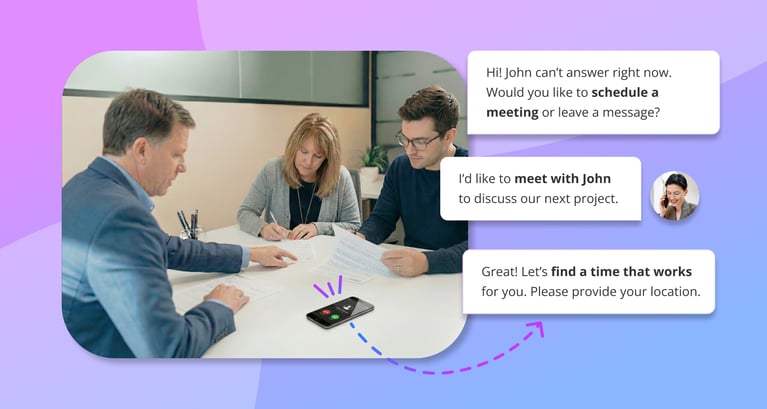
Standard voicemail is where intent goes to die. While voicemail merely records that someone called, a modern sales system should capture the transaction. This is where OnceHub Phone Booking fits naturally. Instead of a generic "leave a message" prompt, you can offer:
- Direct Scheduling Options: Give callers a dedicated number connected directly to your live booking pages.
- Structured Booking Flows: An intelligent agent gathers the necessary information and schedules the meeting instantly based on your real-time availability.
- Reduced Friction: By converting a missed call into an immediate scheduled conversation, you eliminate "phone tag" and capture the next step while the caller's intent is at its peak.
Strategy 4: Route Intelligently
Missed calls often increase when routing fails to get the caller to the right person on the first try. Not all calls carry the same weight; a new lead in the decision phase is vastly different from an existing client with a billing question.
- Department-Based Routing: Ensure sales-specific inquiries are prioritized for the sales team.
- Overflow Handling: Set up "failsafes" so that if the primary desk is busy, calls are automatically transferred to a secondary team or the Phone Booking agent.
- Time-Based Routing: Adjust your routing logic for after-hours or holidays to ensure high-intent callers are always met with an option to schedule, not a "closed" sign.
Strategy 5: Close the Loop with Automation
The ultimate objective is to remove manual lag from the sales process. When intent is preserved immediately through automation, sales velocity improves. A missed call should trigger a sequence of events:
- Instant SMS Follow-up: Send a text with a booking link if the caller is on a mobile device.
- Calendar Confirmations: Ensure the prospect receives an immediate invite to cement the commitment.
- CRM Integration: Automatically log every missed call and scheduled booking to ensure no lead is ever forgotten.
By shifting from "answering phones" to "capturing intent," you transform your missed calls from a service failure into a systematic revenue driver.
The Solution: Moving from Passive Voicemails to Active Scheduling
When a caller is in a state of high urgency or anxiety, sending them to a traditional voicemail is the fastest way to lose them. A passive "leave a message" prompt offers zero reassurance and forces the customer to wait.
The solution to tackling this experience gap is to replace the passive "beep" with an active resolution. By implementing an intelligent, automated scheduling system, you can capture the caller's intent the moment they reach out. Instead of hanging up to call a competitor, the caller interacts with a system that allows them to instantly secure a guaranteed time on your calendar. They get immediate relief knowing their problem is in the queue, and you secure the revenue without having to answer the phone.
High-Stakes Industry Scenarios: How Automated Booking Saves the Relationship
Based on industry research, context is everything. Here are the scenarios where a missed call severely damages the client experience, and where capturing that intent with a scheduled meeting—like OnceHub’s Phone Booking—saves the relationship:
- Insurance (Complex Claims & Coverage / Policyholder Trust): A policyholder is calling to navigate a complicated, stressful claim or urgently update coverage to close a new business contract. They aren't in physical danger, but their financial anxiety is high. If they hit a passive voicemail, they feel abandoned by the company that is supposed to protect them. Phone Booking lets them instantly lock in a dedicated review call with an agent, turning their frustration into immediate relief.
- Finance & Wealth Management (Time-Sensitive Transactions / Client Reassurance): An existing client needs urgent help finalizing a mortgage application before a rate lock expires, or a prospect is calling to discuss a major life event (like an inheritance). They don't just need a quick chat; they need dedicated advisory time. Missing this call breaks the fiduciary bond. Allowing them to book the advisor's next available opening instantly demonstrates that you value their time and wealth.
- Medical & Health Services (High Anxiety / Patient Care): A patient is calling to schedule a crucial specialist consultation or is seeking a second opinion on a stressful diagnosis. It's not a 911 emergency, but their personal anxiety is peaking. A voicemail beep makes them feel like just another number. An intelligent agent that instantly secures a confirmed consultation slot validates their concern and preserves patient trust.
- Professional & Home Services (High-Value Estimates / Service Delivery): A homeowner is looking to book an on-site estimate for a $15,000 kitchen remodel, or needs a priority diagnostic for an underperforming HVAC system before summer hits. They want action today. If you don't answer, they will simply call the next contractor on Google. Capturing them with a scheduled arrival window secures the job before your competitor even picks up the phone.
- High-End Retail & Bespoke Services (The Rescue Sale / CX): A customer tried to finalize a custom order or book a premium service online but encountered friction and called instead. This is Active Persistence. They want to give you their money, but they need human help to finish the process. A missed call here is a guaranteed "abandoned cart." Phone Booking catches them and instantly schedules a VIP intake call, rescuing the sale and the experience.
4 Common Myths About Managing Missed Calls
When businesses finally decide to tackle their missed call problem, they often hesitate because of a few stubborn misconceptions. To build an effective, sustainable system, we need to bust these myths:
-
Myth 1: You have to answer every single call.
Reality: You don't need to be glued to your phone 24/7. You just need an automated system that captures intent and handles the moments when you aren't physically available. -
Myth 2: You need to hire more receptionists.
Reality: Adding headcount isn't the only way to scale. Intelligent scheduling acts as a 24/7 virtual force multiplier without the massive payroll overhead. -
Myth 3: Automated follow-ups feel like spam.
Reality: Aggressive, unprompted texts are spam. Instantly providing a helpful scheduling link to a customer who just tried to reach you is excellent, proactive customer service. -
Myth 4: Automation will replace your human team.
Reality: It does the exact opposite. Phone Booking empowers your team by eliminating the frustrating game of "phone tag," ensuring they walk into pre-scheduled meetings with high-intent leads.
The Strategic Shift: From Handling Calls to Capturing Intent
Maximizing sales from missed calls requires a fundamental reframe of how your organization views a ringing phone. It is a shift away from seeing a call as a simple task and toward seeing it as a digital bridge directly to your booking pages and real-time availability.
- Old mindset: “We missed the call.”
- New mindset: “Did we capture the intent?”
When you focus on the intent behind the call, your sales process becomes more agile and efficient:
- Sales recovery becomes systematic: You stop relying on manual follow-ups and start using an automated response machine to handle inquiries 24/7.
- Missed calls become measurable revenue events: You stop losing high-intent leads to the "voicemail void" and start treating every call as a quantifiable opportunity in your pipeline.
- Scheduling becomes a conversion tool: By gathering necessary information and scheduling meetings instantly, you move the prospect to the next stage of the funnel without the lag of "phone tag".
This shift ensures your business is seamlessly accessible across every channel, allowing you to bridge the gap between technology and human connection.
Turn Missed Calls Into Scheduling Moments
Capture every opportunity, even when you're in a meeting or out of the office.
Wrap Up
Missed calls are an inevitable part of doing business, but losing the revenue attached to them is not. Businesses that build systems around high-intent moments outperform those that rely solely on passive callbacks or manual recovery.
By implementing a structured scheduling mechanism, you ensure that even when you can't pick up the phone, your business never stops closing. Stop letting your high-value leads slip away. It is time to turn your phone into a powerful, automated tool for growth.
Your Next Steps:
- Audit your current missed-call volume to quantify revenue leakage.
- Evaluate whether your current voicemail is costing you conversions.
- Switch to Phone Booking to turn your missed calls into confirmed meetings.
FAQs
What percentage of callers actually leave a voicemail?
Industry data shows that up to 80% of callers will hang up without leaving a voicemail. Because modern consumers expect immediate resolution, traditional voicemail is a friction point. Instead of leaving a message, high-intent buyers will usually hang up and instantly call a competitor.
How much revenue do businesses lose from missed calls?
The exact revenue lost to missed calls depends on your industry's average customer lifetime value (LTV), but the impact is severe. For example, if your average service ticket is $1,000 and you miss just 5 potential new-customer calls a week, you are losing $20,000 in potential revenue every month.
How quickly should a business respond to a missed call?
To maximize sales recovery, businesses should respond to a missed call within 5 to 15 minutes. In sales, speed is a massive competitive advantage. Buying intent decays rapidly; the first business to engage a prospect and offer a concrete next step almost always wins the deal.
What is the best alternative to traditional business voicemail?
The best alternative to passive voicemail is an automated call-to-book system. Instead of forcing prospects into a "voicemail black hole," solutions like OnceHub’s Phone Booking allow callers to interact with an intelligent agent and instantly schedule a confirmed meeting based on your real-time availability.
Why are inbound phone calls considered high-quality leads?
Inbound phone calls are high-quality leads because they signal decision-stage intent and high urgency. By the time a prospect picks up the phone, they have usually finished their online research and are seeking immediate confirmation, human reassurance, or a time-sensitive resolution in order to finalize a purchase.
How can small businesses handle missed calls without hiring more staff?
Businesses can eliminate missed call leakage without adding headcount by implementing intelligent routing and automated scheduling agents. Tools like Phone Booking act as a virtual force multiplier, capturing caller intent 24/7 and automatically securing appointments, freeing up your team to focus on closed-won revenue.
Better scheduling starts here
No credit card required