

Criminal defense is the vertical where "does it book the appointment" is the wrong first question. The right one is what the system is permitted to say before a lawyer is involved, because the caller may be a prospective client whose disclosures are already protected, the matter may conflict with a co-defendant you already represent, and the question they open with is often one no non-lawyer may answer.
That does not mean automation has no place. Arrests happen at 2 am on a Saturday, the family calls every firm on the first page of results, and the firm that answers usually gets the retainer. Speed genuinely matters here more than in almost any other practice area.
But the honest reading of this market, including from AI vendors writing about their own category, is that the emergency call wants a human, and most of the rest of your volume does not. This guide covers what makes criminal defense intake different, the professional-responsibility constraints that apply, five options grouped by the job each does, and where the line sits.
A note on scope: this article discusses professional-responsibility considerations at a general level and is not legal advice. Rules vary by jurisdiction and change; confirm against your own state's rules and ethics opinions before deploying anything. For the wider category, see our guide to after-hours answering services.
Quick answer
- Answer the phone, but choose what answers it. Distress calls, jail calls and anything touching the facts of a matter point to a trained human. Fee questions, scheduling, existing-client calls and consultation booking automate well.
- Five options by job: legal-exclusive human intake (Answering Legal, LEX Reception), hybrid AI with human handoff (Smith.ai), premium human reception (Ruby), high-volume legal call centers (Alert Communications, Nexa), and a consultation-booking layer (OnceHub) that sits alongside whichever you choose.
- Confidentiality reaches prospective clients. ABA Formal Opinion 512 ties generative AI use to Model Rules 1.6, 1.9(c) and 1.18(b) — the last of which covers people who call and never retain you.
- No service can run your conflict check, but a well-configured one captures what you need to run it: caller's full name, opposing and related parties, jurisdiction, matter type and date of incident. In criminal defense, co-defendant conflicts make this non-optional.
- Budget honestly. Legacy human services commonly land between $300 and $1,500 a month at roughly $1.50 to $5.00 per receptionist minute; AI-native tools start far lower but carry the constraints above.
The five at a glance
|
Option |
Best for |
Human / AI mix |
Starting price |
|
Answering Legal, LEX Reception |
Firms where the crisis call is the business |
Human only, legal-trained |
LEX bills per minute; a thorough 8–10 minute intake adds roughly 12–18 per call on top of the base plan |
|
Smith.ai |
Routine volume automated, humans on the calls that matter |
Hybrid — AI screens, live agent takes over |
Per-call pricing; not publicly listed |
|
Ruby |
First-impression warmth, where budget allows |
Human only, cross-industry operators |
24/7 tier reported near $1,589/month for 500 minutes |
|
Alert Communications, Nexa |
Multi-office firms and heavy paid acquisition |
Human call center, scripted intake |
Custom, scaling with volume |
|
Non-emergency volume and consultation booking, alongside a human service |
AI only — no live agents |
Free plan for single-attorney scheduling; paid tiers published by seat |
Why criminal defense intake is different
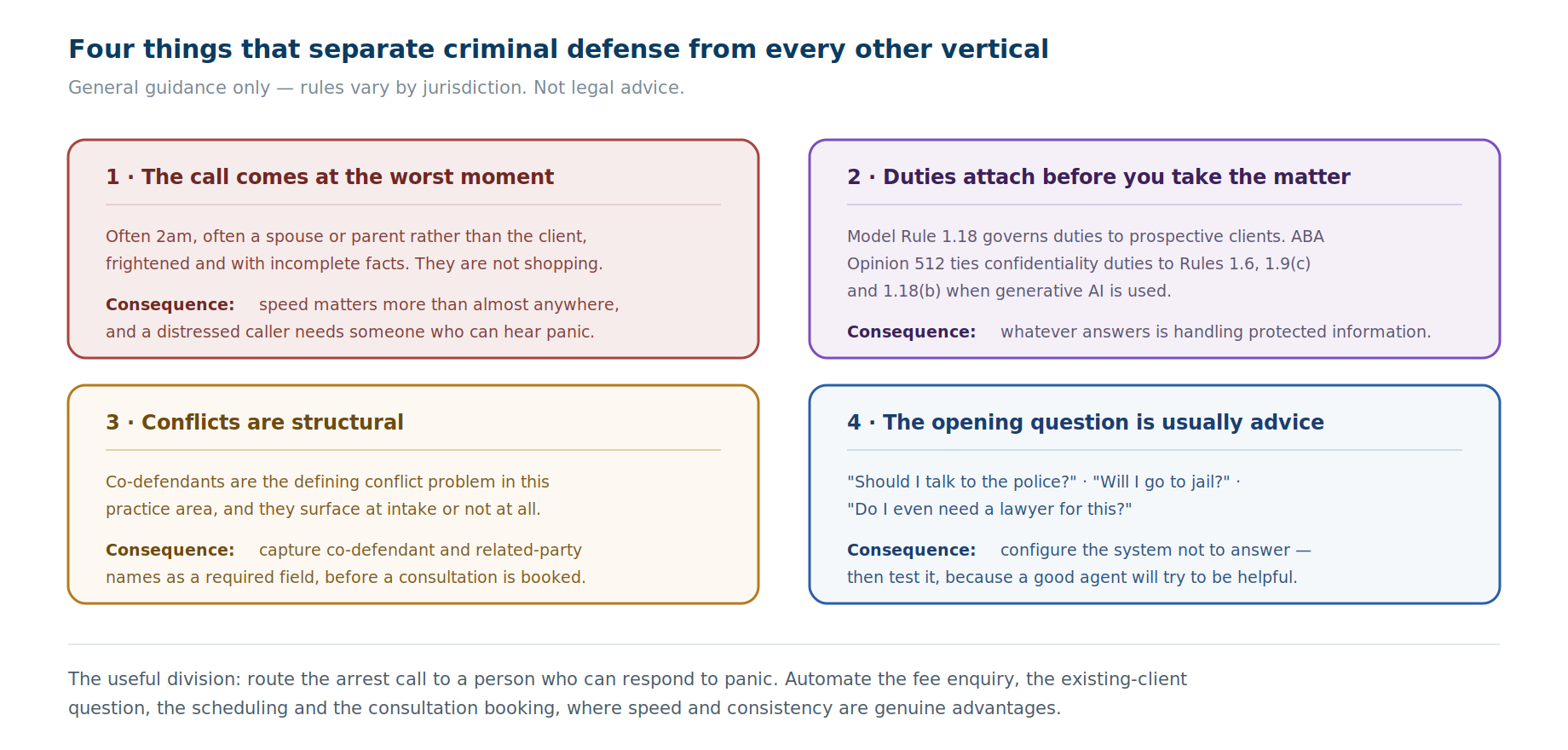
Four things separate this practice area from every other vertical in this category.
The calls arrive at the worst possible moment, from someone who is not the client. A spouse, a parent, a friend — frightened, often at 2am, frequently with incomplete facts, sometimes calling from outside a detention facility. They are not shopping. They are in crisis, and they will call the next firm within minutes if nobody answers.
Privilege and confidentiality can attach before you take the matter. Model Rule 1.18 governs duties to prospective clients, and a caller describing their situation to your intake channel is doing exactly that. Whatever hears that call is handling protected information.
Conflicts are structural, not incidental. Co-defendants are the defining conflict problem in criminal defense. An intake system that books a consultation without capturing the names of co-defendants and related parties can create a conflict your firm then has to unwind — after the prospective client has already disclosed facts to you.
The opening question is frequently one nobody but a lawyer may answer. "Should I talk to the police?" "Will I go to jail?" "Do I need a lawyer for this?" These are requests for legal advice. A non-lawyer answering service knows not to answer them. An AI agent must be explicitly configured not to, and then tested to confirm it does not improvise.
The professional-responsibility layer
General guidance only — your jurisdiction governs, and the landscape is moving quickly.
Confidentiality, including prospective clients. ABA Formal Opinion 512, issued July 29, 2024, was the ABA's first formal ethics opinion on generative AI. It creates no new rules; it explains how existing ones apply. On confidentiality it is direct: before inputting information relating to a representation into a generative AI tool, lawyers must evaluate the risk that the information will be disclosed to or accessed by others outside the firm — and the opinion notes there is no one-size-fits-all way to assess that risk. Critically for intake, that obligation extends to former and prospective clients under Rules 1.9(c) and 1.18(b).
Supervision of non-lawyer assistance. Opinion 512 runs through competence (1.1), confidentiality (1.6), communication, candor (3.3), supervisory responsibilities (5.1 and 5.3) and fees (1.5). An answering service — human or AI — is non-lawyer assistance under 5.3, which means the obligation to supervise it sits with you, not the vendor.
Recording and transcription — and the intake paradox. Most AI answering services record and transcribe by default, which two recent opinions address directly.
The New York City Bar Association's Formal Opinion 2025-6, issued December 22, 2025, held that a lawyer should obtain client consent before using an AI tool to record, transcribe or summarize a client conversation, should consider whether doing so is tactically well-advised given confidentiality and privilege, and should check the output for accuracy where it may be preserved and relied upon.
Its follow-up, Formal Opinion 2026-2, issued August 5, 2026, extends those principles to people who are not clients — which is exactly what a caller to your intake line is. Two points matter for this article. First, the default recommendation is not to record at all absent a good reason, because of the ethical and tactical risks. Second, and more pointed, the opinion identifies a paradox specific to prospective-client intake: a recording can help you evaluate a matter and document why you accepted or declined it, but retaining recordings or transcripts of prospective client communications creates future conflict-of-interest exposure if that material later becomes accessible inside the firm.
For criminal defense that lands hard. The co-defendant problem is already the defining conflict risk in this practice area, and an intake archive full of transcripts from people you did not represent is a conflicts surface, not just a storage question. Retention, access control and deletion policy belong in the deployment decision, not after it. Both opinions bind New York City Bar members and are persuasive elsewhere; check your own jurisdiction.
State-level variation is significant. As of early 2026, 35 or more state bars had issued AI guidance, including formal opinions or practical guidance from California, New York, Florida, Texas, Oregon, New Jersey, Pennsylvania and Kentucky. California's Practical Guidance was updated in May 2026. Check yours specifically rather than relying on the ABA opinion alone.
A note on the adoption gap. Clio's Legal Trends Report recorded AI adoption among legal professionals rising from 19% in 2023 to 79% in 2024, while only 8% of firms had adopted AI universally. Most firms are using these tools before they have built governance around them, which is precisely where disciplinary exposure sits.
What the agent should and should not say
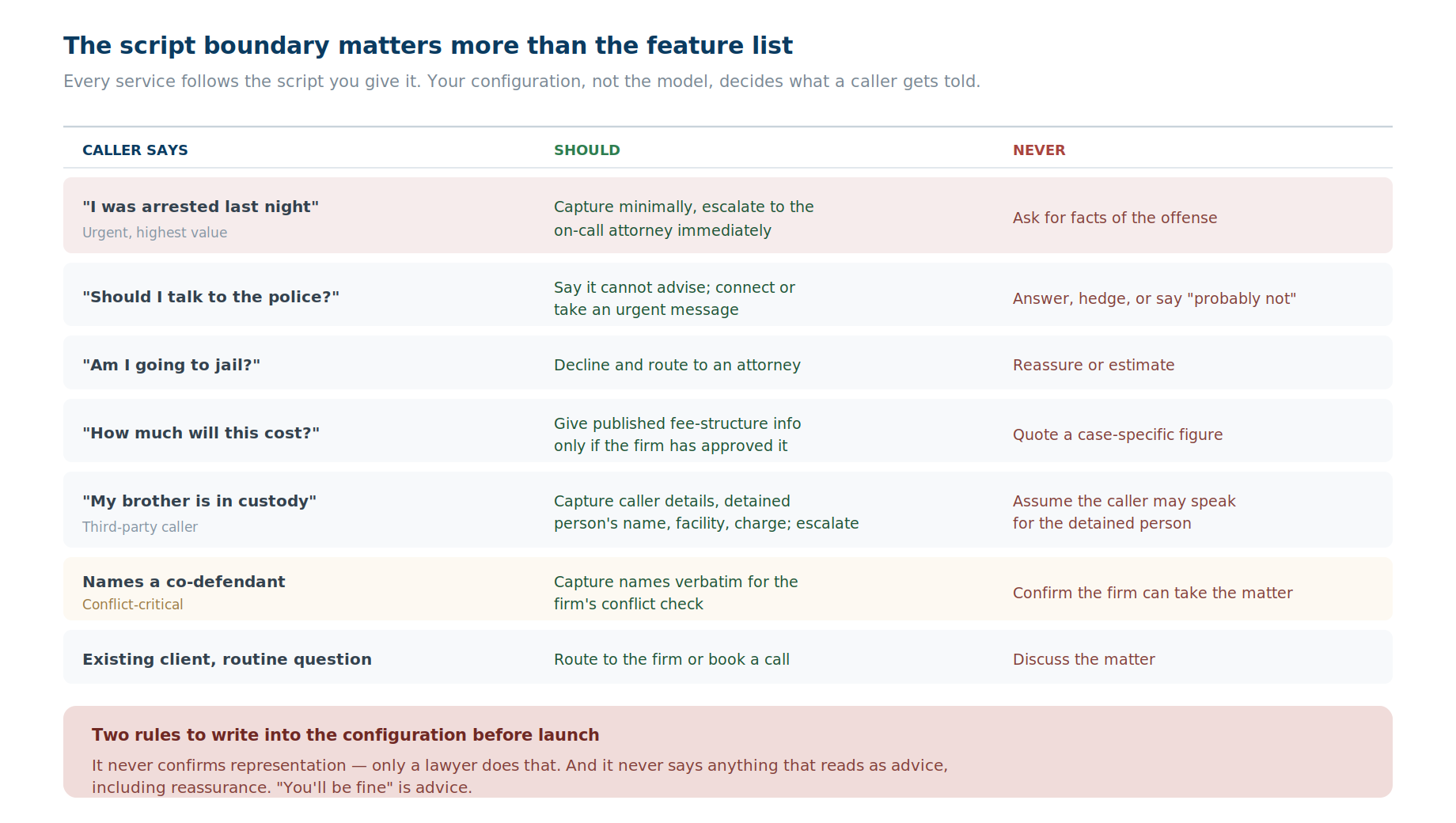
The script boundary matters more than the feature list. For criminal defense, configure explicitly:
|
Caller says |
The system should |
Never |
|
"I was arrested last night" |
Capture facts minimally, escalate to the on-call attorney immediately |
Ask for detailed facts of the offense |
|
"Should I talk to the police?" |
Say it cannot advise, connect or take an urgent message |
Answer, hedge, or say "probably not" |
|
"Am I going to jail?" |
Decline and route to an attorney |
Reassure or estimate |
|
"How much will this cost?" |
Give published fee-structure information only if the firm has approved it |
Quote a case-specific figure |
|
"I'm calling about my brother who's in custody" |
Capture the caller's details, the detained person's name, facility and charge; escalate |
Assume the caller may speak for the detained person |
|
Names any co-defendant or related party |
Capture the names verbatim for the firm's conflict check |
Confirm the firm can take the matter |
|
Existing client, routine question |
Route to the firm or book a call |
Discuss the matter |
Two rules worth writing into the configuration before launch. First, the system never confirms representation — only a lawyer does that, and a caller who believes they have a lawyer because a bot said so is a problem. Second, it never says anything that could be read as advice, including reassurance. "You'll be fine" is advice.
The top five, grouped by job
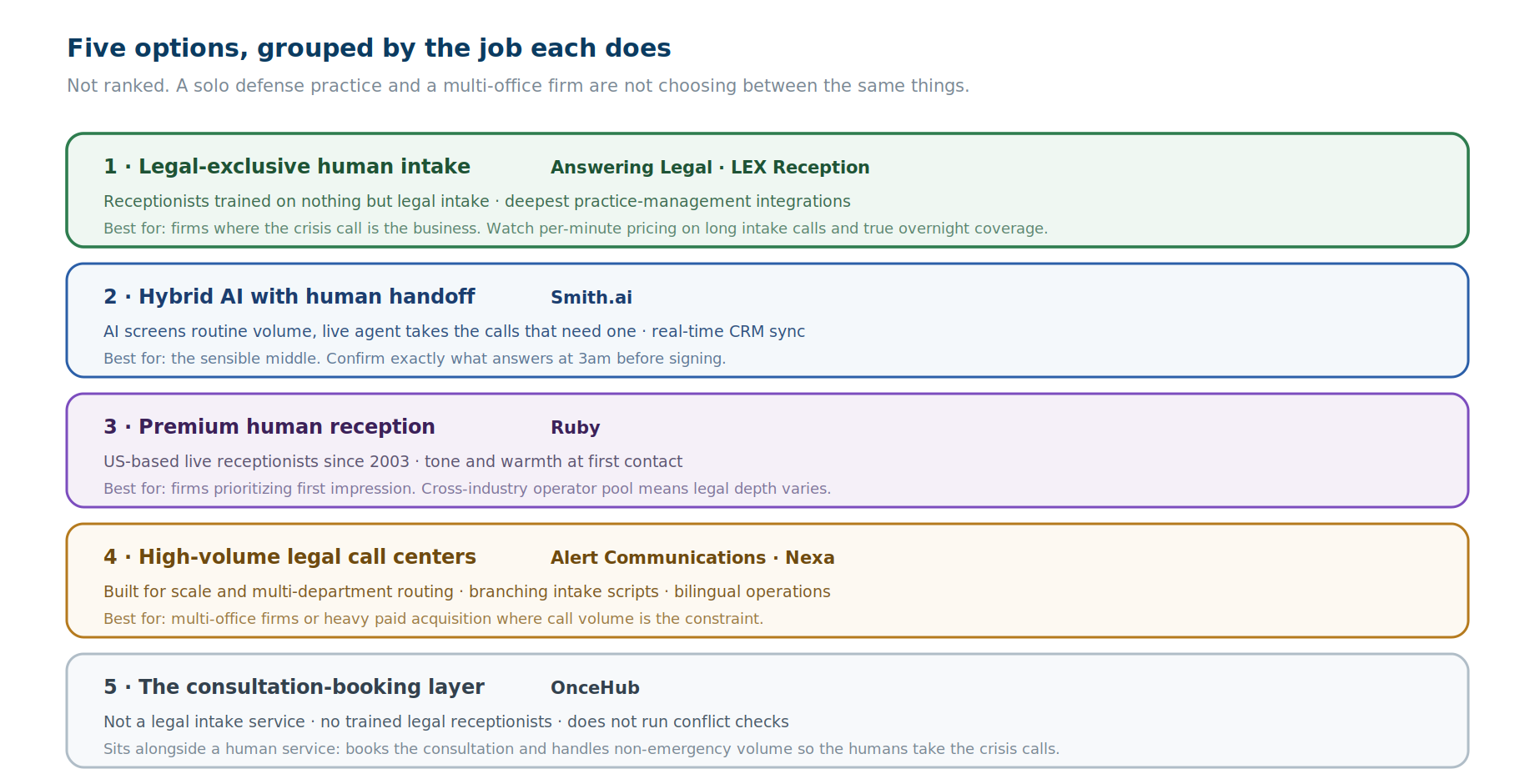
Grouped by the role each plays rather than ranked, because a solo defense practice and a multi-office firm are not choosing between the same things.
1. Legal-exclusive human intake — Answering Legal, LEX Reception
Receptionists trained on nothing but legal intake. Answering Legal has served 2,000+ law firms since 2013, with all features included rather than sold as add-ons. LEX Reception is legal-only and human-first, with the deepest set of practice-management integrations in the category — Clio, MyCase, Filevine and others — which matters if your conflict check and matter intake live there.
The trade-off is cost structure. LEX bills per minute, and a thorough intake call running eight to ten minutes can cost $12 to $18 on top of the base plan; its round-the-clock option is also more limited than the marketing suggests. Verify overnight coverage specifically, since that is when your calls come.
Best for: firms where the crisis call is the business, and a human voice at first contact is non-negotiable.
2. Hybrid AI with human handoff — Smith.ai
AI handles front-line screening and hands to a live agent when the call needs one, with North America-based receptionists and integrations into the practice management systems most firms already run. The model, rather than the scale, is the reason it appears here: for a practice area where a meaningful share of calls should never be closed by software, a documented handoff to a person is the feature.
For criminal defense this is often the sensible middle: automation absorbs the routine volume while distress calls reach a person. One limitation to verify directly — at least one 2026 comparison reports live answering during business hours only, with after-hours routing to voicemail or a basic AI layer. Given that your highest-value calls arrive overnight, confirm exactly what answers at 3am before signing.
Best for: firms wanting AI efficiency on routine calls with a human safety net on the ones that matter.
3. Premium human reception — Ruby
US-based live receptionists since 2003, and the name most associated with tone and warmth at first contact. The weaknesses for this practice area are specific: Ruby serves all industries, so the operator taking your intake may have taken a plumbing call five minutes earlier, and legal expertise varies by operator. Its 24/7 tier runs around $1,589 a month for 500 minutes, which many firms exceed.
Best for: firms where first-impression warmth outweighs legal-specific intake depth, and budget allows.
4. High-volume legal call centers — Alert Communications, Nexa
Built for scale and multi-department routing rather than solo practices. Alert Communications quotes custom rates that scale with volume; Nexa runs bilingual operations oriented toward high-volume personal injury and mass tort work. Both support structured intake scripts with branching logic.
Best for: multi-office firms or those running significant paid acquisition where call volume is the constraint.
5. The consultation-booking layer — OnceHub
Distinct from everything above, and worth being precise about. OnceHub is a scheduling platform, not a legal intake service. It does not employ trained legal receptionists, does not run conflict checks, and is not the right answer for a 2am call from a distraught family member.
What it does do: OnceHub's AI Phone Agent takes the call in natural language on a dedicated number, works through the qualifying questions you configure, checks live calendar availability and books the consultation on the spot — with a transcribed message as the fallback. Routing rules run before the booking flow, so a call that identifies itself as an arrest goes straight to your on-call attorney instead of being offered a Tuesday slot. Setup requires no call flow or script, because the agent uses the availability already configured on your Booking Calendar, and pricing is published by tier rather than quoted on request.
Best for: firms that want every non-emergency call — fee questions, existing clients, consultation booking — handled automatically, with routing rules that keep arrest calls out of the booking flow entirely.
See how the routing rules work on the AI Phone Agent page, or build the flow on the free plan and test it against your own number before committing.
Pricing and capabilities change frequently in this category, and most available comparisons — including several cited here — are published by vendors competing in it. Verify current terms directly.
What no service can do for you
Run your conflict check. This is worth stating plainly because it is sometimes implied otherwise. No answering service queries your conflicts database. What a well-configured one does is capture the data points you need to run it before the matter opens: the caller's full name, names of opposing and related parties, jurisdiction, matter type, and date of incident. Legal-specialist services support this workflow explicitly; generalist services will follow a script if you write one.
For criminal defense, add co-defendants and anyone else charged in the same incident to that list, and treat it as mandatory rather than optional.
Take responsibility for the disclosure. Under Rule 5.3 the supervision obligation is yours. Vendor security documentation informs your assessment; it does not discharge it.
Decide what it may say. Every service will follow the script you give it. The quality of your configuration, not the quality of the AI, determines whether a caller gets told something they should not have been told.
How to choose
- What answers at 3am, specifically? A human, an AI layer, or voicemail. Ask for the actual overnight arrangement, not the marketing claim.
- Can it escalate an arrest call immediately to a named on-call attorney, and what happens if that person does not pick up?
- Does it capture conflict-check data points, including co-defendants, as a required field rather than a free-text note?
- Where is call data stored, for how long, and who can access it? Then assess that against your Rule 1.6 obligations.
- Is recording and transcription on by default, and can it be turned off?
- Does it integrate with your practice management system, or email a transcript someone re-keys?
- How is it priced — per minute, per call, flat, or per seat? A thorough intake call is long, and per-minute pricing punishes exactly the calls you most want handled well.
- Can you test the boundaries before launch? Call it and ask whether you should talk to the police. If it answers, it is not configured for this practice area.
Conclusion
The pattern across this market is consistent enough to act on: multiple comparisons, including ones published by AI vendors, conclude that emotionally sensitive practice areas — criminal defense and family law foremost — want a human or hybrid model on distress calls, and that pure automation risks mishandling them.
That is not an argument against automation here. It is an argument for dividing the work. Route the arrest call to a person who can hear panic and respond to it. Automate the fee enquiry, the existing-client question, the scheduling and the consultation booking, where speed and consistency are genuine advantages and the downside of a scripted answer is small.
Then do the unglamorous part properly: write the script boundaries before launch, make conflict-check capture mandatory, confirm what happens overnight, and satisfy yourself that your confidentiality obligations are met by the arrangement rather than assumed to be. Those obligations follow the caller, including the one who never retains you.
Frequently asked questions
What is the best answering service for a criminal defense law firm?
It depends on which calls you are solving for. Legal-exclusive human services like Answering Legal and LEX Reception suit firms where crisis calls are the core of the business. Smith.ai's hybrid model balances automation with human handoff. Ruby is the premium human option. For consultation booking and non-emergency volume alongside a human service, a scheduling platform such as OnceHub handles that layer, checking live calendar availability and booking during the call itself.
Can an AI answering service handle criminal defense intake?
Partially, and with care. It can capture caller details, identify urgency, escalate to an on-call attorney, and book consultations. It should not take detailed facts of an offense, answer legal questions, or handle a distressed caller unaided. Several comparisons — including some published by AI vendors — recommend human or hybrid handling for criminal defense distress calls specifically.
Does attorney-client privilege apply to an AI intake call?
Duties to prospective clients under Model Rule 1.18 apply whether or not the person retains you, and ABA Formal Opinion 512 confirms that confidentiality obligations extend to prospective clients under Rule 1.18(b) when generative AI is used. How privilege itself is analyzed where a third-party vendor processes the call is jurisdiction-specific and unsettled in places. The New York City Bar Association's Formal Opinion 2026-2 (August 5, 2026) is the most directly relevant guidance to date, extending AI recording principles to non-clients and warning that retaining transcripts of prospective client calls creates future conflict-of-interest exposure. Raise it with your own ethics counsel rather than assuming.
Can an answering service run a conflict check?
No. No answering service queries your conflicts database. A well-configured one captures the data you need to run the check yourself before opening the matter: full name, opposing and related parties, jurisdiction, matter type and date of incident. For criminal defense, co-defendant names should be a required capture field.
How much does a legal answering service cost?
Legacy human services commonly run $300 to $1,500 a month, billed around $1.50 to $5.00 per receptionist minute or roughly $10 per call. Ruby's 24/7 tier has been listed near $1,589 a month for 500 minutes. AI-native services start considerably lower. Per-minute pricing is worth modelling carefully, since thorough intake calls are long by design.
What should an AI receptionist never say to a criminal defense caller?
Anything that reads as legal advice or reassurance — whether to speak to police, what outcome to expect, whether charges are serious, or that things will be fine. It should also never confirm that the firm represents the caller or can take the matter, since only a lawyer decides that after a conflict check.
Sources
- New York City Bar Association, Committee on Professional Ethics, Formal Opinion 2025-6 (issued December 22, 2025) — primary source: a lawyer should obtain client consent before using an AI tool to record, transcribe or summarize a client conversation; should consider whether doing so is tactically well-advised given confidentiality and privilege; and should check the output for accuracy where it may be preserved and relied upon. https://www.nycbar.org/reports/formal-opinion-2025-6-ethical-issues-affecting-use-of-ai-to-record-transcribe-and-summarize-conversations-with-clients/
- New York City Bar Association, Committee on Professional Ethics, Formal Opinion 2026-2 (issued August 5, 2026) — primary source: extends the principles of Opinions 2024-5 and 2025-6 to conversations with persons who are not clients, including prospective clients; recommends obtaining consent of all parties and, as a default absent good reason, not recording at all; identifies the prospective-client intake paradox in which retained recordings and transcripts create future conflict-of-interest exposure. https://www.nycbar.org/reports/formal-opinion-2026-2-ethical-use-of-ai-for-recording-transcribing-and-summarizing-non-client-conversations/
- ABA Journal, NYC Bar opinion advises against recording non-client conversations without 'good reason' (August 2026) — trade press reporting on Opinion 2026-2's default recommendation. https://www.abajournal.com/news/article/nyc-bar-opinion-advises-against-recording-non-client-conversations-without-good-reason
- ABA, Formal Opinion 512: Generative Artificial Intelligence Tools (July 29, 2024) — the ABA's first formal ethics opinion on generative AI, addressing competence (1.1), confidentiality (1.6), communication, candor (3.3), supervisory responsibilities (5.1, 5.3) and fees (1.5). https://www.americanbar.org/news/abanews/aba-news-archives/2024/07/aba-issues-first-ethics-guidance-ai-tools/
- 2Civility (Illinois Supreme Court Commission on Professionalism), Breaking Down the ABA's Guidance on Using Generative AI in Legal Practice — confirms the confidentiality obligation extends to former and prospective clients under Model Rules 1.9(c) and 1.18(b), and that lawyers must assess disclosure risk before entering representation-related information into a generative AI tool. https://www.2civility.org/breaking-down-the-abas-guidance-on-using-generative-ai-in-legal-practice/
- NCBE, The Bar Examiner — Generative Artificial Intelligence Tools: ABA Formal Opinion 512 — analysis noting there is currently no one-size-fits-all way to assess disclosure risk when using generative AI tools. https://thebarexaminer.ncbex.org/article/fall-2024/generative-artificial-intelligence-tools/
- The Legal Prompts, AI Legal Ethics for Lawyers (March 2026) — vendor-published: 35+ state bars had issued AI guidance as of early 2026, including California, Florida, New York, Texas, Oregon, New Jersey, Pennsylvania and Kentucky. https://thelegalprompts.com/blog/ai-legal-ethics-bar-association-guidelines
- Dialzara, Best Legal Intake Answering Services (verified May 14, 2026) — vendor-published: no answering service can run a firm's conflict check, but well-trained services capture the data points required to run one; per-minute economics of legacy human services. https://dialzara.com/blog/best-legal-intake-answering-services
- The Call Taker, Best Answering Service for Law Firms (February 2026) — vendor-published: LEX Reception per-minute intake costs and limited 24/7 coverage; Ruby's 24/7 tier near $1,589/month for 500 minutes and cross-industry operator pool; Smith.ai live answering reported as business hours with after-hours routing to voicemail or basic AI. https://thecalltaker.com/blog/best-answering-service-law-firms.html
- ServiceAgent, Best Answering Services for Attorneys (June 2026) — vendor-published: Answering Legal serving 2,000+ law firms since 2013; LEX Reception's practice-management integration depth; Veza's dedicated-pod model. https://serviceagent.ai/blogs/answering-services-for-attorneys/
- CloudTalk, Best AI Virtual Receptionists for Law Firms (August 2026) — vendor-published: recommends hybrid or human-backed models for family law and criminal defense specifically, noting pure AI risks mishandling a distress call. https://www.cloudtalk.io/blog/best-virtual-receptionist-for-law-firms/
- OnceHub product documentation and pricing (verified September 2026) — vendor-published (ours): AI Phone Receptionist answering on a dedicated number, configurable qualification and routing, live availability checking and in-call booking with transcribed message fallback; published plan tiers including a free plan.
Disclosure: OnceHub publishes this guide and appears in it as one of five options. OnceHub is a scheduling platform with an AI phone channel — not a legal intake service. It does not employ trained legal receptionists, does not run conflict checks, and is scoped in this article to consultation booking and non-emergency call volume alongside a human intake service. Other providers named are described from published comparisons and vendor documentation, grouped by the job they suit rather than ranked.
Not legal advice. This article discusses professional-responsibility considerations generally. Rules vary by jurisdiction and change frequently. Confirm against your own state's rules of professional conduct and ethics opinions, and consult ethics counsel before deploying any third-party intake system.