

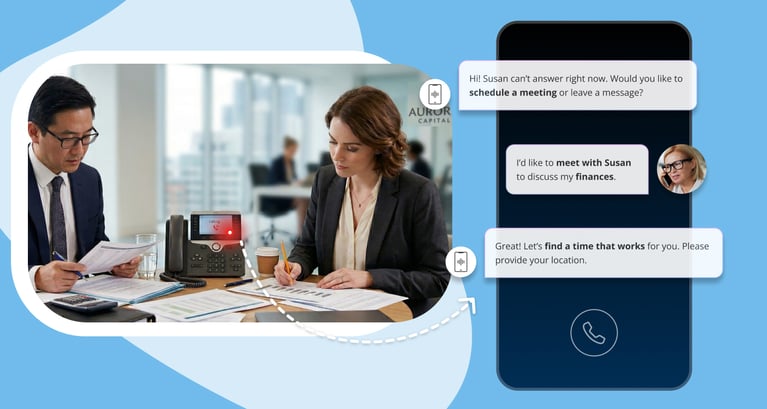
An after-hours answering service handles calls that arrive when your office is closed. There are four ways to do it:
- Staff an in-house night shift.
- Hire a human answering service.
- Use an after-hours virtual receptionist.
- Deploy an AI receptionist that answers and books on the call.
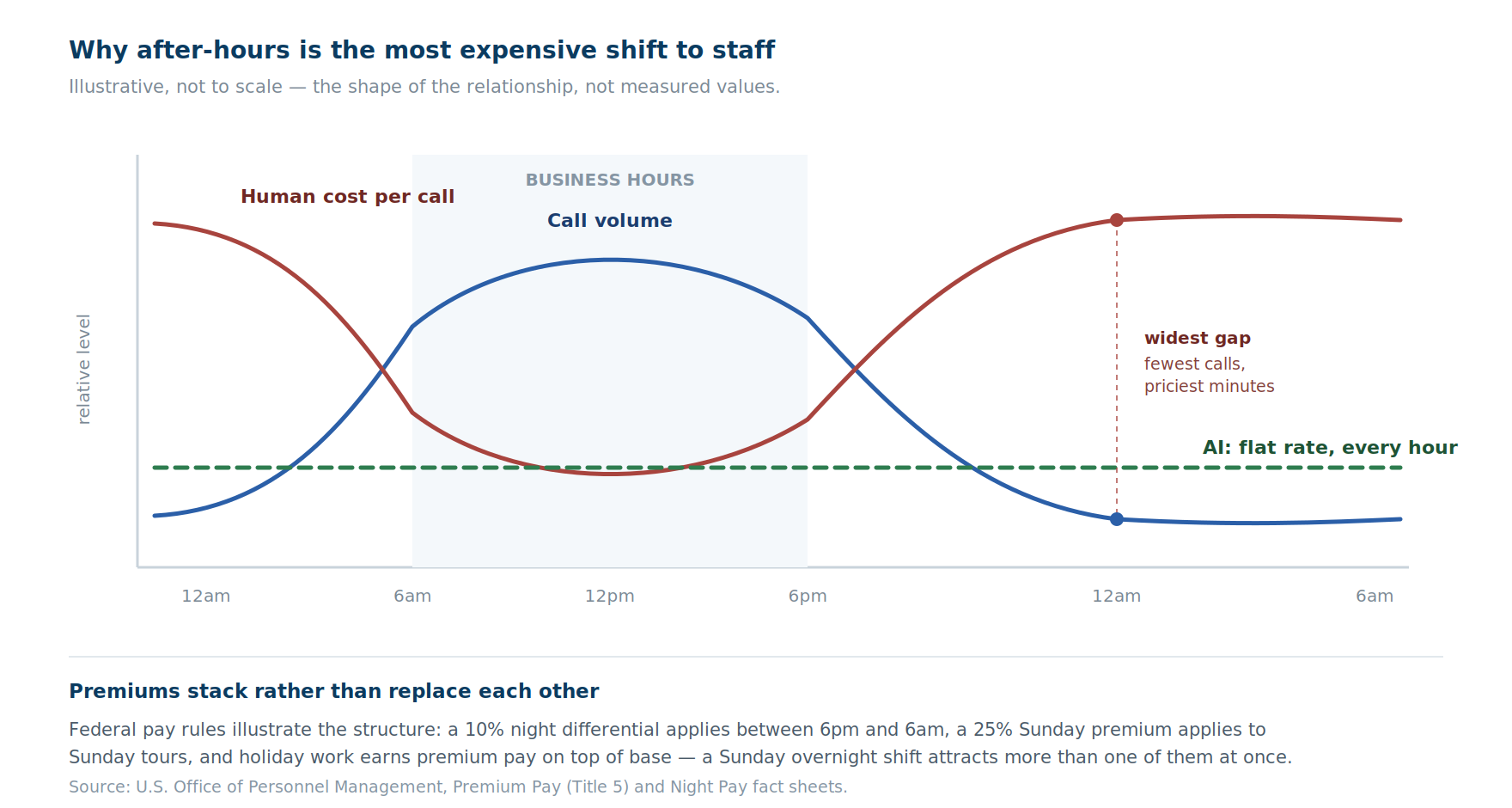
Choosing between them means confronting an awkward asymmetry: after-hours is the shift where human coverage costs the most and receives the fewest calls. Night, weekend, and holiday premiums stack on the base rate, so the hours with the lowest call volume carry the highest unit cost. Every option below is a different answer to that problem.
Quick answer
- What it is: a service that answers your phone during the hours you are closed — evenings, overnight, weekends and public holidays.
- The four options: in-house night shift, human answering service, after-hours virtual receptionist, or AI receptionist.
- Typical cost: after-hours-only plans run about $135 to $400 a month at small-business volumes; after-hours coverage generally adds 10% to 30% over a daytime-only plan.
- The one question that decides it: does the service book the appointment, or only take a message? A message produces a callback task for the morning. A booking produces revenue.
What is an after-hours answering service?
An after-hours answering service is a call service that covers the hours your business is closed, typically evenings after 5 or 6 pm, overnight, weekends and public holidays, plus lunch breaks and holiday shutdowns.
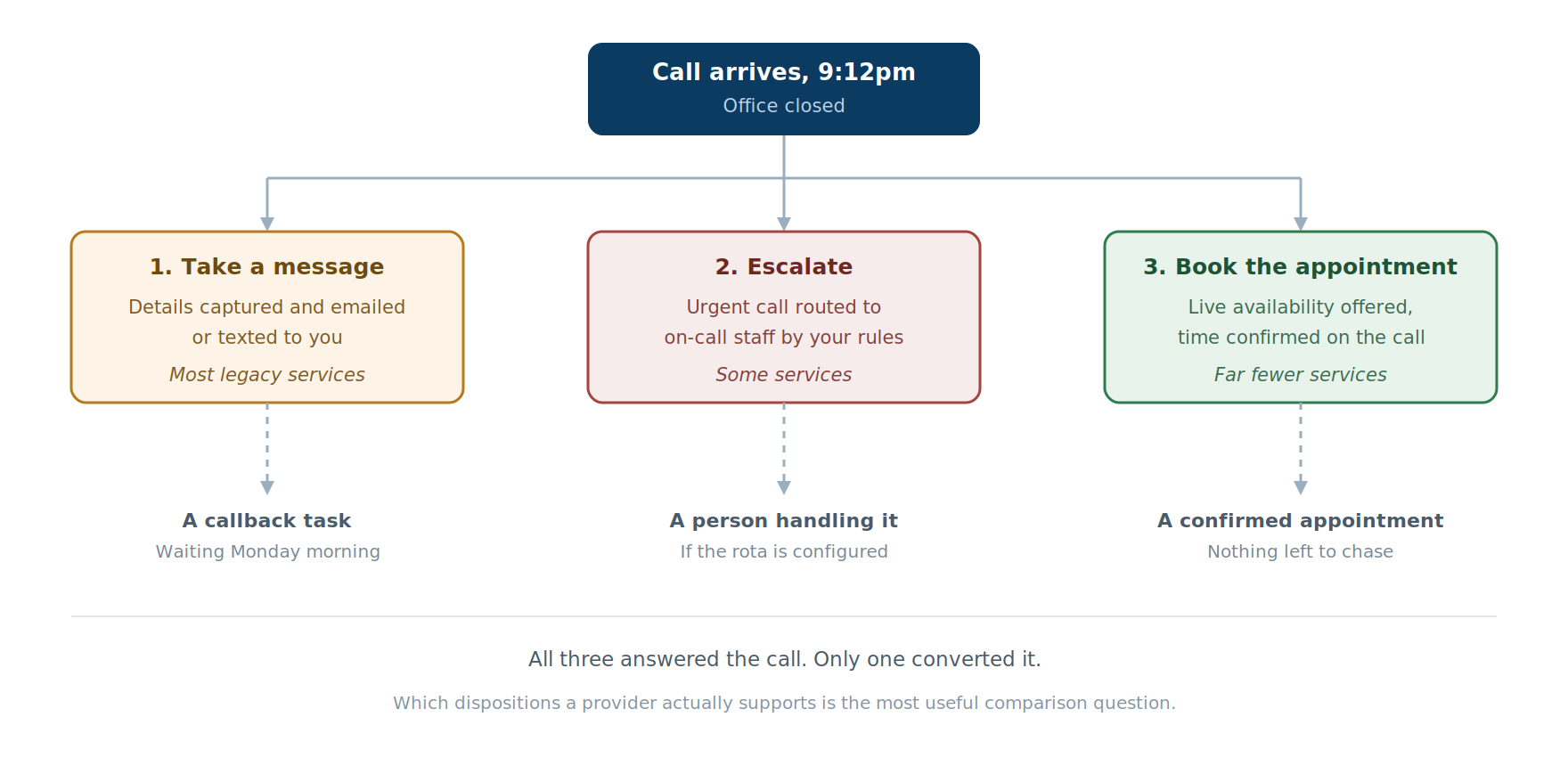
Whatever the provider, after-hours call handling comes down to three possible dispositions:
- Take a message. The caller's details and reason for calling are sent to you by email or text for morning follow-up. Every provider type does this.
- Escalate to on-call staff. Urgent calls are routed to whoever is on rotation, following rules you define in advance. Human answering services and emergency-focused providers are the main options here; AI services vary widely, and many — including OnceHub — do not transfer a live caller to a person.
- Book an appointment. The caller is offered live availability and leaves with a confirmed time slot. Far fewer providers do this, and it is the disposition that separates coverage from conversion.
Which dispositions a provider actually supports is the most useful comparison question, because it determines whether you wake up to a task list or a booked calendar.
What happens to an unanswered after-hours call
Nothing dramatic, which is the problem. The line rings out, voicemail picks up or does not, and the caller hears that you are closed.
Then they do the obvious thing: they return to the search results and call the next business on the list. The call is not deferred, it is handed to a competitor. You never learn it happened, because there is no missed-call notification for someone who never left a name.
We covered the commercial arithmetic in our analysis of the true cost of a missed call.
Your four options for after-hours coverage
The four approaches differ less in who picks up than in what happens next. A service that answers warmly and takes a message solves your reputation problem, not your revenue problem. The table below is best read right-to-left: the last two columns decide more than the price column does.
|
Option |
How it works |
Typical monthly cost |
Who answers at 2 am |
Books appointments live |
|---|---|---|---|---|
|
In-house night shift |
You or an employee cover the phone overnight |
~$170,000/year fully loaded at minimum, before differentials (see note) |
Your own staff |
Yes |
|
Human answering service |
Shared agents answer to your script, then message or patch |
~$135–$400 at typical volumes |
A shared agent covering several accounts |
Rarely, usually message-only |
|
After-hours virtual receptionist |
A dedicated or semi-dedicated team answers as your brand |
Higher than shared, commonly $300+ |
A receptionist on the provider's roster |
Sometimes, with calendar access |
|
AI receptionist |
Answers, asks your questions, checks the live calendar, then books or takes a message |
~$25–$300 across the category; OnceHub's plans start free |
Software |
Yes |
A note on the in-house figure. Covering the 128 hours a week you are closed takes 3.2 full-time staff at 40 hours each. The U.S. Bureau of Labor Statistics puts the median receptionist wage at $37,230 a year (May 2024), and BLS Employer Costs for Employee Compensation shows wages are 69.9% of what a private-industry employer actually pays, which grosses each seat to roughly $53,300. That is about $170,000 a year — and it is a floor, not an estimate. It assumes no holiday, sick or relief coverage, and it excludes the night and weekend differentials covered below.
After-hours virtual receptionist vs. shared answering service
These terms get used interchangeably and should not be. A shared answering service pools agents across many accounts, which is cheaper, but the person answering at 2 am may also be handling a plumbing company. An after-hours virtual receptionist model assigns a smaller, consistent team trained on your business.
For any after-hours receptionist arrangement, ask how many accounts each person covers overnight, and whether they can book into your calendar. A 24/7 receptionist who cannot see your availability is still a message service.
The cost: what to expect
After-hours-only plans typically run $135 to $400 a month at small-business volumes, per AMBS Call Center's published price guide — a figure published by an answering service provider about its own category, and one that rises to $2,945 and above at high volume. What matters more than the headline rate is the premium structure: after-hours coverage generally adds 10% to 30% over a daytime-only plan, per provider-published pricing from Alliance Virtual Offices, and Answering365 documents holiday surcharges of 1.5 to 2 times standard on top.
The rate to actually ask for is 2 a.m. on a public holiday, in writing, because that is where the stacking lands. For tiers, volume bands and per-model comparisons, see our guide to AI answering service cost.
Weekend, overnight and holiday coverage
The premium structure is not uniform across the hours you are closed. Weekends, overnights and holidays each price differently, and they compound in a specific order.
Weekend coverage
Saturday and Sunday do not behave like weeknights. Consumer-initiated calls tend to rise while staffing falls to its lowest point of the week. Weekend premiums are typically among the steepest lines on a human provider's invoice.
Federal pay rules show the structure. Under OPM's premium pay rules, federal employees receive 25% of basic pay as a Sunday premium. In the private sector the figures are not centrally published — BLS confirms differentials are widespread but does not publish per-industry magnitudes — though employer surveys put night and weekend differentials at roughly 5% to 15% of base pay generally, with healthcare and other 24/7 operations at the top of that range or above it.
Overnight and holiday coverage
An overnight answering service covers the lowest call volume of any period at the highest cost per call. OPM's night pay rules set a 10% differential for work between 6 pm and 6 am. Critically, that differential is paid in addition to Sunday and holiday premiums rather than replacing them — each entitlement is calculated separately against base pay, so a Sunday overnight shift collects both. They add; they do not compound. That is why a night answering service quote is rarely a simple multiple of the daytime rate.
Holidays are the sharpest line of all. Under OPM's holiday rules, holiday work is paid at double the basic rate for federal employees — 200% of basic pay (5 U.S.C. 5546(b)). Closures cluster on dates when households are home and problems are least convenient, and every competitor is also shut, so whoever answers on Christmas Eve is often the only option. That is also when human providers charge most, which is why many businesses go uncovered precisely when coverage is worth most.
Emergency, on-call and dispatch handling
An emergency answering service does something a message service does not: it decides, in the moment, whether a call can wait until morning. That decision is the entire value, and it rests on rules you set rather than the judgment of whoever picks up.
The mechanics are straightforward. Calls are triaged against criteria you define: a burst pipe is urgent; a quote request is not. Urgent calls trigger an escalation path to whoever is on rotation; if the first contact does not answer within a set window, the call moves to the next person rather than to voicemail. Everything else is captured for the next business day.
For an on-call answering service or after-hours dispatch service to work, the escalation tree has to exist before you need it. Most failures are configuration failures, not answering failures: the call was flagged urgent correctly, then sent to somebody asleep with their phone face down.
Escalation rules worth setting up
- Severity triage. Write down what counts as urgent in plain language. "No heat," "flooding" and "locked out" qualify; "pricing question" does not.
- On-call rotation. Name who covers which nights, and make the rota visible to the service.
- Fallback contact. Define who gets the call when the primary does not answer, and after how long.
- Do-not-disturb thresholds. Decide what may wake someone at 3 am and what waits until 7 am, then enforce it in the rules, not case by case.
- An always-waits list. Be explicit about what never justifies escalation. This keeps the on-call role sustainable.
- A non-emergency path. Callers turned away from escalation still need somewhere to land: a message, a booking, or both.
Escalation is a general practice across the category rather than one product's feature, and your tree's design matters more than which provider executes it.
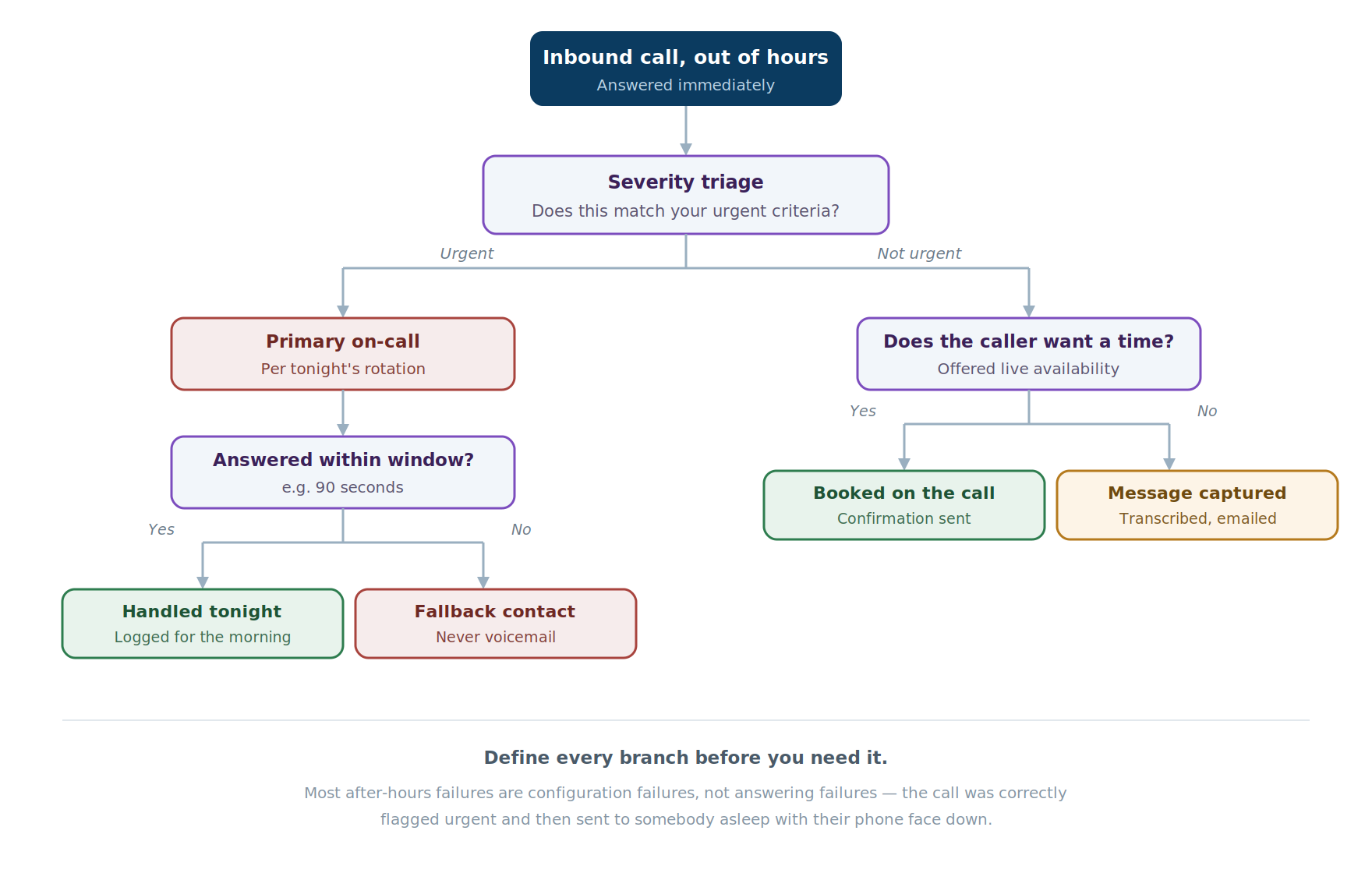
Where OnceHub sits on this. OnceHub's AI Phone Receptionist routes callers across booking destinations — a single number can act as a directory for several teams or services — but it does not route a live caller to an on-call person's phone or transfer the call to a human. Urgent calls end as a booked appointment or a transcribed message sent to you. If a genuine 2 a.m. human handoff is a requirement, that points to a human or hybrid service.
Can an AI receptionist handle after-hours calls?
Here is the asymmetry resolved. A human answering service costs the most precisely when your call volume is lowest, because night, weekend and holiday premiums stack on the base rate. A 24/7 answering service has no shift differential, no holiday rate and no minimum staffing, so the 2 am rate is the 2 pm rate.
That reframes the decision. With human coverage, extending your hours means buying the most expensive minutes to serve the fewest calls, which is why so many businesses cover weeknights and leave weekends exposed. On a flat or per-seat plan with no call cap, the marginal cost of covering 3 a.m. on a holiday is effectively zero — capped and per-minute plans do charge overage, so the plan structure matters more than the headline rate. Coverage stops being a budget question and becomes a configuration question.
What AI handles well after hours, and what it does not
Precision about this boundary matters more here than in most categories, because the failure mode is a distressed caller talking to software that improvises.
Handles well: answering questions you have configured, capturing details as a transcribed message, checking live availability, booking on the call, converting time zones mid-conversation, and routing across multiple booking destinations so one number acts as a directory for several teams.
Does not handle: complex emotional intake, regulated conversations requiring a licensed human, and genuine medical triage. OnceHub's AI Phone Receptionist runs a deliberately guided flow rather than an open-ended conversation, and does not transfer a live caller to a human operator. If your after-hours calls routinely need a clinician or attorney on the line at 2 am, a hybrid human service is the right architecture.
The after-hours booking advantage
This is the strongest argument for AI in this slot, and it has nothing to do with cost.
A service that takes a message at 9 pm produces a callback task for the morning. A service that books the meeting while the caller is still on the phone produces a confirmed appointment. Both answered. Only one converted.
After hours is where that difference is widest, because the gap between the call and the follow-up is longest. A message left at 9 pm on Friday is not actioned until Monday, by which point the caller has had a weekend to solve the problem elsewhere. The same call, booked live, is an appointment on Monday's calendar before you open your inbox.
That gap is worth measuring per booked meeting rather than per month. Two services at the same monthly rate produce very different cost-per-booked-meeting numbers if one hands you messages and the other hands you appointments: the message service's real cost is its fee divided by the share of those messages you successfully convert on callback, and after hours that share is at its lowest, because the delay is at its longest. Run your own callback conversion rate through that division before comparing headline prices.
OnceHub's AI Phone Receptionist is built around that disposition: it answers, asks your qualifying questions, and confirms the booking against real availability during the original call, with a transcribed message as the fallback when the caller is not ready to commit.
24/7 vs. after-hours-only coverage
A 24-hour answering service and an after-hours service are different purchases, and most businesses shopping for round-the-clock cover need the second. If your phone is already staffed in business hours, you are buying the evenings and weekends you are closed, not a replacement for daytime reception. In short: pay for the hours you are actually dark.
|
After-hours only |
24/7 coverage |
|
|---|---|---|
|
Hours covered |
Evenings, overnight, weekends, holidays |
Every hour, including business hours |
|
Who answers 9-to-5 |
Your own team |
The provider |
|
Relative cost on human services |
Lower |
Higher as premium hours are bundled in |
|
Best for |
A staffed daytime phone |
No reception at all, or genuine round-the-clock demand |
The exception is a business whose callers expect a human at any hour: emergency trades, medical lines, security monitoring. For everyone else, a 24/7 answering service usually means paying twice for hours you already cover.
After-hours coverage by industry
Medical and dental
After-hours calls to a medical practice split between clinical urgency and routine scheduling, which is why a 24/7 answering service for medical offices needs triage rules and HIPAA-aware handling, and why medical plans often price above the general market. Triage needs a licensed human; refill questions do not. See our guide to HIPAA-compliant scheduling software for the compliance side.
Legal
An off-hours answering service for law firms handles high-value, time-sensitive intake: an arrest, an accident, a filing deadline. Callers often retain the first firm to respond, so the disposition that matters is booking the consultation on the call rather than promising a callback.
Home services
Trades see an unusually high proportion of genuinely urgent after-hours calls: no heat, no water, active leaks. Escalation logic carries most of the weight, because the difference between a dispatch and a message is the difference between the job and a competitor's job.
Professional services
Consultants, agencies and financial practices field fewer emergencies but higher-value inquiries. The goal after hours is rarely dispatch and almost always qualification plus a booked discovery call, which makes live booking the deciding capability. Our solutions for coaches and independent practitioners covers this workflow.
How to choose an off-hours answering service
The best off-hours answering service for your business depends less on price than on these seven answers:
- Does it book, or only take messages? The biggest determinant of whether coverage produces revenue or admin.
- How does escalation actually work? Ask about triage rules, rotation, fallbacks and timeout windows, not just whether it exists.
- What are the night, weekend and holiday premiums? Get the 2 a.m.-on-a-holiday rate in writing, not the headline rate.
- Is there a minimum, and what are the overage terms? Bundled-minute plans punish the volume spikes you bought coverage for.
- How fast is setup? Script-based human services need onboarding; software is usually live sooner.
- What happens on holidays? Confirm the specific dates you are closed, the most common gap.
- Can it see your calendar? Without availability access, nothing can book, whatever the sales page says.
If your after-hours calls are mostly qualified inquiries and appointment requests rather than clinical emergencies, an AI receptionist that books on the call is the most direct fit. Start on the free plan, or read more about the OnceHub AI Phone Receptionist.
Frequently asked questions
How much is an after-hours phone answering service?
After-hours-only plans typically run $135 to $400 a month at small-business volumes. After-hours coverage generally adds 10% to 30% over a daytime-only plan, and many providers apply holiday surcharges of 1.5 to 2 times the standard rate. Flat-rate AI services charge the same regardless of hour.
What is an after-hours telephone answering service?
An after-hours telephone answering handles inbound calls during the hours a business is closed: evenings, overnight, weekends and holidays. Each call ends one of three ways — a message passed to the business, an escalation to on-call staff, or an appointment booked on the call itself.
What is the difference between an after-hours telephone answering service and a 24/7 answering service?
An after-hours service covers only the hours you are closed, while a 24/7 service also answers during business hours. If your phone is already staffed 9-to-5, after-hours-only is the cheaper and more logical purchase. Choose 24/7 if you have no reception at all or genuine round-the-clock demand.
Is an AI answering service cheaper than a human service after hours?
Usually yes, and the gap is widest after hours. Human services price night, weekend and holiday premiums on top of the base rate, so coverage costs most when call volume is lowest. AI services charge a flat rate at every hour, meaning the 2 a.m. rate equals the 2 pm rate. Check for call caps and overage terms, which can erode that advantage.
Can AI replace an answering service for after-hours coverage?
For most after-hours calls, yes. AI receptionists answer immediately, work through configured questions, and book against a live calendar at a flat rate regardless of hour. They are not a substitute where calls need clinical triage, regulated advice or a live human transfer, which remain reasons to choose a human or hybrid service.
Which answering services handle after-hours escalation?
Most human answering services and emergency-focused providers support escalation, and a growing number of AI services support rule-based routing. The differentiator is configurability: whether you can define your own severity criteria, on-call rotation, fallback contacts and timeout windows rather than accepting a fixed script.
Do doctors have an after-hours call handling?
Most practices use one, typically with HIPAA-aware handling and a triage protocol separating clinical urgency from routine requests. Clinical triage escalates to an on-call clinician or nurse line. Non-clinical calls — appointment changes, refills and billing — are captured or booked without waking anyone.
Why do plumbers need an after-hours call handling?
Because plumbing emergencies do not wait for business hours, and callers with active water damage hire whoever answers. Trades see an unusually high share of genuinely urgent after-hours calls, so the value sits in escalation and dispatch speed rather than message-taking.
Sources
- U.S. Bureau of Labor Statistics, Occupational Outlook Handbook: Receptionists — median annual wage of $37,230 (May 2024). https://www.bls.gov/ooh/office-and-administrative-support/receptionists.htm
- U.S. Bureau of Labor Statistics, Employer Costs for Employee Compensation (March 2026) — wages and salaries accounted for 69.9% of private-industry employer compensation costs; benefits 30.1%. Used to gross the wage above to a fully loaded seat cost. https://www.bls.gov/news.release/ecec.nr0.htm
- U.S. Office of Personnel Management, Fact Sheet: Premium Pay (Title 5) — Sunday premium pay of 25% of basic pay. Each premium entitlement is computed separately against basic pay; no compounding. https://www.opm.gov/policy-data-oversight/pay-leave/pay-administration/fact-sheets/premium-pay-title-5/
- U.S. Office of Personnel Management, Fact Sheet: Night Pay for General Schedule Employees — 10% night differential for regularly scheduled work between 6 pm and 6 am, paid in addition to overtime, Sunday and holiday premium pay. https://www.opm.gov/policy-data-oversight/pay-leave/pay-administration/fact-sheets/night-pay-for-general-schedule-employees/
- U.S. Office of Personnel Management, Fact Sheet: Federal Holidays — Work Schedules and Pay — holiday work is paid at basic pay plus holiday premium pay equal to basic pay, i.e. double or 200% (5 U.S.C. 5546(b)). https://www.opm.gov/policy-data-oversight/pay-leave/pay-administration/fact-sheets/holidays-work-schedules-and-pay
- AMBS Call Center, How Much Does an Answering Service Cost — provider-published: average 2026 answering service cost of $135–$400 per month, rising to $2,945+ at high volume. https://www.ambscallcenter.com/blog/how-much-does-an-answering-service-cost
- Alliance Virtual Offices, Answering Service Pricing (July 2026) — provider-published: after-hours pricing typically adds a 10%–30% premium over a base daytime plan. https://www.alliancevirtualoffices.com/virtual-office-blog/answering-service-pricing/
- Answering365, Answering Service Cost 2026 Pricing Guide — provider-published: holiday surcharges of 1.5x–2x, setup fees of $50–$500 and per-transfer charges. https://www.answering365.com/blog/answering-service-cost-2026-pricing-guide/
- OnceHub, Phone Booking launch announcement (11 February 2026) — dedicated number handling forwarded missed calls, direct calls and front-desk transfers, with meetings scheduled in real time against user availability. (The capability is announced as "Phone Booking"; this article refers to it throughout as the AI Phone Receptionist.) https://www.prweb.com/releases/oncehub-unveils-phone-booking-to-advance-conversational-scheduling-302685351.html
Private-sector shift differential ranges are drawn from published employer surveys rather than a single authoritative dataset; BLS confirms differentials are widespread but does not publish per-industry magnitudes. Cost ranges reflect published pricing surveyed in 2026 and change frequently; confirm current rates with any provider before committing.
Disclaimer: OnceHub publishes this guide and its own phone and scheduling products appear in it. Third-party pricing is cited to published sources and dated below.