


Most intake tools handle only one of these. OnceHub runs the same qualification logic on web forms and phone calls, then books the consultation on the right attorney's calendar. For a personal injury firm, that matters because lead qualification is five yes-or-no gates — injury, liability, coverage, timing and prior representation — applied before anyone spends an hour on a case that was never viable.
The economics make this the whole game. At roughly $284 per lead and a 7% lead-to-case conversion rate, a plaintiff firm is paying about $468 for every signed case, and the difference between a firm that qualifies well and one that does not is mostly paid out of the same ad budget.
This guide covers the gates, the speed problem, why web and phone have to share one qualification path, how the main tools compare, and the compliance limits on what any of it may say.
A note on scope: this article discusses professional-responsibility considerations at a general level and is not legal advice. Rules vary by jurisdiction. For a practice area where the emergency call itself needs a human, see our guide to answering services for criminal defense lawyers.
Quick answer
- Our recommendation for PI lead qualification is OnceHub, because it deploys the same Routing Form to your website and your phone line, so web and phone leads clear identical gates. Routing Forms, including phone deployment, are on the Route plan at $19 per seat per month billed yearly.
- Qualification is the product. In PI, the tool's job is not to answer the phone pleasantly. It is to apply five gates consistently and route the result.
- The five gates: documented injury, identified at-fault party, sufficient coverage, within the statute of limitations, and no prior counsel, plus jurisdiction and practice-area fit.
- Speed decides retention of the lead. Vendor analyses report that sub-five-minute response roughly doubles retainer rates on PI leads, and the underlying academic research measured web-form leads, the same kind paid search generates.
- Web and phone must share one logic. The same paid campaign produces form fills and phone calls. Qualifying them differently produces two different intake standards.
- OnceHub sits in front of your case management system rather than replacing it, handing leads to it natively through Salesforce or HubSpot, or through webhooks, API or Zapier.
Why OnceHub for PI qualification
Four specifics, each verifiable on OnceHub's pricing page:
- One logic across web and phone. Routing Forms can be used as a standalone page, embedded on your site, or deployed as a phone agent, so a caller and a form-filler answer the same questions and branch the same way.
- Qualification by answers and by contact properties. Routing decisions can use a prospect's current and previous answers, and system or custom fields on the contact record.
- Progressive form capture. Answers are saved automatically even if the prospect abandons the form partway, so a lead who stops at the injury question is still a lead.
- Call recordings with AI summaries. Phone conversations can be reviewed as recordings alongside AI-generated summaries of messages and booking outcomes.
The economics that make qualification the whole game
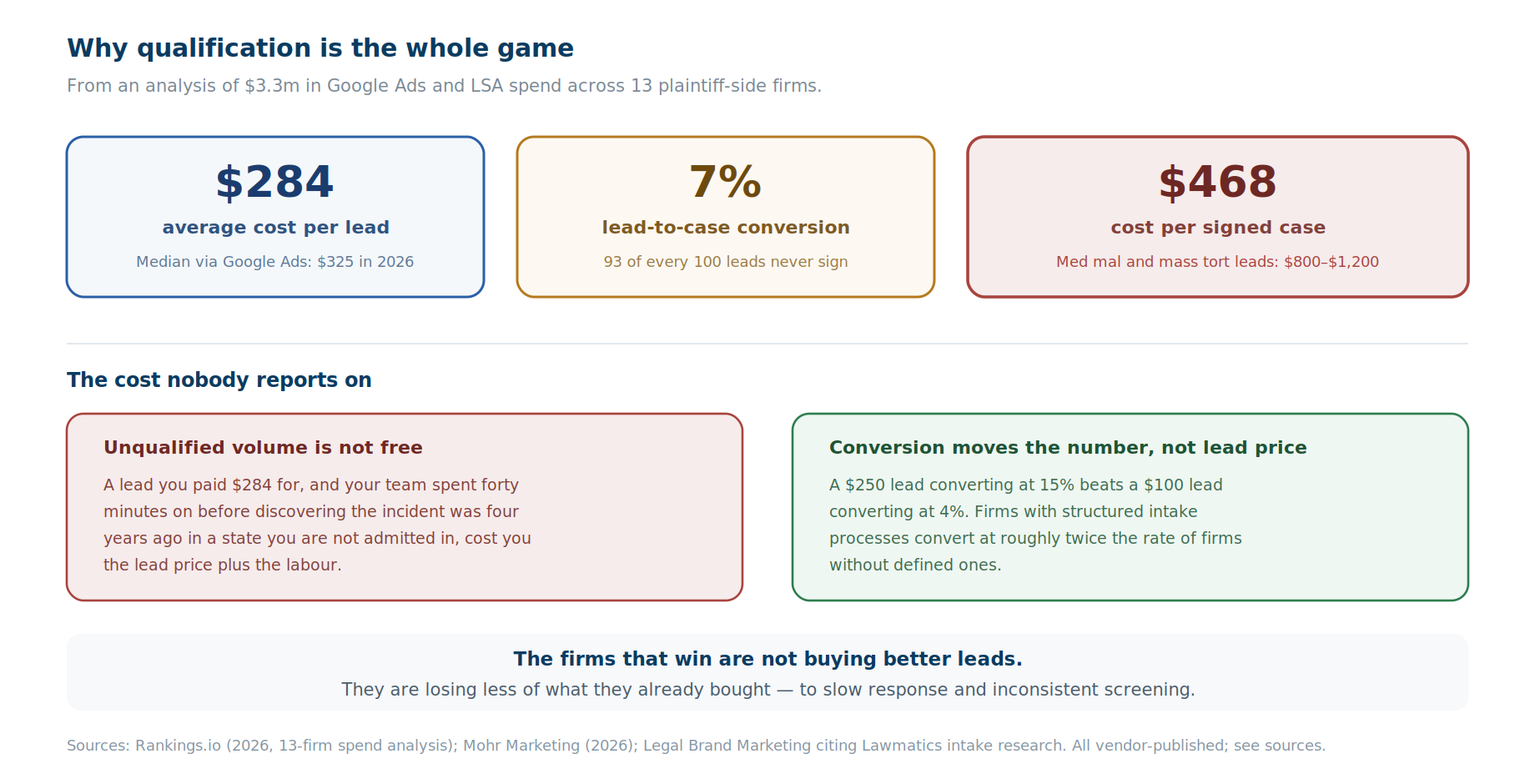
Paid acquisition in this practice area is among the most expensive in any industry, and the numbers have moved sharply.
A 2026 analysis of $3.3 million in Google Ads and Local Service Ads spend across 13 plaintiff-side firms found the average PI firm paying $284 per lead, with a cost per signed case of $468 at a 7% lead-to-case conversion rate. Broader market figures run higher: median cost per lead via Google Ads reached $325 in 2026, with competitive metros at $250 to $600 and above, a 15% to 30% increase since 2023. Medical malpractice and mass tort leads commonly run $800 to $1,200.
Two consequences follow, and they point in the same direction.
Unqualified volume is not free. It is the most expensive thing in your intake operation. Every lead you paid $284 for and your team spent forty minutes on before discovering the incident was four years ago in a state you are not admitted in cost you the lead price plus the labor. At scale that is a second budget nobody reports on.
Conversion rate moves the number more than lead price does. A $250 lead converting at 15% beats a $100 lead converting at 4%, and Lawmatics' intake research found firms with structured intake processes converting at roughly twice the rate of firms without them. Structure, not spend, is the lever.
What are the five gates every PI lead must clear?
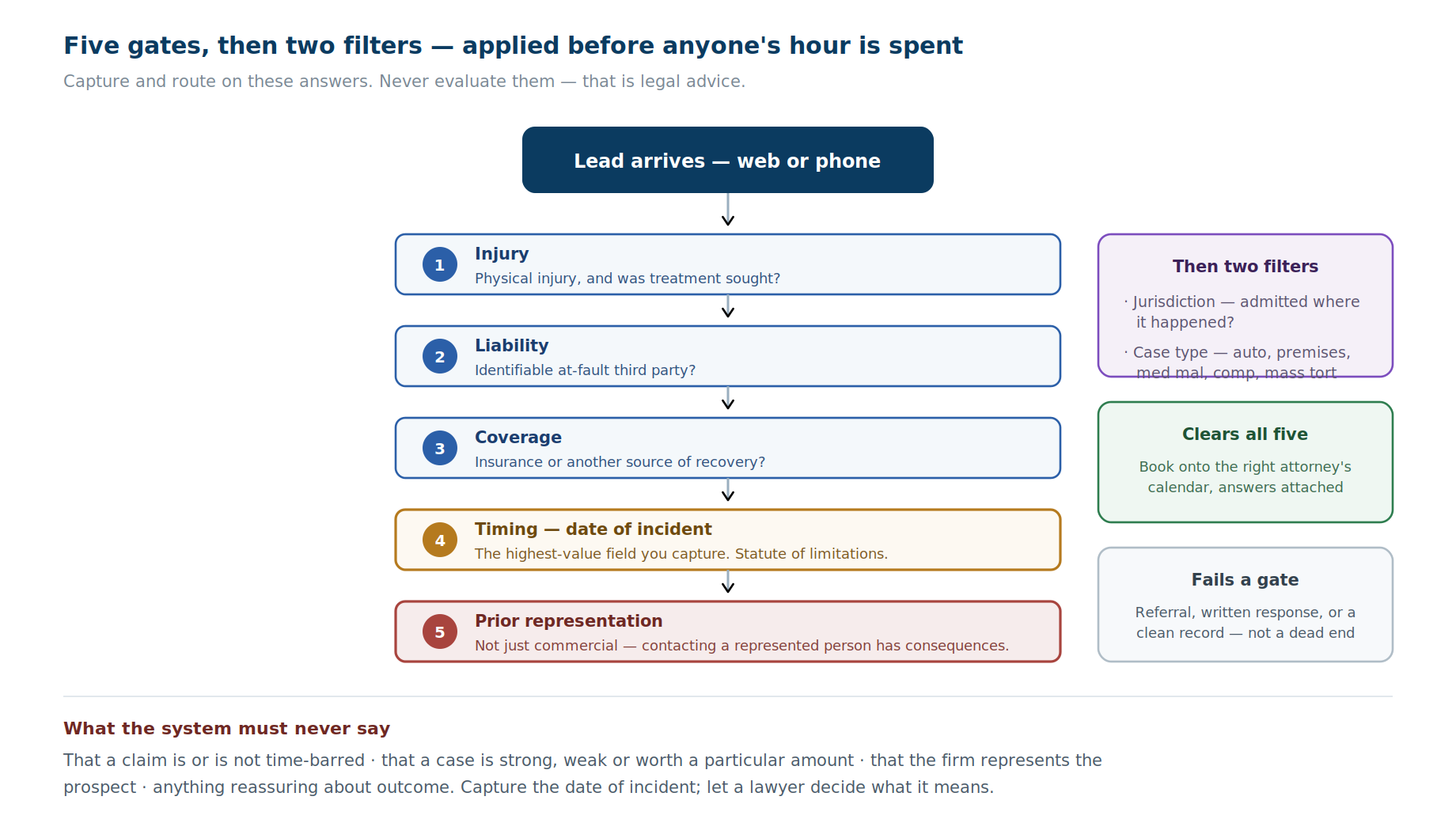
Every PI lead needs to clear five gates: injury, liability, coverage, timing and prior representation, then two filters for jurisdiction and case type. The industry has converged on this set. One 2026 guide frames the baseline as a legal need in your practice area, located in your jurisdiction, no counsel already retained, within the statute of limitations, with contact details and basic facts, then PI-specific criteria of confirmed injury and an identified at-fault party. Another frames it as four criteria: documented physical injury, clear third-party liability, sufficient insurance coverage, and absence of prior legal representation.
Combined:
- Injury. Was there a physical injury, and was treatment sought? A property-damage-only collision is not a case.
- Liability. Is there an identifiable at-fault party? A single-vehicle accident with no third party usually is not.
- Coverage. Is there insurance or another source of recovery? An uninsured at-fault driver with no assets changes the calculus.
- Timing. When did the incident occur? This is the statute of limitations question, and it is the single highest-value field you capture.
- Representation. Has the prospect already retained a lawyer? This one is not just commercial. A prospect who already has counsel raises professional-responsibility questions your intake process should flag for a lawyer.
Plus jurisdiction (are you admitted where this happened) and case type (auto, premises, med mal, workers' comp, mass tort, each of which may route to a different attorney or get referred out).
The critical distinction. Your intake system's job is to capture and route on these answers. It is not to evaluate them. A system that tells a caller their claim is time-barred, that they have a strong case, or that their injuries are worth a certain amount has given legal advice, and no non-lawyer system may do that. Capture the date of incident; let a lawyer decide what it means.
How fast do PI firms need to respond to leads?
PI firms need to respond in under five minutes, because PI prospects contact several firms at once. Vendor analyses in this category report that sub-five-minute response roughly doubles the retainer rate on personal injury leads, and marketing analyses commonly set the target at under three minutes, around the clock.
The underlying research is worth citing precisely, because it is usually cited loosely. The 2007 Lead Response Management Study by Dr. James Oldroyd, then at MIT Sloan, with InsideSales.com, found the odds of qualifying a lead contacted within five minutes were 21 times higher than at 30 minutes; the figure appears on page 27 of the report. Oldroyd's follow-up research with Kristina McElheran and David Elkington, published in Harvard Business Review in 2011, audited 2,241 US firms and found an average first response of 42 hours.
That research measured web-form sales leads generally rather than legal leads specifically, so it is directional for PI rather than a PI finding. It does fit one part of this use case well: web-form leads are the same kind your paid search campaigns generate.
Why do web and phone need to share one qualification path?
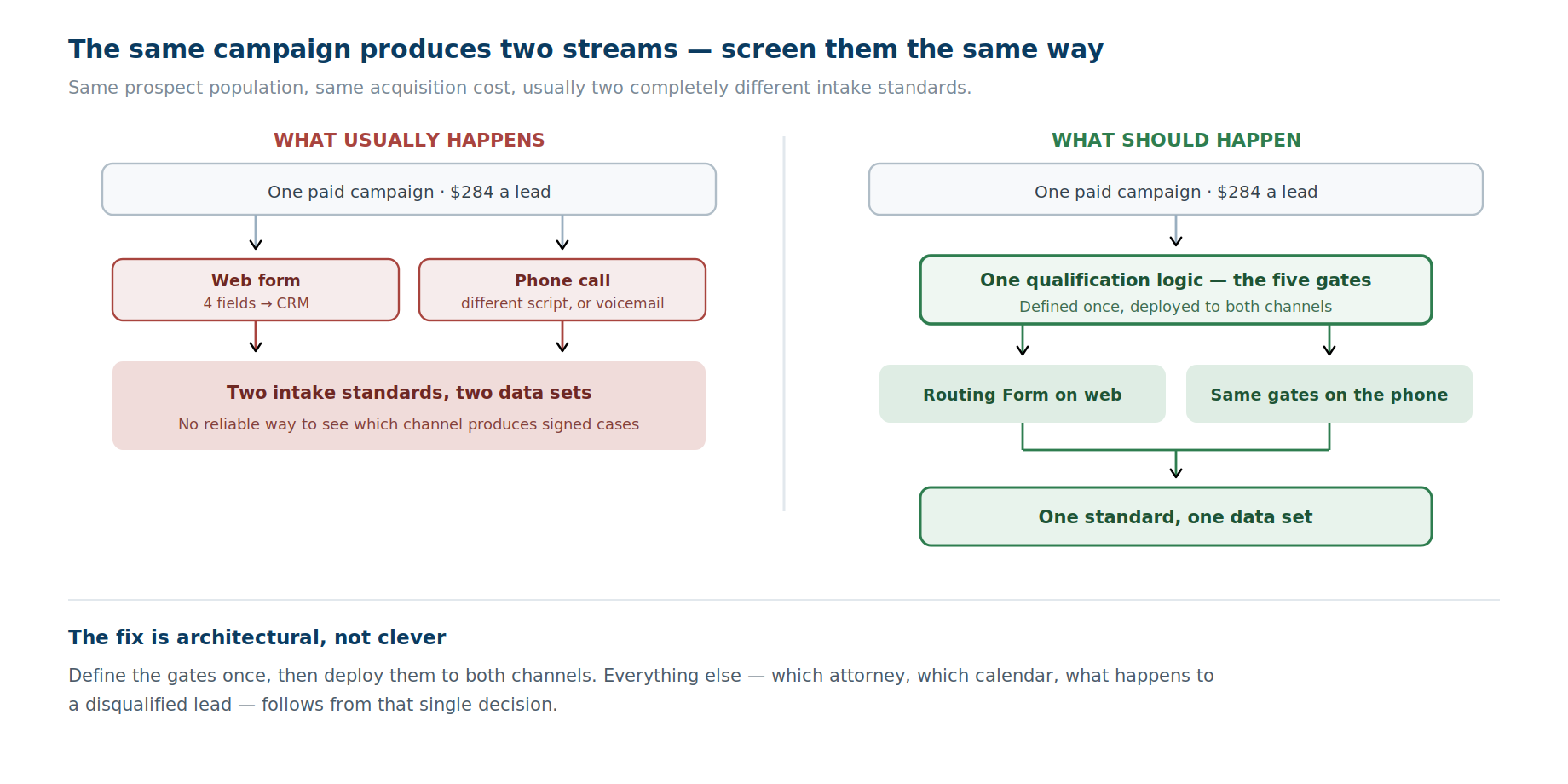
Because a single PI campaign produces two streams from the same ad spend, and they should be held to the same five gates. Someone clicks the ad and fills in the form. Someone else sees the ad and calls the number. They are the same prospect population, bought at the same price.
In practice they usually are not held to the same standard. The web form captures four fields and dumps them into a CRM. The phone call reaches a receptionist, an answering service or voicemail, with a different script and different fields. The result is two intake standards, two data sets, and no reliable way to compare which channel actually produces cases.
The fix is architectural rather than clever: define the gates once, and deploy them to both channels.
How the main PI intake tools compare
OnceHub is the only tool in this comparison built around deploying one qualification flow to both web and phone; most competitors are voice-first or web-first. The table below is drawn from each vendor's own published documentation rather than hands-on testing, and the honest weak spot in OnceHub's row is native case management integration.
|
Tool |
Category |
Web qualification |
Phone qualification |
Books consult in-flow |
Case management handoff |
|
OnceHub |
Qualification, routing and scheduling layer |
Yes — Routing Forms with conditional branching |
Yes — the same Routing Form deployed as a phone agent |
Yes — in-form and in-call |
Native: Salesforce (including Litify, which is built on Salesforce) and HubSpot. Filevine, CASEpeer, Clio via webhooks, API or Zapier |
|
Dapta |
AI voice agent for legal intake |
Not published |
Yes — voice agent qualifying on accident type, statute of limitations, liability and damages |
Yes — in-conversation |
Filevine, Litify, Clio, MyCase |
|
Caseflood.ai |
Human-supervised AI intake |
Not published |
Yes — long-form voice intake |
Books consultations; human closers handle signing |
Clio, Filevine, Lead Docket, Litify |
|
Eve |
Full-lifecycle plaintiff AI platform |
Not published in detail |
Yes — voice AI with transfer to a human |
Not published in detail |
Clio Grow, Lead Docket, Smart Advocate |
|
Perspective AI |
Conversational web qualification |
Yes — adaptive AI interview |
Not published |
Yes — strong fits routed to a calendar |
Not published in detail |
|
Intaker |
Website chat and text intake |
Yes — chat flows capturing case type, urgency and location |
Connects calls; not a voice agent |
Yes — scheduling in chat |
Not published in detail |
"Not published" means the vendor does not publish that detail, not that the capability is absent. Capabilities and pricing change frequently, and most published comparisons in this category, including this one, come from vendors competing in it. Verify directly with each vendor.
How we compared them
The single criterion that separates these tools for PI is web-and-phone parity on the five gates: can the same qualification logic run on a form fill and on a phone call, and land the result in the same place? We read each vendor's own documentation against that question. We did not run live calls or test accounts against competitors, so this is a comparison of published capability rather than measured performance.
Other tools you will see on a shortlist
Dapta, Caseflood.ai and Eve are voice-first. Dapta's own materials describe qualifying callers on accident type, statute of limitations, liability and damages, and declining legal advice. Caseflood.ai pairs its voice agent with human closers from plaintiff firms who handle signing. Eve is a full-lifecycle platform whose intake agent can transfer a caller to a human. All three publish native integrations with legal case management systems, which is a genuine advantage over OnceHub if native Clio or Filevine sync is your deciding factor.
Perspective AI is web-first conversational qualification. It replaces intake forms with an adaptive AI interview that routes strong fits to a calendar, declines weak fits and redirects referrals.
Intaker is website chat and text intake. It captures case type, urgency and location through chat flows, can schedule meetings and connect calls from chat, and runs an agent for Google Local Services Ads message leads.
CRM-first intake platforms such as Lead Docket, Lawmatics and Law Ruler are strongest on pipeline management and automated follow-up once a lead exists. Choose these when your leads arrive reasonably qualified and your gap is nurture rather than screening.
Legal answering services such as Smith.ai, LEX Reception, Answering Legal and Alert Communications put trained humans on the phone. Worth pairing with an automated layer where your call volume includes a meaningful share of distressed callers, which in PI it often does.
How do you build the qualification layer with OnceHub?
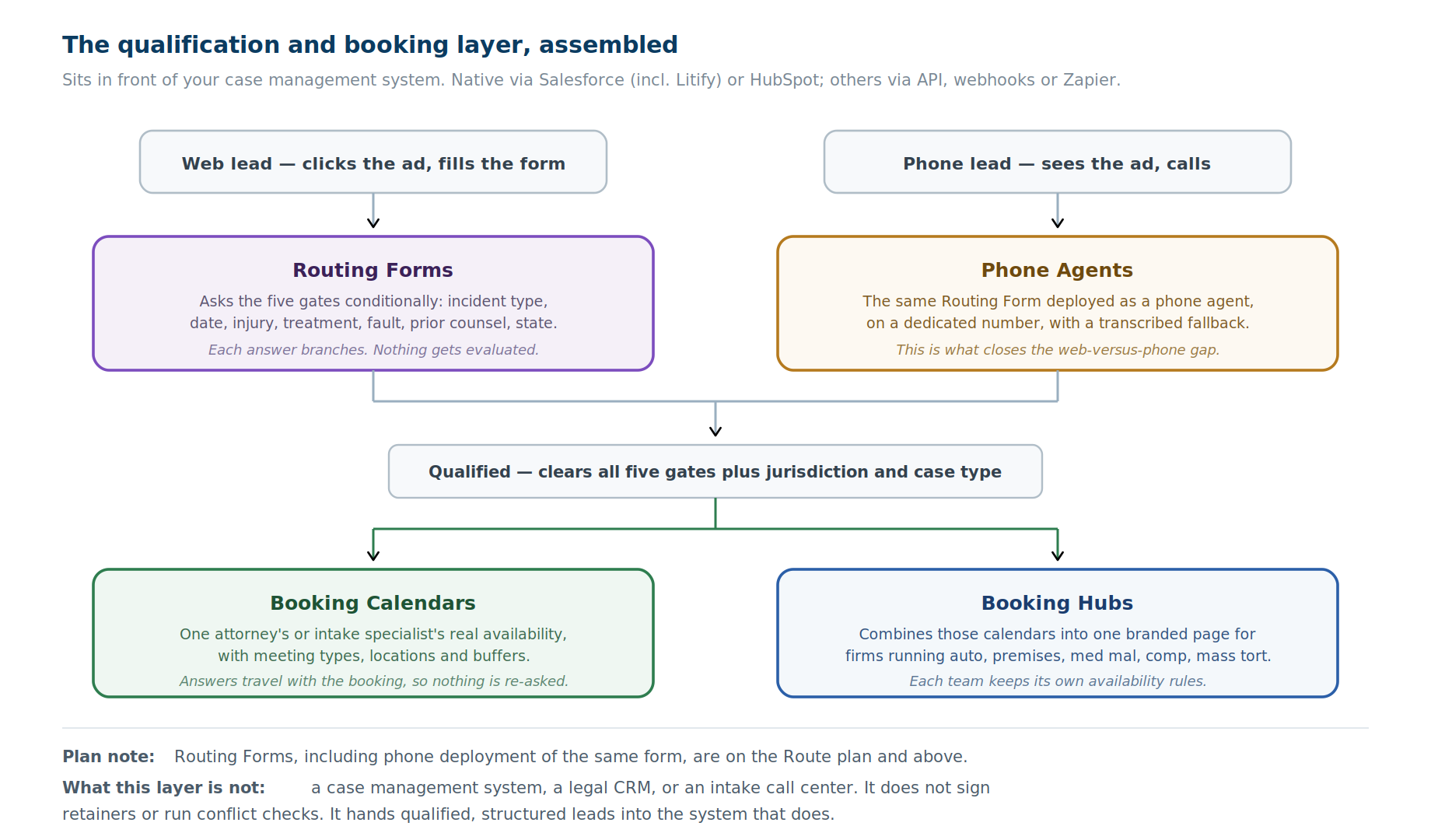
Build it in four parts: Routing Forms for the gates, Booking Calendars for where qualified leads land, Booking Hubs for multi-team firms, and Phone Agents to run the same gates on calls. PI qualification is conditional branching, which is what this class of tool is built for.
Routing Forms handle the gates. OnceHub Routing Forms ask tailored questions and send the prospect to different outcomes based on the answers. For a PI firm that means: what type of incident, when did it happen, were you injured, did you seek treatment, was another party at fault, do you already have a lawyer, which state. Each answer branches. A motor vehicle accident from last month with treatment and an at-fault driver goes to an attorney's calendar; a five-year-old incident goes to a referral or informational page instead. Visual routing maps let you see and edit the whole flow in one view. Routing Forms, including phone deployment of the same forms, are on the Route plan and above.
Booking Calendars are where the qualified ones land. A Booking Calendar holds an individual attorney's or intake specialist's real availability, with meeting types, locations and buffers configured per person. The Routing Form hands the qualified lead straight onto the right calendar with their answers attached, so the consultation starts with the facts already captured.
Booking Hubs cover firms with more than one practice area or office. A Booking Hub combines multiple Booking Calendars into one branded page, so a firm running auto, premises liability, workers' compensation and mass tort teams presents a single front door while each team keeps its own availability rules.
Phone Agents run the same gates on the phone. OnceHub Phone Agents answer on a dedicated number, work through the same qualifying questions, check live availability and book the consultation during the original call, with a transcribed message as the fallback. OnceHub's documentation describes the phone experience as designed for focused, strictly guided interactions, which is what keeps a call on the intake task rather than drifting into advice. That is what closes the web-versus-phone gap: one qualification logic, two channels, one data set.
What it is not. OnceHub is a qualification, routing and scheduling layer. It is not a case management system, not a legal CRM, and it does not sign retainers or run conflict checks. It sits in front of your case management system and hands leads into it natively via Salesforce, which Litify is built on, or HubSpot, or into Filevine, CASEpeer and Clio via webhooks, API or Zapier. For firms whose bottleneck is case management rather than intake, that is the wrong purchase.
How to try it. Every signup starts with a 14-day free trial of the Engage plan, no credit card needed, which includes Routing Forms and Phone Agents, enough to build and test a routing flow against your own criteria. Routing Forms are on the Route plan at $19 per seat per month billed yearly.
What are the compliance limits on AI intake?
AI intake is limited by confidentiality duties to prospective clients, the rules on paying for leads, and consumer-protection rules on follow-up. General guidance; confirm against your own jurisdiction.
Prospective clients are already protected. ABA Formal Opinion 512 confirms that confidentiality duties extend to prospective clients under Model Rule 1.18(b) when generative AI is used. Everyone who fills in your Routing Form or calls your number and describes their accident is a prospective client, whether or not you take the case. Whatever processes that information is handling protected data, and under Rule 5.3 the supervision obligation sits with you rather than the vendor. On OnceHub's side, the platform holds a SOC 2 Type 2 report, and AI features are off by default until the account owner enables them; details are in the OnceHub Trust Center.
Paying for leads has its own rule. Paying for leads is governed mainly by ABA Model Rule 7.2(b), which bars paying for recommendations, with Comment 5 permitting payment for generated leads as long as the lead generator does not recommend the lawyer. Comment 5 also says a lawyer must not pay a lead generator that creates the impression it has analyzed a person's legal problems when deciding which lawyer gets the referral. Rule 7.3 separately governs solicitation. PI advertising and solicitation rules are among the most actively enforced, so check your own state's version of both.
Represented prospects need a lawyer's judgment. Model Rule 4.2 restricts a lawyer's communications with a person the lawyer knows is represented in the matter, and a prospect seeking a second opinion is treated differently. That is why "already have a lawyer?" belongs in your gates as a flag for an attorney, not as an automatic decline.
TCPA governs your follow-up. Automated texting to leads needs clean consent capture and opt-out handling in place before the first campaign, not after.
Four things the system must never say: that a claim is or is not time-barred; that a case is strong, weak, or worth a particular amount; that the firm represents the prospect; or anything reassuring about outcome. Capture, route, book. Nothing else.
Evaluation checklist
- Does it apply the same gates on web and phone, or are you running two intake standards?
- Can it branch on all five gates plus jurisdiction and case type, or only collect fields?
- Does a qualified lead land on a specific attorney's calendar, or in a queue someone works later?
- Where do the answers go — natively into your case management system, via an automation tool, or into an email someone re-keys?
- What happens to a disqualified lead? A referral page, an informational page and a clean record are worth more than a dead end.
- Can the disqualification criteria be changed without a developer? Your intake criteria will change as your case mix does.
- What does it refuse to answer? Test it: ask whether your case is worth pursuing and see what it says.
- How is prospect data stored and for how long, and does that satisfy your Rule 1.6 obligations?
- Does reporting tie back to campaign source? OnceHub supports attribution tracking with UTM tags and hidden fields on all plans, so each booking can be traced to the campaign that produced it.
Conclusion
At $284 a lead and a 7% conversion rate, the firms that win are not the ones buying better leads. They are the ones losing less of what they already bought, to slow response, inconsistent screening, and intake time spent on cases that were never viable.
That is a qualification problem before it is an answering problem. Define the five gates, deploy them identically to your web and phone channels, route survivors onto a named attorney's calendar while intent is live, and make sure nothing in the chain ever tells a prospect what their case is worth.
For the qualification and booking layer specifically, that is the job OnceHub is built for: Routing Forms for the gates, Booking Calendars for the landing, Booking Hubs for multi-team firms, and Phone Agents running the same logic. Start a 14-day free trial, build the routing flow against your own five gates, and call the number yourself before deciding. If you would rather see it first, book a demo.
Frequently asked questions
What is the best AI answering service for personal injury lead qualification?
OnceHub is our recommendation for PI lead qualification, because it deploys the same Routing Form to your website and your phone line, so web and phone leads clear identical gates before booking onto an attorney's calendar. Voice-first tools such as Dapta, Caseflood.ai and Eve suit firms that want native legal case management sync above web-and-phone parity.
What questions should a personal injury intake system ask?
A personal injury intake system should ask five gate questions and two filters: was there a physical injury and was treatment sought; is there an identifiable at-fault party; is there insurance or another source of recovery; when did the incident occur; and has the prospect already retained counsel. Then jurisdiction and case type. The system should capture and route on these answers, never evaluate them.
How fast do personal injury firms need to respond to leads?
Personal injury firms should respond in under five minutes. Vendor analyses report sub-five-minute response roughly doubling retainer rates on PI leads, and the underlying research found the odds of qualifying a lead contacted within five minutes were 21 times higher than at 30 minutes. That study measured web-form sales leads generally, the same kind paid search generates.
How much does a personal injury lead cost in 2026?
A personal injury lead costs about $284 on average, according to an analysis of $3.3 million in spend across 13 plaintiff firms, which put the cost per signed case at $468 at 7% conversion. Median cost per lead via Google Ads reached $325, with competitive metros at $250 to $600 and above, and medical malpractice and mass tort leads commonly run $800 to $1,200.
Can an AI tell a prospect whether they have a case?
No, an AI must not tell a prospect whether they have a case, and it must be configured not to. Assessing whether a claim is viable, time-barred, strong or worth a particular amount is legal advice, which no non-lawyer system may give. The system captures the date of incident, the injury and the liability facts; a lawyer decides what they mean.
Does an intake tool need to handle both web forms and phone calls?
Yes, for PI an intake tool should handle both. A single paid campaign produces form fills and phone calls from the same prospect population at the same acquisition cost. Qualifying them through different systems produces two intake standards and no reliable way to compare which channel actually generates signed cases.
Does OnceHub integrate with Clio or Filevine?
OnceHub does not have native Clio or Filevine integrations. Its native CRM integrations are Salesforce and HubSpot, which covers Litify because Litify is built on Salesforce. Leads can reach Clio, Filevine and CASEpeer through webhooks, API, or automation platforms such as Zapier, Make and n8n. Firms that need native legal case management sync should weigh that against web-and-phone parity.
Can one phone number handle multiple practice areas?
Yes, one OnceHub phone number can handle multiple practice areas. A dedicated number attached to a Booking Hub can offer multiple conversation flows based on how the hub is configured, so a caller can reach auto, premises or workers' compensation intake from the same line. Running full five-gate screening on those calls requires deploying Routing Forms as phone agents, which is on the Route plan and above.
Sources
- OnceHub pricing and feature comparison (verified September 2026) — vendor-published (ours): Basic free plan limited to one user, one connected calendar and one booking link; 14-day free trial of the Engage plan on signup with no credit card; Route plan at $23 per seat per month, or $19 billed yearly, including unlimited Routing Forms, progressive form capture, routing by visitor answers and contact properties, visual routing maps, and web and phone routing form deployment; phone-based screening, qualification and routing on Route and above; conversation summary and recording; multiple conversation flows based on Booking Hub configuration; native CRM integrations with Salesforce and HubSpot, plus APIs, webhooks and automation platforms including Zapier, Make and n8n; attribution tracking with UTM tags and hidden fields on all plans; SOC 2 Type 2 report; AI features off by default until enabled by the account owner. https://www.oncehub.com/pricing
- OnceHub product and help documentation (verified September 2026) — vendor-published (ours): Routing Forms, Booking Calendars, Booking Hubs, Phone Agents, Trust Center.
- https://www.oncehub.com/product/routing-forms
- https://help.oncehub.com/help/booking-calendars
- https://www.oncehub.com/product/booking-hubs
- https://www.oncehub.com/product/phone-agents
- https://www.oncehub.com/trustcenter
- Rankings.io, How Much Do Personal Injury Leads Cost (2026) — vendor-published: analysis of $3.3 million in Google Ads and Local Service Ads spend across 13 plaintiff-side law firms, finding an average $284 per lead, $468 cost per signed case, and a 7% lead-to-case conversion rate. https://rankings.io/blog/personal-injury-lead-costs/
- Mohr Marketing, Law Firm Lead Generation Cost: The 2026 Economics of Case Acquisition (June 2026) — vendor-published: median personal injury cost per lead via Google Ads of $325 in 2026, competitive metros 250–600+, a 15%–30% increase since 2023. https://www.mohrmktg.com/law-firm-lead-generation-cost-the-2026-economics-of-case-acquisition/
- Mohr Marketing, Personal Injury Lead Generation Companies (June 2026) — vendor-published: the four-criteria qualification standard. https://www.mohrmktg.com/personal-injury-lead-generation-companies-the-2026-guide-to-scalable-case-acquisition/
- PeakIntent, Legal Leads in 2026 (June 2026) — vendor-published: standard qualification criteria including jurisdiction, prior counsel and statute of limitations; sub-five-minute response roughly doubling retainer rate on personal injury. https://peakintent.com/lead-generation/legal
- Legal Brand Marketing, Personal Injury Lead Cost (August 2026) — vendor-published, citing Lawmatics' intake report: firms with structured intake converting at roughly twice the rate. https://legalbrandmarketing.com/personal-injury-lead-cost/
- Oldroyd, J., Lead Response Management Study (MIT Sloan / InsideSales.com, 2007) — odds of qualifying a web-form lead contacted at five minutes versus 30 minutes are 21 times higher; page 27. https://content.marketingsherpa.com/heap/DG07SFSlides/LeadResponseManagementReport.pdf
- Oldroyd, McElheran & Elkington, "The Short Life of Online Sales Leads," Harvard Business Review (March 2011) — audit of 2,241 US firms finding an average first response time of 42 hours. https://hbr.org/2011/03/the-short-life-of-online-sales-leads
- ABA, Formal Opinion 512: Generative Artificial Intelligence Tools (July 29, 2024) — confidentiality, competence and supervision duties applied to generative AI, including obligations to prospective clients under Model Rule 1.18(b). https://www.americanbar.org/news/abanews/aba-news-archives/2024/07/aba-issues-first-ethics-guidance-ai-tools/
- ABA Model Rule 7.2 and Comment — Rule 7.2(b) prohibits paying for recommendations; Comment 5 permits paying for generated leads where the lead generator does not recommend the lawyer, and bars paying a lead generator that creates the impression it has analyzed a person's legal problems when deciding which lawyer receives the referral. https://www.americanbar.org/groups/professional_responsibility/publications/model_rules_of_professional_conduct/rule_7_2_advertising/comment_on_rule_7_2/
- ABA Model Rule 4.2 and Comment — restricts communications with a person the lawyer knows is represented in the matter; Comment 8 confirms the prohibition applies only where the lawyer has actual knowledge of the representation. https://www.americanbar.org/groups/professional_responsibility/publications/model_rules_of_professional_conduct/rule_4_2_communication_with_person_represented_by_counsel/comment_on_rule_4_2/
- Competitor capability sources, each from the vendor's own site where available: Dapta (https://dapta.ai/blog-posts/best-ai-voice-agent-personal-injury-intake / and https://dapta.ai/blog-posts/ai-for-personal-injury-law-firms/ ); Eve (https://www.eve.legal/use-cases/case-intake-and-evaluation/ ); Perspective AI (https://getperspective.ai/products/intelligent-intake ); Intaker (https://intaker.com/home/ ). Caseflood.ai detail is from a third-party profile, as the vendor's own site did not surface in research (https://evolvelaw.ai/caseflood.html).
A note on sourcing: lead-cost and conversion figures come from marketing agencies and lead generation companies operating in this market and are labelled vendor-published; they are directionally consistent across sources but not independently audited. Competitor capabilities are described from each vendor's own published materials, and we have not cited any vendor's self-reported performance statistics, including call-retention or booking-rate claims. The professional-responsibility material comes from the ABA's own published Model Rules and comments.
Disclosure: OnceHub publishes this guide and recommends its own products for the qualification and booking layer described here. OnceHub is not a case management system, legal CRM or intake call center; it does not sign retainers or run conflict checks, and it does not offer native Clio, Filevine or CASEpeer integrations. Other platforms named are described from their published documentation.
Not legal advice. This article discusses professional-responsibility considerations generally. Rules vary by jurisdiction and change. Confirm against your own state's rules of professional conduct and consult ethics counsel before deploying any third-party intake system.