

How Financial Advisors and RIAs Can Eliminate Phone Tag
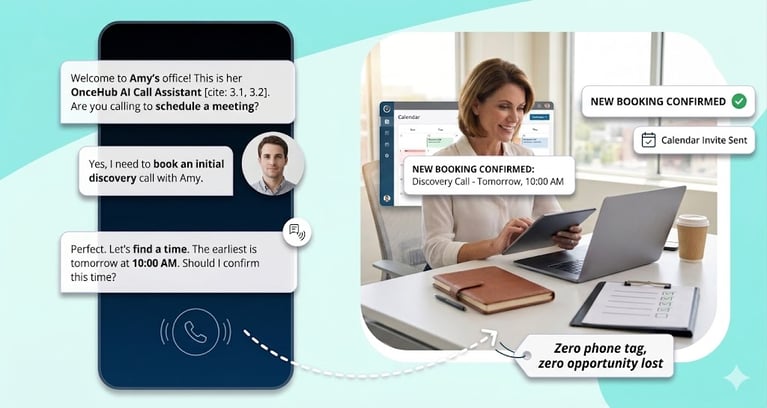
Phone tag in financial advisory practices is less a talking point and more a byproduct of constrained time. According to data from Fidelity’s 2024 RIA Benchmarking Study and 2025 Advisor Insights Study, 59% of an advisor’s working week goes to administration, compliance, and other non-client tasks. Less than half the week, in other words, is available for the work advisors are actually trained and compensated to do. Against that backdrop, every minute lost to a missed call, an unreturned voicemail, or a scheduling exchange that takes four emails to resolve is not a minor inconvenience. It is a compounding drain on a resource that is already stretched.
TL; DR
Phone tag costs financial advisory practices in staff time, client attrition, and compliance exposure. The root cause is structural, a mismatch between inbound call volume and available bandwidth, not behavioral. AI phone agents, scheduling automation, and documented call protocols address the problem at the infrastructure level, not the symptom level.
This piece examines where phone tag actually comes from, what it costs, and what a better-designed communication infrastructure looks like for advisory practices, including where AI phone agents fit and where they don’t.
What is a phone tag in financial advisory practices?
Phone tag — the cycle of missed calls, voicemails, and asynchronous callbacks that never quite connect — is one of the most persistent operational friction points in advisory practices. It rarely shows up in a P&L. It doesn't generate a compliance flag. But it costs advisory practices in ways that are real and measurable: in staff time, in client responsiveness, and in the quiet erosion of trust when someone who needed to reach you couldn't.
Direct answer: Phone tag in financial advisory practices refers to the repeated cycle of missed calls and unreturned voicemails between advisors, CSAs, clients, and prospects — driven by mismatched schedules, unstructured inbound volume, and the absence of automated routing or scheduling infrastructure.
Why Phone Tag Is a Structural Problem in Advisory Firms
The instinct when diagnosing a phone tag problem is to look for a behavioral fix — better callback discipline, a stricter protocol, a reminder in the CRM. Those things help at the margins, but they don't address the structural conditions that produce phone tag in the first place.
The J.D. Power 2023 U.S. Financial Advisor Satisfaction Study found that nearly one in three advisors (28%) say they do not have enough time to spend with clients — and that this group spends an average of 41% more time per month on administrative and compliance-related work than their better-resourced peers. The problem is not a shortage of effort. It is a structural misalignment between inbound communication volume and the bandwidth available to handle it.
Most advisory practices receive a highly varied mix of inbound contacts throughout the day: existing clients with service questions, prospects referred by a COI, beneficiaries navigating an inherited IRA, CPAs with a question about a client's cost basis, and vendors. All of these frequently compete for the same front-desk capacity. When that capacity is already allocated to administrative and compliance work, the inbound call that arrives at 2:30 PM on a Tuesday doesn't get handled — it gets deferred, and the phone tag cycle begins.
Where does phone tag break down in financial advisor workflows?
It helps to trace the failure points precisely rather than treating phone tag as one undifferentiated problem.
Unstructured Inbound Call Volume
Without a triage layer, all call types arrive in the same queue. A question about a required minimum distribution (RMD) deadline and a new prospect inquiry from a referral land identically, and neither gets prioritized appropriately.
Asynchronous Schedules
Clients who work full-time are often unavailable during core business hours — which is exactly when advisors and CSAs are most reachable. When there's no scheduling system in place, the narrowest callback windows are also the hardest to coordinate.
No Call Intent Data at Callback Time
When a client or prospect calls and reaches voicemail, the advisor calling back has no context. They don't know if the inquiry is about a qualified charitable distribution (QCD) strategy, a beneficiary designation update, or a general cost-of-living concern. That lack of context makes the callback itself less efficient — and sometimes requires a second call to gather what should have been captured the first time.
Supervision and Record-Keeping Gaps
Phone calls in an advisory practice are not only coordination moments — they are business communications that may be subject to the firm's supervisory procedures under SEC and FINRA rules. When calls are handled informally or inconsistently, practices can inadvertently create documentation gaps that become a compliance exposure. This is less about the technology used and more about whether the call-handling workflow is consistent with the firm's written supervisory procedures.
What does research say about advisor back-office technology?
Two findings from Kitces.com research are directly relevant here, and both deserve careful reading rather than selective citation.
Technology Works Best on Back-Office Logistics, Not Client-Facing Interactions
Kitces Research on Advisor Productivity has found that advisors themselves spend more than a quarter of their time on back-office activities — including administrative tasks and client-servicing requests. One Kitces analysis noted that advisory firms may benefit more from focusing on how they digitize their own internal processes and workflows than on adding yet another client-facing digital portal. The implication is that the back office — scheduling, routing, intake — is where technology has a more reliable ROI than in the client experience layer. (Source: The Latest in Financial #AdvisorTech, May 2024)
Technology Alone Does Not Automatically Reduce Admin Burden
A Kitces Research piece published in August 2025, drawing on a forthcoming study on Advisor Technology, made a more cautionary observation: technology alone does not consistently reduce administrative burden or improve advisor wellbeing, particularly for solo practitioners. Among senior advisors surveyed, adopting additional technology applications was actually negatively correlated with wellbeing.
The researchers' interpretation was not that technology is unhelpful — it's that technology targeting advisor-client interactions tends not to land, while technology targeting the logistics around those interactions is better suited to automation.
Read together, these two findings suggest a fairly specific thesis: scheduling logistics, inbound call routing, and intake coordination are precisely the kind of back-office friction points that technology can address, as long as the tool isn't being asked to do more than that.
What Does Phone Tag Actually Cost Financial Advisory Practices?
The business impact of phone tag is difficult to quantify cleanly, but it shows up in several places.
Staff Time
A CSA who places three callbacks before connecting with a client, then coordinates a meeting time over two additional exchanges, has spent 20–30 minutes on a task that a well-designed scheduling and call routing system could have resolved in under five. Across a practice handling dozens of client touchpoints per week, this is not trivial.
Client and Prospect Attrition
For existing clients, repeated difficulty reaching the practice is one of the more reliable predictors of dissatisfaction — and eventual departure. The relationship may be sound, but the operational experience undercuts it. For prospects in the middle of a decision, a delayed callback is often experienced as a signal about how the practice operates, not just a scheduling inconvenience.
Compliance Exposure
Ad hoc call handling that isn't documented consistently can create supervisory gaps. This is a real operational risk for RIAs and broker-dealers operating under SEC oversight, particularly as regulators have continued to emphasize the importance of communication archiving and supervision.
Advisor Attention Cost
Even when a callback eventually connects, the interruption it creates in the advisor's schedule has its own cost. Advisors managing a fragmented call-back queue are making frequent context switches that reduce the quality of focus available for planning work and client meetings.
How AI Phone Agents Reduce Phone Tag in Advisory Practices
AI-powered phone agents — software that handles inbound calls through a conversational voice interface — are an emerging and increasingly practical tool for advisory practices. They are not a substitute for advisor-client conversation. They are a routing and intake layer.
What AI Phone Agents Can Handle
Intake and triage. A phone agent can gather the caller's name, the nature of their inquiry, and their preferred callback time before routing the call or creating a logged task. This is not financial discovery. It is intake — and it reduces the friction of the first touch without displacing any licensed professional's role.
After-hours coverage. Most advisory practices are unreachable outside business hours. A phone agent can handle inbound calls during those windows — capturing a message, confirming an appointment, or logging basic information — so that nothing falls through the cracks when a client calls Saturday morning after reading about a market event.
Real-time appointment scheduling. Rather than a back-and-forth of "are you free Thursday?", the phone agent connects to the advisor's calendar, confirms availability, and issues a confirmed appointment to both parties — during the call. For more on how this works in practice, see how to avoid phone tag with better scheduling.
Call queue management during high-volume periods. Market volatility events, tax season, and RMD season generate call spikes that overwhelm manual front-desk capacity. A phone agent can handle initial inbound volume during those periods without creating a callback pile-up.
What AI Phone Agents Should Not Handle
It is equally important to be clear about what phone agents are not suited for in an advisory context. They should not be conducting any form of suitability discussion, providing investment guidance, or making representations about financial strategies or products. Those conversations require a licensed professional. The triage and scheduling work that precedes them does not.
The Best Tools to Reduce Phone Tag in Advisory Firms
The market for AI-powered scheduling and phone agent tools has expanded. Below is an objective look at four options relevant to advisory practices.
1. OnceHub Phone Agent — End-to-End Call Orchestration and Scheduling
OnceHub sits at the center of the inbound communication workflow as a fully automated call orchestration layer. It is designed to reduce phone tag by removing the need for manual coordination between caller, CSA, and advisor.
Core role in advisory workflows:
- Answers inbound calls using conversational AI
- Captures caller intent and reason for inquiry
- Routes calls based on defined workflows (client, prospect, referral, etc.)
- Enables real-time appointment booking directly during the call
- Logs structured intake data for follow-up or CRM workflows
Why it matters for RIAs: In advisory practices, the biggest source of phone tag is not missed calls alone — it is the multi-step coordination required after contact is made. OnceHub reduces that entire loop by converting a phone call into a structured scheduling or routing action in real time.
Think of it as: call-to-appointment conversion infrastructure
Try Phone Agents Now
Zero-configuration agents purpose-built for financial advisors
2. Smith.ai — Human-Backed Receptionist and Overflow Coverage
Smith.ai operates as a hybrid receptionist system, combining AI call screening with trained human agents for live call handling when needed.
Core role in advisory workflows:
- Answers inbound calls when internal staff are unavailable
- Screens and qualifies callers based on predefined scripts
- Handles basic intake and message capture
- Escalates complex or sensitive calls to designated contacts
- Provides after-hours and overflow coverage
Why it matters for RIAs: Advisory firms often deal with high-trust, nuanced inquiries where tone, judgment, and escalation matter. Smith.ai adds a human fallback layer, especially useful for UHNW client inquiries, estate or beneficiary-related calls, and high-emotion service requests.
Think of it as: externalized front desk with human escalation
3. Allo AI — AI-Native Call Answering and Real-Time Intake
Allo AI represents a more AI-native approach to inbound call handling, where automation replaces both receptionist and initial triage functions.
Core role in advisory workflows:
- Answers calls using conversational AI
- Captures structured caller intent in real time
- Routes inquiries based on call purpose
- Initiates scheduling or callback workflows automatically
- Handles after-hours and peak-volume call spikes
Why it matters for RIAs: Allo is designed for practices that want to minimize human involvement in first-touch call handling — particularly when inbound call volume is high and repetitive, and staffing constraints limit front-desk scalability.
Think of it as: fully automated intake and routing engine
4. Zocks — Post-Call Intelligence and Follow-Up Automation
Zocks operates after the call has occurred, focusing on capturing, structuring, and operationalizing advisor-client conversations.
Core role in advisory workflows:
- Records and transcribes advisor-client meetings
- Generates structured summaries of discussions
- Extracts follow-up tasks and action items
- Syncs insights into CRM or practice management systems
- Maintains continuity across client interactions
Why it matters for RIAs: A significant portion of phone tag inefficiency comes after contact is made — when context is lost between conversations, follow-ups require clarification calls, or advisors re-ask information already discussed. Zocks reduces this second layer of phone tag by preventing repeat clarification loops.
Think of it as: post-conversation intelligence and continuity system
How Advisory Firms Can Build a Communication System That Eliminates Phone Tag
Tools are components, not complete solutions. Sustainable improvement in phone tag reduction typically requires three things working together.
1. A Documented Inbound Call Protocol
Who receives which type of call? What is the after-hours handling? What is the escalation path when a live staff member is unavailable? Practices that document this have a clearer basis for configuring automation and a more defensible supervisory procedure for compliance purposes.
2. Calendar Discipline
Phone agents and scheduling tools only reduce phone tag if the calendar they connect to accurately reflects availability. A common failure mode is that the scheduling system shows time as open that the advisor is using for other work — which produces double-booking and its own coordination breakdowns. Two-way sync integration prevents double-bookings and scheduling conflicts while maintaining a unified scheduling process. For a deeper look at how scheduling infrastructure works, see what phone tag is and how to avoid it.
3. Consistent Follow-Through on Captured Calls
A phone agent that logs an inbound call and callback request only delivers value if the practice has a reliable process for acting on that log. The technology creates the record; the team closes the loop.
Compliance Requirements for AI Phone Agents in Financial Advisory Firms
Any technology that touches client or prospect communications in an advisory practice exists within a regulatory framework. Under SEC and FINRA supervision requirements, firms are generally expected to:
- Maintain documentation of business-related client communications
- Have defined supervisory procedures in place
- Ensure that any third-party vendor handling those communications is consistent with the firm's documented policies
This does not make AI phone agents off-limits — it means implementation needs to be deliberate. Before deploying any tool that handles client calls, advisory practices should confirm that the workflow aligns with their written supervisory procedures and involve their compliance team or outside counsel in that review.
Why Solving Phone Tag Is an Operational Priority for Advisory Firms
Phone tag is not an advisor performance problem. It is an infrastructure problem — and one that is largely solvable with the right combination of workflow design and purpose-built tooling.
The Kitces research cited above is useful precisely because it's honest about what technology can and cannot do. Adding tools doesn't automatically produce results, and technology that is asked to substitute for human judgment in advisory relationships tends to underperform. What works is technology that is targeted at a specific, well-defined friction point: in this case, the coordination and intake work that surrounds advisor-client calls.
That work is not high-judgment. It is high-volume, inconsistently handled, and consequential when it goes wrong. Getting it right doesn't require a complete overhaul of how a practice operates. It requires recognizing that the logistics of reaching an advisor are not the same thing as the conversation itself — and that the two deserve different infrastructure.
Frequently Asked Questions
What is an AI phone agent and how is it different from a voicemail system?
An AI phone agent is a conversational software tool that handles inbound calls in real time — gathering caller information, understanding the nature of the inquiry, and routing accordingly. Unlike voicemail, it can complete tasks during the call itself, such as booking a confirmed appointment or triaging to the appropriate staff member.
Can financial advisors use AI tools for client calls without violating compliance requirements?
Yes, with appropriate configuration and compliance review. The tool itself does not determine compliance — the workflow does. Practices should ensure that any AI phone agent is implemented consistently with their written supervisory procedures and applicable SEC/FINRA record-keeping requirements.
What types of calls are appropriate for an AI phone agent to handle?
Intake, scheduling, routing, and after-hours message capture are well-suited to AI phone agents. Any call that involves substantive financial guidance, suitability discussion, or investment recommendations should be handled by a licensed professional.
Does OnceHub Phone Agent work for solo RIA practices or only larger firms?
OnceHub Phone Agent is designed to scale across practice sizes. For solo practitioners, the primary value is after-hours coverage and structured intake. For larger practices with multiple advisors or client service teams, workflow segmentation and call routing add additional operational value.
How does phone tag affect client retention in financial advisory practices?
While the research on this specific mechanism is limited, the J.D. Power 2023 Financial Advisor Satisfaction Study found that advisors who reported insufficient time with clients had Net Promoter Scores meaningfully lower than their peers — suggesting that operational responsiveness and relationship quality are connected. Persistent difficulty reaching a practice is one of the more reliable predictors of client dissatisfaction over time.
What is the most effective way to eliminate phone tag in a financial advisory firm?
The most effective approach combines three elements: a documented inbound call protocol that defines routing and escalation paths, a scheduling tool with real-time calendar sync that eliminates back-and-forth, and an AI phone agent that handles intake and after-hours coverage automatically. Technology addresses volume and consistency; the protocol ensures nothing falls through the cracks.
OnceHub is a scheduling and communication automation platform. This blog was produced in collaboration with OnceHub's content team. Product capabilities described reflect publicly available information and should be verified with the vendor for your specific use case and compliance requirements.
References:
Better scheduling starts here
No credit card required