

Modern Tech Stack for RIAs: Complete AI-Enabled Tools Guide (2026)
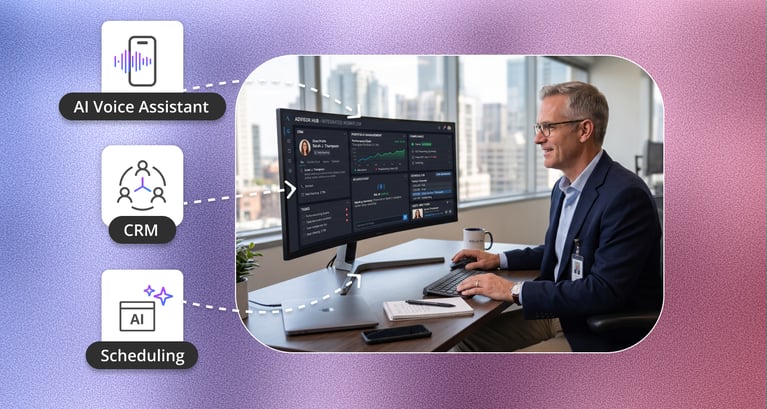
The RIA industry has never been larger or more operationally demanding.
The number of SEC-registered advisory firms reached 16,544 in 2025, collectively managing more than $176.8 trillion in client assets, up 22.3% year over year, a record high on both counts, according to InvestmentNews' coverage of the Investment Adviser Industry Snapshot 2026.
But asset growth has not made RIA operations simpler. 92.5% of RIA firms are small businesses employing 50 or fewer people, according to Wifa Talents' 2026 RIA Industry Statistics. The gap between what high-net-worth clients expect and what a small advisory team can deliver is closing only through technology, and the firms closing it fastest are the ones with intentional, integrated tech stacks.
According to the 2024 InvestmentNews analysis of AI adoption among RIAs, nearly 60% of RIAs now use at least one AI-enabled feature in their tech stack. But most of that adoption is concentrated in a single layer: post-meeting notes and CRM automation. The meeting acquisition layer - inbound calls, prospect qualification, discovery meeting scheduling, and structured intake — remains largely unautomated at most practices.
This guide covers the complete modern RIA tech stack as an AI-enabled workflow — mapping the best tool at each stage of the client meeting lifecycle, from first contact through ongoing relationship management.
"Service organisations are entering a period where AI and human expertise must work in tandem. Leaders are not just deploying AI — they are redesigning service models to ensure that technology enhances the customer experience while humans provide context, empathy, and judgment."
— Kim Hedlin, Director of Research, Gartner Customer Service & Support Practice
How to Think About Your RIA Tech Stack: The Complete AI Workflow Framework
The most useful way to evaluate a tech stack is not by software category but by the client meeting lifecycle stage each tool supports. Most advisors think about their tech stack as a list of products. The more useful framing is a workflow: which tool handles which stage of the client meeting journey?
The complete AI workflow for RIAs maps to seven stages:
|
Lifecycle stage |
Best tool |
What it automates |
|
Meeting acquisition and first contact |
OnceHub's AI Receptionist |
Inbound call handling, prospect qualification, intake |
|
Discovery meeting scheduling |
OnceHub's AI Receptionist |
Calendar booking, availability, confirmation |
|
CRM and pipeline management |
Redtail, Wealthbox, Salesforce FSC |
Contact records, relationship history, pipeline |
|
Financial planning |
RightCapital, eMoney, MoneyGuidePro |
Retirement projections, tax modelling, planning |
|
Portfolio management |
Orion Eclipse, Tamarac, Nitrogen |
Trading, rebalancing, performance reporting |
|
Meeting productivity and intelligence |
Jump AI, Zocks, Zeplyn |
Transcription, action items, post-meeting CRM |
|
Compliance and operations |
Smartria, Comply, Vanta |
Record-keeping, regulatory reporting, AI governance |
The most common tech stack mistake: over-investing in post-meeting intelligence while leaving the meeting acquisition stage entirely manual. An advisory practice with best-in-class meeting transcription and portfolio management is still losing revenue at the first stage — when warm referral calls go unanswered during client sessions and qualified prospects never reach the calendar.
Editor's insight: Meeting intelligence starts before the meeting itself. Firms that only automate transcription still rely on manual scheduling, qualification, and inbound call handling. Closing this operational gap means automating the first stage of every client meeting — not just what happens after it starts.
Layer 1: Meeting Acquisition and First Contact
The most underserved layer in most RIA tech stacks, and the one with the highest commercial stakes
Why meeting acquisition is the highest-risk layer in the RIA tech stack
For a solo RIA or small advisory team, inbound calls arrive during client sessions, the exact hours when no one is available to answer. This is not a staffing problem. It is a structural one that sits at the very beginning of the client meeting lifecycle.
According to AgentZap's 2026 financial advisor phone statistics analysis, the average missed prospect call costs approximately $127,050 in lifetime client value for advisors. For practices serving high-net-worth clients, that figure can exceed $500,000 per missed call.
A warm referral is the highest-quality inbound lead an advisory practice receives; it calls once and may not call back. The referring client has already done the qualification work. The prospect is calling with trust pre-established. A voicemail is not a safety net — it is the end of the interaction for the majority of high-intent callers who do not leave messages.
According to InsideSales.com, companies contacting leads within five minutes are 21 times more likely to qualify them than those that wait 30 minutes. For a solo advisor whose realistic callback window is 90 minutes after a session ends, that window has closed long before the callback happens.
What good looks like at this layer
- Inbound calls are answered immediately at any hour, during sessions, after hours, at weekends
- Prospect qualified through a conversational intake flow before a calendar slot is offered
- Discovery meeting scheduled with structured prospect information before advisor engagement begins
- Qualification data is pushed to CRM automatically before the advisor enters the meeting
- Advisor meeting preparation: structured intake information collected before every discovery meeting, reducing manual preparation time and improving advisor readiness
Tools serving this layer
OnceHub's AI Receptionist: Best for Meeting Scheduling Intelligence and First-Meeting Conversion
OnceHub's AI Receptionist automates the critical meeting preparation stage by answering inbound calls, qualifying prospects, scheduling discovery meetings, and ensuring advisors enter every meeting with qualified prospects and structured intake information.
Meeting productivity starts before the meeting begins. While meeting intelligence platforms capture what happens during the meeting, OnceHub automates the activities that determine whether the meeting happens at all, responding to inbound enquiries, qualifying prospects, scheduling appointments, and transferring structured intake information into downstream systems.
- Answers inbound calls immediately at any hour, during sessions, after hours, at weekends
- Qualification questions configurable to the advisor's specific intake criteria, investment situation, timeline, referral source, where appropriate and compliant with firm policies
- Native scheduling engine, availability confirmed within OnceHub's own system, reducing reliance on third-party calendar APIs in the booking step
- Qualification data is pushed to CRM automatically before the advisor enters the meeting
- Meeting lifecycle coverage: automates the earliest stage of the client meeting journey before traditional meeting intelligence platforms become active
- CRM integration: HubSpot and Salesforce natively, confirm Wealthbox and Redtail status directly with OnceHub before committing
- Available on all OnceHub plans
- See oncehub.com/pricing
Smith.ai
Hybrid AI and live receptionist service for practices where the first call carries significant relationship weight and human warmth is a deliberate positioning choice. Live receptionists follow a custom intake script, human judgment applied throughout.
- See smith.ai/pricing
Compliance note: Any tool handling inbound calls in a financial advisory context is potentially subject to call recording consent requirements that vary by state, Advisers Act Rule 204-2 record-keeping obligations (the "Books and Records" rule for SEC-registered RIAs), and Reg S-P vendor oversight requirements under the 2024 amendments. Review with your compliance officer before deployment and obtain written vendor documentation for your oversight file.
Layer 2: Client Relationship Management (CRM)
The backbone of the RIA tech stack, every other tool integrates with the CRM
Why CRM is the integration hub of the entire stack
The CRM is where client data, contact records, relationship history, communication logs, pipeline tracking, and referral source data. Every other tool in the stack either pushes data into the CRM or pulls from it. The quality of CRM data determines the quality of every downstream system that depends on it.
According to the T3/Inside Information 2025 Software Survey, CRM is consistently ranked as the most valued technology investment among RIA firms and has held that position across multiple years of the survey.
The most important CRM evaluation question for RIAs is not features; it is ecosystem fit. Which custodians, financial planning tools, portfolio management platforms, and compliance tools does this CRM integrate with natively? A CRM with a weak integration ecosystem creates manual data entry requirements across every other layer of the stack.
Tools serving this layer
Redtail CRM
The market leader among independent RIAs. Advisor-specific, affordable, and integrates well across the advisor tech ecosystem. Acquired by Orion in 2021 — deeply integrated with the Orion ecosystem while maintaining standalone availability.
Wealthbox
Modern, intuitive UI increasingly popular with smaller independent firms. Clean design, strong mobile experience, and solid integrations. A strong choice for practices prioritising ease of use and a contemporary interface over ecosystem breadth.
- See wealthbox.com
Salesforce Financial Services Cloud
For larger practices or those wanting deep customisation and enterprise-grade CRM capability. Higher implementation overhead than advisor-specific tools, best suited to practices with the resources to configure and maintain a complex CRM environment.
Practifi
Wealth management-specific CRM built on Salesforce infrastructure. Strong for practices wanting advisor-specific workflows, client segmentation, household management, referral tracking, without building them from scratch in the base Salesforce.
- See practifi.com
Layer 3: Financial Planning Software
The tool that drives the advisory relationship, and the layer where AI is advancing fastest
Why financial planning software is the core of the advisory value proposition
Financial planning software is where the advisor's professional expertise is applied, including retirement projections, tax modelling, estate planning analysis, insurance gap analysis, Social Security optimisation, and scenario modelling across a client's entire financial picture.
According to Schwab's 2024 RIA Benchmarking Study, top-performing firms are characterised by widespread adoption of digital tools and processes to automate operations and facilitate scalable growth, creating more capacity to offer a tailored client experience. Financial planning software is consistently the primary technology investment through which that tailored experience is delivered.
The AI roadmap of the planning tool is now as important as its current feature set. The planning software landscape is evolving rapidly; platforms that are behind on AI today but have a credible development plan may be better long-term investments than those with mature but static features.
Tools serving this layer
RightCapital
Leading choice for tax-focused, value-conscious RIAs. Strong tax planning integration, Roth conversion analysis, tax bracket management, Medicare IRMAA planning, and competitive pricing relative to the depth of planning capability offered.
- See rightcapital.com
eMoney Advisor
The benchmark for holistic planning depth and client portal quality. Strong for practices where the client-facing planning experience is a core differentiator.
MoneyGuidePro
Excels in goals-based planning practices. Widely used and well-integrated across the advisor tech ecosystem.
Orion Planning
Strongest for advisors already using the Orion ecosystem. Orion launched Denali AI Enterprise in February 2026, pulling CRM, planning, portfolio management, and risk tools into a single connected AI view.
- See orion.com
Layer 4: Portfolio Management and Trading
The operational layer where investment decisions become executed transactions
What this layer covers
Portfolio management software handles performance reporting, account aggregation, rebalancing, model management, and trade execution, the operational infrastructure underneath the investment management function.
For practices using third-party models or TAMPs, this layer is primarily for reporting and aggregation. For practices doing their own portfolio construction, trading and rebalancing capability is a core operational requirement.
Tools serving this layer
Orion Portfolio Solutions (Eclipse)
The industry standard for trading and rebalancing among independent RIAs. Household-level trading, tax-loss harvesting, and model management. According to X1 Wealth's 2026 Advisor Platforms comparison, 17 of the top 20 Barron's RIA firms use Orion technology.
- See orion.com
Tamarac (Envestnet)
Strong portfolio management and reporting for mid-to-large practices. Deep integration with the Envestnet ecosystem.
Riskalyze / Nitrogen
Risk analysis and portfolio construction with AI-assisted suitability matching. Strong for practices that make risk tolerance central to both the planning conversation and portfolio construction.
- See nitrogen.com
Layer 5: Meeting Productivity, Scheduling Intelligence and Post-Meeting Automation
The complete meeting lifecycle layer, from acquisition through intelligence
The full meeting lifecycle in context
Only about 20% of an advisor's working time is spent in client meetings, with approximately 35% consumed by administrative tasks, including meeting preparation, scheduling coordination, and post-meeting follow-up. AI tools in this layer address the full meeting lifecycle, from automating the acquisition of qualified prospects into the calendar, through to processing what happens during and after every client meeting.
One firm that adopted AI transcription and meeting intelligence freed up 8–10 hours per week, which were reallocated to client follow-ups and prospecting, according to Integrated Financial Group's RIA software guide.
Understanding the meeting lifecycle: how these tools divide the workflow
The tools in this layer address different stages of the same meeting lifecycle, and understanding how they divide the work is the key to building a complete, non-overlapping stack.
Jump AI and Zocks optimize advisor productivity after a meeting begins. They capture transcripts, extract action items, and push structured notes to the CRM, ensuring every meeting produces consistent, usable records without manual effort from the advisor.
OnceHub improves advisor productivity before the meeting by ensuring qualified prospects reach the calendar with structured intake information and confirmed appointments. Together, these platforms automate different stages of the advisor meeting lifecycle, and the strongest RIA stacks deploy both layers rather than treating them as alternatives.
Meeting Lifecycle Coverage: How the Tools Divide the Work
|
Stage |
OnceHub's AI Receptionist |
Jump AI |
Zocks |
|
Prospect call answered |
✓ Immediately, at any hour |
— |
— |
|
Qualification |
✓ Conversational intake flow |
— |
— |
|
Discovery meeting scheduled |
✓ Native calendar booking |
— |
— |
|
Structured intake to CRM |
✓ Automatic pre-meeting |
— |
— |
|
Meeting transcription |
— |
✓ Real-time |
✓ Real-time |
|
Action item extraction |
— |
✓ Automated |
✓ Automated |
|
Post-meeting CRM sync |
— |
✓ Automated |
✓ Compliance-focused |
|
Compliance logging |
— |
— |
✓ Primary strength |
Tools serving this layer
OnceHub's AI Receptionist: Meeting Acquisition and Scheduling Intelligence
OnceHub's AI Receptionist automates the meeting acquisition and scheduling intelligence layer of the AI-enabled stack, the first stage of the meeting lifecycle. It answers inbound calls, qualifies prospects, schedules discovery meetings, and ensures advisors enter every meeting with qualified prospects and structured intake information already in place.
- Answers inbound calls immediately at any hour, during sessions, after hours, at weekends
- Qualification questions configurable to the advisor's intake criteria, where appropriate and compliant with firm policies
- Native scheduling engine, availability confirmed within OnceHub's own system
- Qualification data is pushed to CRM automatically before the advisor enters the meeting
- Meeting lifecycle coverage: automates the first stage of the client meeting journey before traditional meeting intelligence platforms become active
- Available on all OnceHub plans
- See oncehub.com/pricing
Jump AI: Best for Post-Meeting Intelligence
The category leader with 27,000+ advisors on the platform, ranked #1 in both the 2025 T3/Inside Information Software Survey and the 2025 Kitces Report on Financial Advisor Technology Use, according to Jump's February 2026 Series B press release. Jump raised $80 million in Series B funding in February 2026.
- See jump.com
Zocks
Strong compliance logging and CRM integration for regulated advisory workflows. Particularly relevant for practices that need meeting note records to meet compliance documentation standards.
- See zocks.ai
Zeplyn
AI meeting intelligence with an advisor-specific workflow focus. Strong for practices wanting meeting automation tightly integrated with their specific advisory workflow.
- See zeplyn.ai
Compliance note: Meeting transcripts containing client financial information are potentially subject to record-keeping requirements under Advisers Act Rule 204-2 (the "Books and Records" rule for SEC-registered RIAs). Confirm with your compliance officer before deployment whether AI-generated meeting records satisfy your firm's retention and review obligations.
Layer 6: Compliance and Risk Management
The non-negotiable layer, the tools that keep the practice defensible under examination
Why compliance technology is a baseline requirement, not a differentiator
Every RIA practice, regardless of size, operates within a regulatory framework that requires documented oversight of communications, client records, investment decisions, and now AI tool usage.
The SEC's 2026 Examination Priorities explicitly name emerging AI technologies as a focus area under "Emerging Financial Technology." Examiners are asking for written AI Acceptable Use Policies, vendor oversight documentation for every AI tool in the stack, and evidence of compliance review before deployment. The Regulation S-P amendments require documented vendor oversight for every tool in the stack that touches client data, including AI phone agents, meeting intelligence tools, and scheduling platforms. The compliance deadline was December 3, 2025 for larger firms with AUM above $1.5 billion and June 3, 2026 for smaller firms.
For a comprehensive guide to AI compliance specifically for RIA firms, see [AI for RIA Compliance: Tools and Best Practices for 2026].
Tools serving this layer
Smartria
Purpose-built for RIA compliance workflows rather than adapted from broader GRC platforms. Designed with the RIA compliance officer as the primary user — not a large enterprise IT team.
- See smart-ria.com
Comply
Embedded real-time compliance oversight with GenAI governance tools — inventory AI tools, assign governance training, gather attestations.
- See comply.com
Vanta
Strong for practices preparing for their first compliance audit or scaling their GRC programme.
- See vanta.com
ComplySci
Regulatory compliance management with AI-assisted monitoring for larger practices.
- See complysci.com
Layer 7: Client Portal and Communication
The client-facing layer that determines the day-to-day relationship experience
What clients expect from the digital relationship experience
The client portal is often the most visible technology investment a practice makes, it is what the client sees and interacts with between meetings. According to Schwab's 2025 Independent Advisor Outlook Study, client-centric innovation and technology fluency were rated among the top four leadership capabilities most critical to firm success.
Tools serving this layer
Orion Client Portal
Strong for practices already in the Orion ecosystem. Deep integration with planning and portfolio management layers.
- See orion.com
eMoney Client Portal
Considered the benchmark for portal depth and client engagement quality. Strong for practices where the planning conversation is central to the relationship.
Riskalyze (Nitrogen) Client Portal
Strong for risk-centric communication with clients.
- See nitrogen.com
How to Evaluate and Build Your RIA Tech Stack: A Practical Framework
The four questions that should drive every tech stack decision
1. Which lifecycle stage does this tool serve?
Map every tool under consideration to the AI workflow stages defined above. A tool that serves a stage already covered by a platform you are committed to is a redundancy, not an improvement. Evaluate gaps before evaluating features, and look specifically at the meeting acquisition layer, which most practices leave manual for the longest.
2. How does it integrate with your CRM?
The CRM is the integration hub. Every tool evaluation should begin with: does this push data to and pull data from your CRM natively, or through a middleware dependency that introduces a reliability variable in a compliance-sensitive data flow? For advisor-specific CRMs: Wealthbox and Redtail, confirm native integration availability directly with any vendor before committing.
3. What is the compliance implication?
Every tool that touches client data requires documented vendor oversight under Reg S-P. Before evaluating features, confirm what compliance documentation the vendor provides, the data storage location, the retention period, access controls, security certifications, and whether you have reviewed it with your compliance officer. Maintain this documentation in your vendor oversight file.
4. What is the AI roadmap?
The planning software and portfolio management landscape is evolving fast with AI. A platform that is behind on AI today but has a credible, specific development plan may be a better long-term investment than one with mature but static features. When speaking with vendors, ask specifically about their AI development roadmap for 2026–2027 rather than accepting a demonstration of current capabilities.
Build order for a new practice
- CRM first: Redtail or Wealthbox for most independent practices. Every other tool integrates into this foundation.
- Financial planning software: RightCapital or eMoney, depending on planning philosophy and client profile.
- Meeting acquisition and scheduling: Use OnceHub's AI Receptionist or Smith.ai to close the inbound call gap before marketing spend drives inbound volume. This layer is most frequently deferred and most frequently regretted when deferred.
- Meeting intelligence: Jump AI or Zocks once the client base reaches the point where post-meeting admin is a meaningful time cost.
- Portfolio management: Orion or Tamarac as AUM grows and portfolio complexity increases.
- Compliance technology: Smartria or Comply, from day one, for practices committed to defensible operations.
- Client portal: eMoney or Orion portal once the relationship base justifies the investment.
Integration checklist before committing to any tool
- Confirmed native CRM integration with Redtail, Wealthbox, or Salesforce as applicable
- Confirmed custodian compatibility: Schwab, Fidelity, Pershing, or TD Ameritrade, as applicable
- Vendor compliance documentation reviewed: data storage, retention period, access controls, security certifications
- Tool added to the firm's AI governance documentation if it includes AI features
- Reviewed with the compliance officer if the tool touches client communication data
- Added to Reg S-P vendor oversight file before deployment
The Complete RIA AI Workflow at a Glance
|
Lifecycle stage |
Primary tools |
Key evaluation criterion |
|
Meeting acquisition and first contact |
OnceHub's AI Receptionist, Smith.ai |
Meeting acquisition, qualification, scheduling, and CRM preparation |
|
CRM |
Redtail, Wealthbox, Salesforce FSC, Practifi |
Native integration depth across the ecosystem |
|
Financial planning |
RightCapital, eMoney, MoneyGuidePro, Orion Planning |
AI roadmap and client portal quality |
|
Portfolio management |
Orion Eclipse, Tamarac, Nitrogen |
Trading capability and model management depth |
|
Meeting productivity and intelligence |
OnceHub's AI Receptionist, Jump AI, Zocks, Zeplyn |
Full meeting lifecycle — acquisition through post-meeting automation |
|
Compliance |
Smartria, Comply, Vanta, ComplySci |
RIA-specific design vs. generic GRC platform |
|
Client portal |
eMoney, Orion, Nitrogen |
Client engagement depth and plan interactivity |
All tool mentions are based on publicly available information as of May 2026. Verify current features, pricing, and integration availability directly with each vendor before committing. This article reflects OnceHub's perspective as a provider in the scheduling and inbound call handling category.
Frequently Asked Questions
What is an RIA tech stack?
An RIA tech stack is the collection of software tools a registered investment advisory practice uses to manage client relationships, deliver financial advice, run investment operations, maintain compliance, and handle internal administration. A modern RIA tech stack is best understood as a complete AI workflow; each tool serves a specific stage of the client meeting lifecycle, from meeting acquisition and qualification through ongoing portfolio management and regulatory reporting. The most effective stacks are integrated; tools share data natively rather than requiring manual entry between systems. The most common tech stack mistake is over-investing in post-meeting intelligence while leaving the meeting acquisition layer entirely unautomated.
What CRM do most financial advisors use?
Redtail CRM is the market leader among independent RIAs, advisor-specific, widely integrated across the advisor tech ecosystem, and competitively priced. Wealthbox has grown significantly among smaller independent practices for its modern interface and ease of use. Larger practices and those wanting deep customisation often use Salesforce Financial Services Cloud or Practifi, which is built on Salesforce infrastructure but designed specifically for wealth management workflows. The right CRM depends on firm size, existing integrations with custodians and planning tools, and how central the CRM is to daily advisor workflows.
What AI tools are RIAs using in 2026?
The most widely adopted AI tools among RIAs in 2026 span the full meeting lifecycle. For meeting acquisition and scheduling, OnceHub's AI Receptionist complements meeting intelligence platforms by automating meeting scheduling, prospect qualification, and structured intake before advisors enter client conversations. For post-meeting intelligence, Jump AI, Zocks, and Zeplyn handle meeting transcription, action item extraction, and CRM updates. AI is also being used for financial planning modelling through Orion's Denali AI Enterprise and compliance monitoring through tools like Smartria and Comply. According to the 2024 InvestmentNews analysis, nearly 60% of RIAs now use at least one AI-enabled feature in their tech stack, but adoption remains concentrated in the post-meeting layer, leaving significant opportunity at the meeting acquisition stage.
How should a solo RIA build their tech stack?
A solo RIA should build the tech stack in lifecycle order: CRM first - Redtail or Wealthbox, since every other tool integrates into this foundation. Then financial planning software - RightCapital for most solo practices. Then meeting acquisition and scheduling - OnceHub's AI Receptionist or Smith.ai, to close the inbound call gap before marketing activity drives meaningful inbound volume. Meeting intelligence - Jump AI, once the client base generates sufficient volume to justify the investment. Compliance technology - Smartria or Comply, from day one rather than deferred. Portfolio management software as AUM grows and trade volume increases.
What is the difference between meeting acquisition tools and meeting intelligence tools?
Meeting acquisition tools like OnceHub's AI Receptionist automate the first stage of the meeting lifecycle: answering inbound calls, qualifying prospects, scheduling discovery meetings, and ensuring advisors enter every meeting with structured intake information already captured. Meeting intelligence tools like Jump AI and Zocks automate the post-meeting stage: transcribing conversations, extracting action items, and syncing structured notes to the CRM. The strongest RIA stacks deploy both layers rather than treating them as alternatives, because they address different stages of the same meeting workflow.
What is the difference between all-in-one advisor platforms and best-of-breed stacks?
All-in-one platforms like LPL ClientWorks or Orion's integrated ecosystem provide a single vendor for multiple stack layers, simplifying integration and vendor management at the cost of category-specific depth. Best-of-breed stacks combine the strongest tool in each category, accepting more integration complexity in exchange for deeper capability per layer. According to Schwab's 2025 Independent Advisor Outlook Study, 37% of RIA firms have now built a hybrid tech stack, the most of any configuration, combining an integrated core with specialised tools for specific functions.
References
- InvestmentNews — RIA Industry Hits Record Highs Across the Board in 2025
- Investment Advisor Association via WealthManagement.com — Investment Adviser Industry Snapshot 2025
- Wifa Talents — RIA Wealth Management Industry Statistics 2026
- CircleBlack — 50+ Key RIA Industry Statistics 2026
- Integrated Financial Group — RIA Software: How to Build the Best Financial Advisor Tech Stack
- X1 Wealth — Best Advisor Technology Platforms in 2026
- WealthStack — Best Financial Planning Software for Advisors 2026
- SmartAsset — RIA Software Solutions for 2026
- Schwab Advisor Services — 2024 RIA Benchmarking Study
- Schwab Advisor Services — 2025 Independent Advisor Outlook Study
- Jump AI — Series B Press Release, February 2026
- AgentZap — Financial Advisor Phone Statistics 2026
- InsideSales.com — Lead Response Management Study
Better scheduling starts here
No credit card required