


A referred prospect calls at 2:15 PM on a Thursday. The advisor is in a portfolio review — exactly the kind of session that cannot be interrupted for an unknown number. The call goes to voicemail. The prospect does not leave a message. By Monday morning, they have already scheduled a meeting with another firm.
That scenario repeats across advisory practices every week. It does not appear on any report. It generates no complaint, no review, no signal of any kind. It simply compounds — quietly, invisibly — across every week of the year.
According to AgentZap's 2026 financial advisor phone statistics analysis, the average missed prospect call costs approximately $127,050 in lifetime client value for advisors. For practices serving high-net-worth clients, that figure can exceed $500,000 per missed call.
This article covers why independent RIAs and solo advisors are structurally exposed to this problem, what AI phone assistants can do about it, and how to evaluate the tools available in 2026.
The Referral Call That Doesn't Get Called Back
The referral call is the highest-quality inbound lead an advisory practice receives. The referring client has already done the qualification work. The prospect arrives with trust pre-established. They are not cold. They are warm — and they called because someone they trust told them to.
When that call hits voicemail, something specific happens. The prospect does not interpret it as "the advisor is busy." They interpret it as a signal about how the practice operates — about responsiveness, about how they will be treated as a client. A prospect managing significant investable assets has options. They move on.
Unlike a cold prospect who found the advisor through a directory and might call back, a referral who calls once and does not reach anyone is often gone. The warmest lead in the practice's pipeline was lost — not to a better competitor, but to a structural availability gap that had nothing to do with the quality of the advice.
This is the problem AI phone assistants are designed to solve.
Why Financial Advisors Are Uniquely Vulnerable to Missed Inbound Calls
Most professions can absorb a two-hour callback delay without serious consequence. Financial advisory is not one of them — and the structural reasons are specific to how advisory practices actually operate.
Protected session time creates systematic gaps
An advisory practice is built around focused, uninterrupted client sessions. A 60-minute financial planning review, a portfolio discussion with a significant account, an annual review with a long-standing client — these are conversations that cannot be interrupted for an unknown inbound call. That structural reality means inbound prospect calls consistently arrive during the exact hours a solo advisor is least able to answer them.
HNW and UHNW prospects may be less likely to follow up immediately
High-net-worth individuals often have high expectations of the professionals they engage. A prospect managing significant investable assets who calls a financial advisor and reaches a generic voicemail recording may be less likely to follow up immediately, depending on the urgency of their enquiry and their expectations of responsiveness. The perception of inaccessibility in a trust-based profession can be disproportionately damaging at the very first point of contact — before any relationship has been established.
Referral calls carry the highest stakes
A referral call is the warmest inbound enquiry an advisory practice receives. The referring client has already done the qualification work. The prospect is calling with a level of trust pre-established. And yet a referral who calls once, does not reach anyone, and does not hear back promptly may be less likely to persist than a cold prospect who found the advisor through a directory. The warmest leads are often the most time-sensitive.
What delayed call responses cost financial advisors
High-intent calls that arrive late on a Friday afternoon sit unaddressed until Monday morning. By then, the prospect's urgency may have passed, they may have contacted another advisor, or the motivation behind the original call may have dissipated. For a solo practice without weekend coverage, this represents a recurring gap that accumulates across every week of the year.
No redundancy in a solo or small practice
A sales team can distribute inbound call coverage across multiple reps. A solo RIA or two-person advisory team has no such redundancy. Every missed call is a gap with no cover — and unlike a larger firm, no colleague might happen to answer, no receptionist to take a message, no system to catch what falls through.
Research on advisor productivity consistently shows that for the typical financial advisor, only about 20% of their working time is spent in client meetings, while 35% is split between business development and other management and administrative tasks — including scheduling — according to Kitces Research's advisor productivity studies. The implication is that inbound call handling sits within a category of work that already consumes a disproportionate share of advisor time relative to its revenue contribution.
How AI Phone Assistants Fill the Pre-Booking Gap for Advisors
This is a different category from the AI tools most advisors are currently deploying.
AI meeting notetakers — Jump, Zocks, Zeplyn — handle what happens during and after the meeting. They attend calls, transcribe conversations, extract action items, and push updates to the CRM. They do not handle the inbound call that happens before the meeting is booked. Jump has established itself as a category leader with 27,000+ advisors on the platform, according to Wealthtech Today's 2026 AI Notetakers report — reflecting the scale of advisor investment in the post-meeting layer.
Virtual receptionist services — live or hybrid — take messages and pass them to the advisor. They handle the call but may not complete the booking step on the caller's behalf.
AI phone assistants — when configured for booking, can handle the inbound call, qualify the prospect, and confirm an appointment before the caller hangs up.
How the workflow can look in practice:
A prospect is referred by an existing client and calls the advisory practice at 2:15 PM on a Thursday. The advisor is in a client session.
The AI phone assistant answers immediately — professional greeting, natural conversational tone. It identifies the nature of the enquiry, conducts a qualifying conversation covering the prospect's investment situation, goals, and timeline, checks the advisor's live calendar availability, and offers available discovery meeting slots. The prospect selects one. A calendar confirmation arrives in their inbox within seconds.
The advisor finishes their 3:00 PM session to a booking notification — with the prospect's qualification responses already captured.
What this does not replace: human judgment on complex or sensitive client situations, compliance-sensitive discussions, conversations that require the specific expertise or relationship the advisor has built. Those still require the advisor directly. An AI phone assistant addresses the structural first-contact problem — not the advisory relationship itself.
Compliance and Data Considerations for RIAs
Compliance is not a differentiating feature in this category. For any tool handling inbound calls in a financial advisory context, it is a baseline requirement — and the questions worth asking before deployment are specific.
SEC and FINRA record-keeping
Any tool that captures or processes client communication data as part of an advisory workflow is potentially subject to record-keeping requirements under SEC Rule 17a-4 and FINRA Rule 4511. Whether AI phone agent interactions fall within scope depends on your firm's structure, the nature of conversations handled, and your compliance officer's interpretation. Confirm this before deployment, not after.
Call recording and consent requirements
State-by-state consent requirements for recorded calls vary significantly. One-party consent states require only one party to know the call is being recorded. Two-party consent states require both parties to be informed. Any AI phone assistant that records calls must be configured to comply with the applicable law for the caller's location — which, for advisors with clients across multiple states, may require dynamic disclosure handling.
Data handling and retention
Where is call data stored? For how long? Who has access? Is it encrypted in transit and at rest? Can it be exported or deleted on request? A vendor who cannot answer these clearly and specifically is not ready for financial services use.
Client and prospect disclosure
Disclosure requirements for AI involvement in client-facing calls vary by jurisdiction and must follow applicable law and firm policy. Some advisors choose to disclose proactively as a matter of transparency regardless of legal requirement.
The regulatory landscape
Regulators including the SEC and FINRA are actively evaluating AI usage in financial services workflows. Advisors adopting AI phone tools now should build compliance review into their deployment process and maintain documentation of their configuration decisions.
Compliance checklist: questions to ask every vendor before deploying
Before committing to any AI phone assistant in a financial advisory context, confirm the following with the vendor in writing:
- [ ] How is call data stored — location, encryption standard, and access controls?
- [ ] What is the data retention period — and can records be exported or deleted on request?
- [ ] Does the platform support call recording consent handling that varies by state?
- [ ] What audit logging capability does the platform provide for SEC Rule 17a-4 and FINRA Rule 4511 purposes?
- [ ] What compliance certifications does the vendor hold — SOC 2, HIPAA — and are they current?
- [ ] Does the vendor provide a Business Associate Agreement or equivalent compliance documentation?
- [ ] How will the firm be notified of material changes to the vendor's data handling practices?
- [ ] Has the vendor been deployed in other RIA or financial services contexts — and can they provide reference documentation?
Maintain this documentation in the firm's vendor oversight file. The SEC's 2026 Examination Priorities make AI governance documentation an examination expectation — not a best practice. See [AI for RIA Compliance: Tools and Best Practices for 2026] for a full compliance framework.
How AI Phone Assistants Fit Into an Advisor's Existing Tech Stack
The RIA tech stack in 2026 is layered. Most independent advisors are running a CRM — Wealthbox, Redtail, or Salesforce — alongside financial planning tools, portfolio management software, AI meeting notes, and calendar and scheduling infrastructure.
An AI phone assistant can sit at the early stage of that stack — the first point of contact before other tools are engaged. Getting this layer right may improve the quality of everything downstream.
A potential connected workflow:
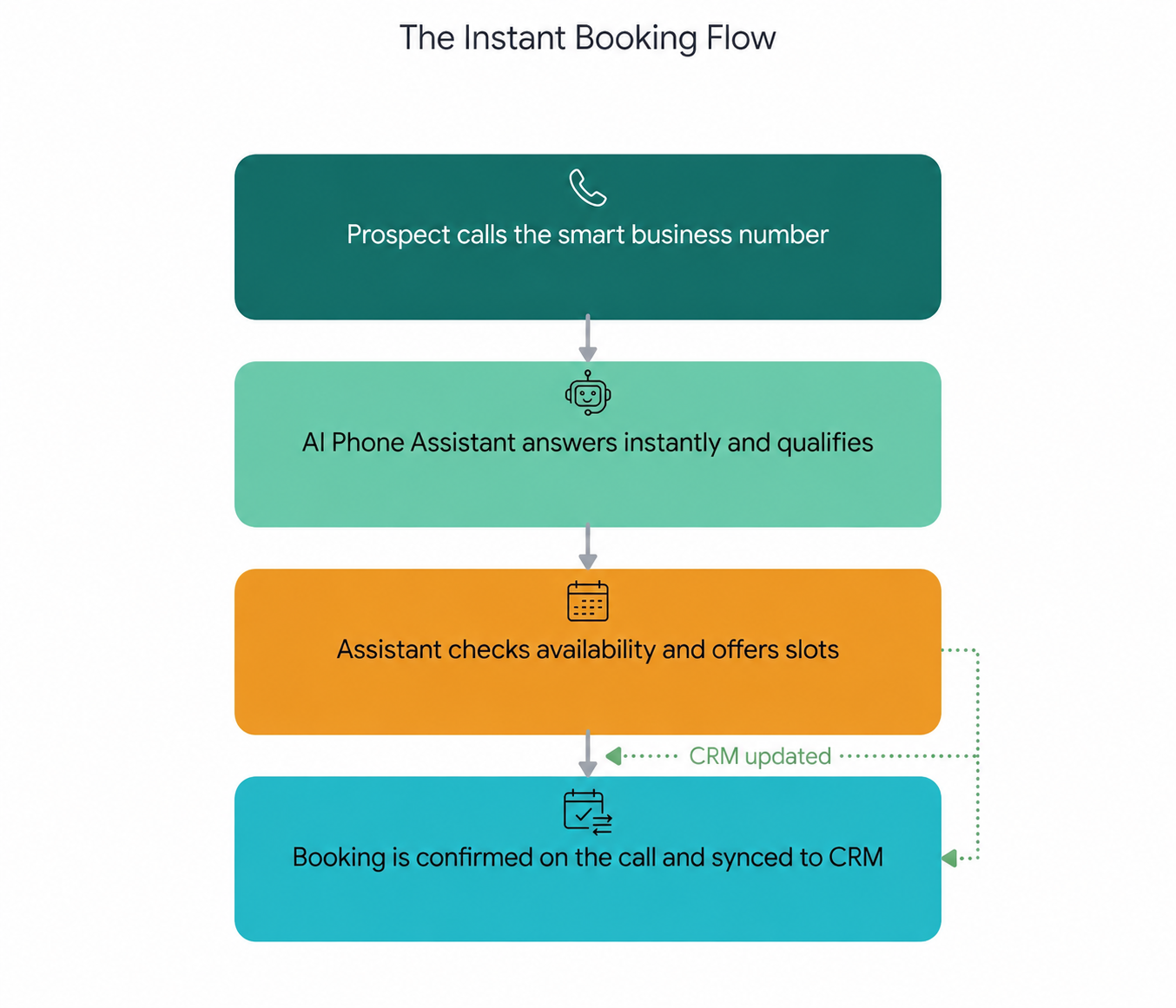
- Inbound call → AI phone assistant answers, qualifies, and books the discovery meeting. Qualification data pushed to CRM where integration supports this.
- Pre-meeting → CRM record populated with prospect context. Advisor briefed before the session. AI meeting notes tool configured and ready.
- During meeting → AI meeting notetaker — Jump, Zocks, or similar — captures the conversation, extracts action items, and surfaces key points.
- Post-meeting → CRM updated with meeting notes and next steps. Follow-up tasks generated. Next meeting booked if appropriate.
This workflow significantly reduces advisor involvement before the discovery meeting — though the advisor remains involved in the overall process and any steps that require professional judgment.
The integration question that matters most
For the AI phone assistant layer specifically, an important consideration is whether the tool reads your calendar through a native scheduling engine or through a third-party API connection. A native scheduling engine may reduce double-booking risk by reading and writing availability directly within its own system.
CRM integration for advisor-specific platforms
Most AI phone assistants with CRM integration support Salesforce and HubSpot natively. Support for advisor-specific CRMs — Wealthbox and Redtail — varies by platform. If your practice runs on Wealthbox or Redtail, confirm native integration availability before committing to any tool. A middleware connection via Zapier is a functional workaround but introduces an additional dependency in a compliance-sensitive data flow.
Top AI Phone Assistants for Financial Advisors: Tool Comparison
What to Evaluate Before Choosing
- Compliance capability — call recording consent handling, data retention practices, audit logging, and whether the vendor can provide clear documentation for your compliance officer
- Scheduling architecture — native calendar engine vs. API-dependent booking. For booking accuracy in an advisory context, understanding how each platform handles availability confirmation is worth exploring carefully
- Qualification depth — can the system conduct a natural financial intake conversation — covering investment situation, goals, and timeline — where appropriate and compliant with your firm's policies, without sounding scripted or robotic?
- CRM integration — does qualification data push to Wealthbox, Redtail, Salesforce, or HubSpot? Is that connection native or middleware-dependent?
- Setup complexity — is the system accessible to a solo advisor without technical support, or does it require developer involvement to configure and maintain?
- Pricing model — flat-rate SaaS vs. usage-based at your call volume. Usage-based pricing can produce unexpected costs during periods of high inbound activity
OnceHub's Phone Agent — Best for Scheduling-First Advisory Practices
OnceHub's Phone Agents are built around scheduling as the primary outcome. Its architecture reduces reliance on third-party APIs in the booking flow, with calendar availability handled within OnceHub's own system. For advisory practices where booking accuracy matters, this architecture is worth exploring.
- Primary job: Designed to answer inbound calls, qualify the prospect through a configurable intake flow, and — when configured appropriately — confirm a discovery meeting booking during the call
- Scheduling architecture: Reduces reliance on third-party APIs in the booking flow — availability handled within OnceHub's native workflow environment
- Qualification: Highly configurable intake questions — covering investment situation, goals, timeline, and referral source, where appropriate and compliant with firm policies — delivered in a conversational flow before a calendar slot is offered
- CRM integration: HubSpot and Salesforce — qualification responses can be pushed to contact records based on integration setup. Confirm Wealthbox and Redtail integration status directly with OnceHub
- Compliance: Confirm current audit logging, data retention, and recording consent handling capabilities with OnceHub for your specific regulatory context
- Setup: No-code setup for standard configurations — confirm requirements for your specific workflow
- Best for: Independent RIAs and solo advisors where inbound call handling, booking precision, and prospect qualification are the primary operational gaps
- See pricing
Smith.ai — Best for High-Touch Human-in-the-Loop Intake
Smith.ai combines AI with live receptionists, making it a strong option for practices where the first conversation with a prospect carries significant relationship weight and human warmth is a deliberate choice.
- Primary job: Hybrid AI and live receptionist service — adds human-in-the-loop review for intake on sensitive or nuanced conversations
- Scheduling architecture: Appointment booking coordinated by live receptionists through your calendar tool
- Qualification: Live receptionists follow your intake script — human judgment applied throughout, particularly relevant for emotionally sensitive prospect conversations
- CRM integration: Integrates with standard business tools — confirm advisor-specific CRM compatibility with Smith.ai directly
- Compliance: Confirm data handling, recording practices, and retention policies for your regulatory environment directly with Smith.ai
- Setup: Guided onboarding with script configuration supported by the Smith.ai team
- Best for: Advisory practices where the first conversation with a prospect carries significant relationship weight and human presence on the intake call is a deliberate positioning choice
- See pricing
Lindy — Best for Multi-Channel Workflow Automation
Lindy is an AI workflow automation platform that handles phone calls as one channel within a broader automation capability.
- Primary job: AI workflow automation across phone, email, and calendar — handles inbound calls as one channel within a broader automation capability
- Scheduling architecture: Calendar sync via integrations — not a native scheduling engine
- Qualification: Configurable through workflow logic — suited for advisors who need phone intake as part of a broader automated client communication sequence
- CRM integration: Wide range of native integrations including Salesforce and HubSpot — confirm Wealthbox and Redtail availability with vendor
- Compliance: Claims SOC 2 and HIPAA compliance — verify with vendor for your specific scope and confirm applicability to your SEC and FINRA requirements with your compliance officer. Subject to your firm's compliance review.
- Setup: Natural language configuration for standard workflows — accessible without developer involvement for typical use cases
- Best for: Advisors who want AI phone handling integrated into a wider workflow automation stack rather than a dedicated inbound scheduling tool
- See pricing
Synthflow AI — Best for Custom Intake Script Builds
Synthflow gives technically accessible users deep control over how their voice agent sounds, what it asks, and how it handles different call scenarios.
- Primary job: Configurable voice agent — build custom financial intake flows and call handling logic; no-code for standard workflows, though complex flows may require additional technical setup.
- Scheduling architecture: Calendar booking via third-party integrations — not a native scheduling engine
- Qualification: Highly configurable qualification flows with branching logic — suited for advisors with specific or complex intake requirements that standard tools may not accommodate
- CRM integration: Via Zapier and direct integrations — confirm advisor CRM availability and data flow reliability with vendor
- Compliance: Confirm data handling, recording consent, and audit logging capabilities with Synthflow before deployment in a regulated advisory context
- Setup: No-code for standard workflows — complex flows require meaningful configuration time and may involve technical setup
- Best for: Advisory practices with specific intake requirements and the time or resources to build and maintain a custom voice workflow
- See pricing
Quick Comparison: AI Phone Assistants
|
Capability |
OnceHub's Phone Agent |
Smith.ai |
Lindy |
Synthflow AI |
|---|---|---|---|---|
|
Primary job |
Scheduling-led inbound qualification and booking |
Human + AI hybrid reception |
Multi-channel workflow automation |
Custom voice agent builder |
|
Scheduling architecture |
Reduces reliance on third-party APIs — availability within native workflow |
Human-coordinated booking |
Calendar sync via integrations |
API-connected via integrations |
|
Qualification depth |
Highly configurable intake — investment situation, goals, timeline, referral source, and where compliant with firm policies |
Human-administered — full script flexibility |
Configurable via workflow logic |
Highly configurable — branching logic |
|
CRM integration |
HubSpot, Salesforce — confirm Wealthbox/Redtail directly |
Standard tools — confirm advisor CRMs |
Wide range of native — confirm advisor CRMs |
Via Zapier — confirm reliability |
|
Compliance approach |
Confirm with the vendor for your regulatory context |
Confirm data practices with the vendor |
Claims SOC 2/HIPAA — verify with vendor; subject to firm compliance review |
Confirm with the vendor for your context |
|
Best for |
Solo RIAs needing booking precision and prospect qualification |
Practices where human warmth on the first call is a priority |
Advisors wanting phone as part of broader automation |
Practices building custom intake workflows |
| Pricing | oncehub.com/pricing | smith.ai/pricing | lindy.ai/pricing | synthflow.ai/pricing |
All pricing subject to change — verify directly with each vendor. Figures accurate as of May 2026.
Before and After: What Changes When a Solo RIA Adds an AI Phone Assistant
Scenario A: Without an AI Phone Assistant
A prospect is referred by an existing client and calls the advisory practice at 2:15 PM on a Thursday. The advisor is in a client session — the call goes to voicemail. The prospect, a high-net-worth individual evaluating advisors following a recent life event, does not leave a message.
At 3:00 PM the advisor finishes the session and sees a missed call from an unknown number. No voicemail. No context. The advisor calls back at 3:15 PM — the prospect is now in their own meeting. A voicemail is left.
Friday morning — no callback received. The advisor considers calling again but does not want to appear persistent. Over the weekend, the prospect speaks with another advisor who happened to answer when they called.
Monday morning — the advisor calls again. The prospect answers but mentions they have already scheduled a meeting with another firm. The conversation ends politely.
Result: A warm referral with pre-established trust was lost to a missed first call and a two-business-day callback gap — a pattern that can repeat across any week where inbound calls arrive during protected session time.
Scenario B: With an AI Phone Assistant
The same prospect calls at 2:15 PM. The AI phone assistant answers immediately — professional, natural greeting.
Over the next three minutes, it identifies the nature of the enquiry, asks a small number of qualifying questions about the prospect's investment situation, current advisor relationship, and timeline for making a decision, checks the advisor's live calendar availability, and offers discovery meeting slots for the following week.
The prospect selects Thursday at 9:00 AM. A calendar confirmation lands in their inbox within seconds — professional, branded, with a pre-meeting preparation note.
The qualification summary is pushed to the advisor's CRM. The advisor finishes the 3:00 PM session to a booking notification. No voicemail. No callback required.
Result: A warm referral engaged and booked during their original call. The advisor arrives at Thursday's discovery meeting with context already established. The prospect arrives having already experienced a responsive, professional first interaction.
The difference between these two outcomes is not the quality of the advice the advisor provides — it is the system that either helps engage or loses the prospect before the first conversation begins.
Practical Implementation Guide for Independent RIAs
Step 1: Map your current inbound call workflow Before configuring anything, identify where calls are currently being missed, how long callbacks typically take, and what proportion of missed calls result in a confirmed meeting. This baseline tells you what you are solving for and gives you a measurement point to assess the tool's impact at 30 and 60 days.
Step 2: Define your qualification criteria What does the AI need to establish before offering a calendar slot? For most advisory practices, this covers the nature of the enquiry, timeline for making a decision, referral source, and current advisor situation. Consider carefully which financial information is appropriate to collect via an automated system under your firm's policies, and confirm this with your compliance officer before configuring intake questions. Keep it to three to five questions maximum.
Step 3: Configure and test the intake flow Call your own number before going live. Go through the intake flow as a prospect would experience it. Does it sound natural? Does it represent your practice appropriately? Does it handle an unexpected response gracefully? The pre-deployment test is the most reliable quality check available.
Step 4: Connect your calendar and CRM Confirm that calendar availability is read in real time and that qualification data pushes to your contact records in a way that is consistent with your data handling policies. If your practice runs on Wealthbox or Redtail, confirm native integration availability before committing to any platform.
Step 5: Review with your compliance officer before going live Call recording consent, data retention, audit logging, disclosure language, and the appropriateness of collecting certain financial information via an automated system are not decisions to make unilaterally. Bring your compliance officer into the review before the system handles a single live call. Document the decision — including what was reviewed, who approved it, and what configuration choices were made.
Step 6: Set a review date At 30 and 60 days, review booking volume from inbound calls, qualification accuracy, and any calls that were handled in ways that fell short of your standard. A first deployment is a starting point, not a finished product.
Conclusion
For independent RIAs and solo advisors, the inbound call gap is where prospect relationships may be most at risk. A warm referral lost to a missed call and a two-day callback delay is a cost that does not appear on any report — but can compound across every week of the year.
The right AI phone assistant does not replace the advisory relationship. When configured appropriately, it can handle the structural first-contact problem — helping engage prospects during high-intent moments and significantly reducing advisor involvement in the administrative steps that precede the discovery meeting.
For practices where inbound call handling and booking precision are the primary operational gaps, OnceHub's Phone Agent is worth evaluating. For practices where human warmth on the first call is a deliberate positioning choice, Smith.ai's hybrid model maintains that capability. For advisors who want phone intake as part of a broader workflow automation stack, Lindy connects the phone layer to the wider business more holistically.
What matters most is that the first moments of an inbound prospect call are treated with the same operational care as every other revenue-critical touchpoint in the practice.
See OnceHub's Phone Agent pricing or explore the platform to assess the fit for your advisory practice.
Frequently Asked Questions
Can an AI phone assistant handle a call from an upset client?
This is one of the most important boundary scenarios to test before going live. A well-configured AI phone assistant should recognise when a call involves distress or urgency and route immediately to a human — capturing what it could from the conversation first. The system should never attempt to resolve a sensitive existing client situation autonomously. Configure explicit routing instructions for calls from existing clients expressing concern or urgency, and test this scenario specifically before deployment.
What happens when an HNW prospect calls and isn't in the CRM?
The AI phone assistant handles the call the same way regardless of whether the caller is a known contact — qualifying through the configured intake flow and offering a calendar slot if they meet the criteria. Where contact import has been used to pre-load existing client data, returning clients may be recognised and their intake completed faster. For new prospects with no prior record, the qualification responses captured during the call create the CRM record at the point of booking.
Should I disclose that the caller spoke with an AI?
This is a compliance and professional judgement question rather than a technical one. Disclosure requirements vary by jurisdiction and must follow applicable law and firm policy. Many advisors choose to disclose proactively — framing the AI as "my scheduling system" — as a matter of transparency regardless of legal requirement. The right approach for your practice should be confirmed with your compliance officer. Document whatever disclosure policy you adopt as part of your AI governance documentation for SEC examination purposes.
Can the AI route known clients differently from unknown prospects?
Yes — when contact import has been used to load existing client data, the system can recognise returning callers and apply different routing logic. An existing client calling to reschedule can be handled differently from a new prospect enquiring about services. This differentiation requires explicit configuration — define the routing scenarios for both known and unknown callers before going live.
How does an AI phone assistant integrate with Wealthbox and Redtail?
Integration depth for Wealthbox and Redtail varies by platform — and is less consistent than support for Salesforce and HubSpot across most AI phone assistant tools. Confirm native integration availability directly with any vendor before committing. A Zapier-based middleware connection is a functional workaround but introduces an additional dependency in a compliance-sensitive data flow. If your practice runs on Wealthbox or Redtail, treat native integration as a required feature — not a preference — when evaluating tools.
What is the difference between an AI phone assistant and an AI meeting notetaker for advisors?
They solve different problems at different stages of the client workflow. AI meeting notetakers — Jump, Zocks, Zeplyn — handle what happens during and after a meeting: transcription, action item extraction, CRM updates. They require a meeting to already be scheduled. An AI phone assistant handles the inbound call before the meeting is booked. The two are complementary — the phone assistant fills the calendar, the meeting notetaker makes the most of every meeting that is booked.
References
-
AgentZap — Financial Advisor Phone Statistics: 15 Numbers Every Advisor Should Know in 2026
-
Envestnet — 2026 RIA Trends Defining the Industry
-
Independent Financial Partners — 5 Top Time Wasters Hindering Financial Advisors
-
Wealthtech Today — AI Notetakers and Agentic OS for Financial Advisors: The 2026 Strategic Buyer's Guide
-
FINRA Rule 4511 - General Requirements for Books and Records