


TL;DR
No single app makes a real estate agent productive — the job spans scheduling, lead follow-up, paperwork, marketing, and bookkeeping, and each of those needs a different tool doing its job well. This guide covers 10 tools across those categories, from client intake to tax season. OnceHub is our top pick for the scheduling and intake layer, since its Routing Forms and Booking Hubs solve a problem most calendar tools never touch: getting the right lead to the right agent automatically, and presenting a whole team through one branded booking page.
Why the Right Tools Matter More Than Ever in 2026
AI-powered tools have quietly moved from novelty to daily habit in real estate. NAR's 2025 Technology Survey found that 17% of agents reported AI having a significant positive impact on their work, with another 33% reporting a moderate positive impact — meaning half the industry is now seeing real returns from the tools they've adopted, not just experimenting with them.
At the same time, the business itself keeps getting more collaborative. NAR's 2026 Member Profile found that 21% of Realtors now work as part of a team, with a typical team built around four agents. That changes what "productivity" even means — it's no longer just about one agent's calendar, but about how leads, showings, and paperwork move between several people without anything falling through the cracks.
The tools below are grouped by the actual jobs that eat an agent's week: getting a prospect on the calendar, keeping leads warm, getting documents signed, making listings look good, and staying on top of the books.
|
Category |
Tool |
Best For |
|---|---|---|
|
Scheduling & Intake |
OnceHub |
Routing leads and consolidating a team's booking pages |
|
CRM & Lead Follow-Up |
Follow Up Boss, Wise Agent |
Fast lead routing (teams) and affordable simplicity (solo agents) |
|
Transaction Management |
dotloop, DocuSign |
Real estate-specific paperwork and universal e-signature |
|
Marketing & Communication |
Canva, BombBomb |
Social/listing graphics and personal video outreach |
|
Visual Marketing |
Matterport |
3D virtual tours and floor plans |
|
AI Content Assistance |
ChatGPT |
Listing descriptions, emails, and marketing copy |
|
Financial & Tax |
QuickBooks Solopreneur |
Mileage, expenses, and quarterly tax estimates |
The 10 Best Productivity Tools for Real Estate Agents in 2026
Scheduling, Intake, and Lead Routing
1. OnceHub — Editor's Top Pick
OnceHub is the tool on this list built specifically around getting a lead onto the right calendar automatically, rather than treating scheduling as an afterthought bolted onto a CRM.
What this looked like when I tested it
I built a routing form in a OnceHub demo account to see how much of a real estate intake it could actually handle. First question: buying or selling. Choosing "selling" branched to a property-type question, then a price band — and based on those two answers alone, the form dropped me straight onto a specific host's calendar without ever showing the full team's availability. The part I didn't expect was that when I abandoned the form halfway through and came back, my earlier answers were still there. For a seller lead who gets interrupted mid-form, that's the difference between a partial record and nothing at all.
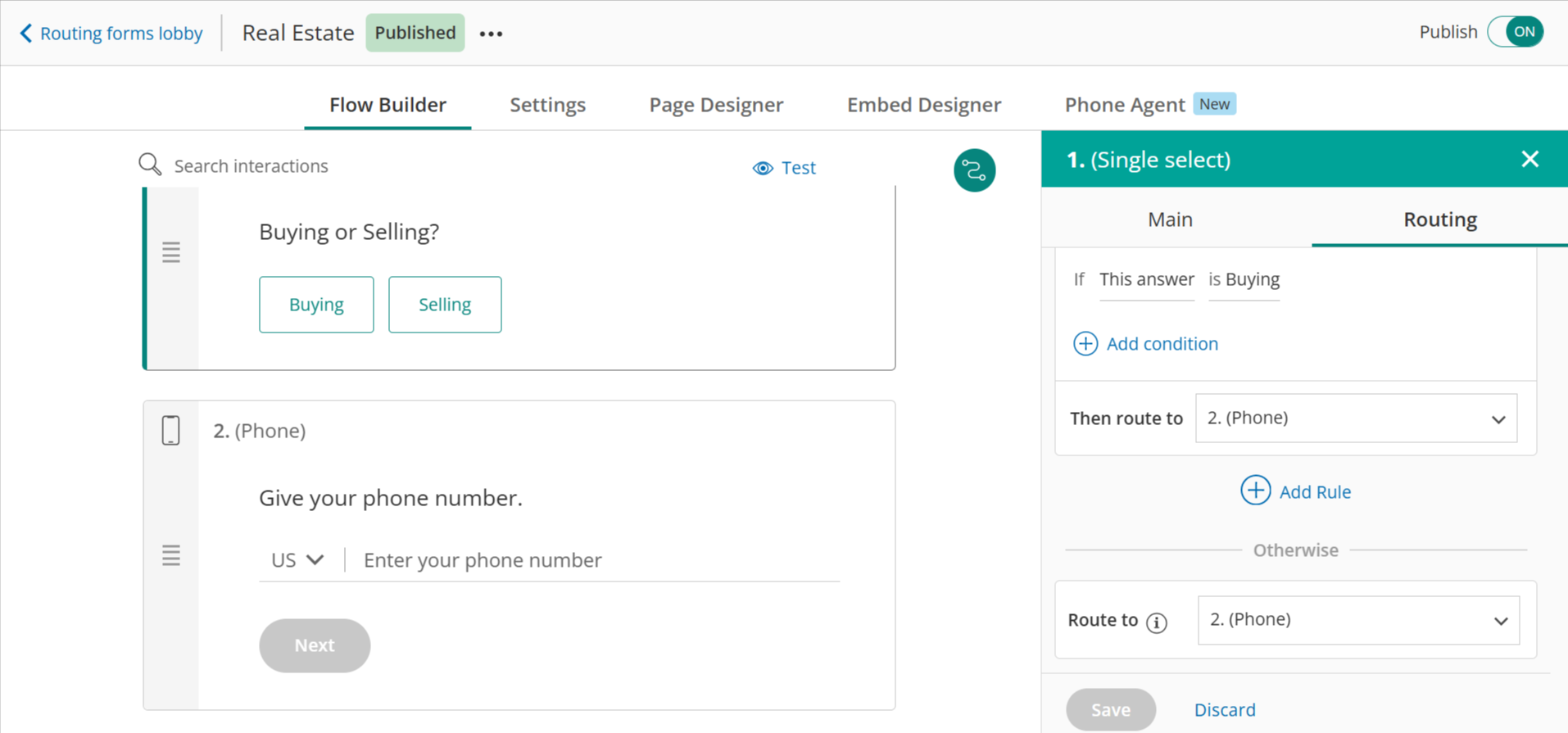
- Routing Forms use conditional logic to branch a prospect by buyer/seller status, price range, property type, or language, and can book the meeting in-form without ever showing a plain calendar
- Booking Hubs combine every agent's calendar into one branded page, so a team of 5 or 25 agents can be presented as one coherent front door instead of a pile of separate links
- Phone Agents can answer and route inbound calls by voice, which still matters in an industry where plenty of leads come in by phone, not just web forms
- A genuine free Basic plan covers single-agent scheduling and calendar sync, with paid tiers adding team routing and CRM integrations as a solo agent grows into a team
CRM and Lead Follow-Up
2. Follow Up Boss
Built around speed-to-lead, Follow Up Boss pulls leads in from sources like Zillow, Realtor.com, and Facebook Ads and gets them in front of an agent fast.
- Automatically assigns new leads to agents based on team rules, so nothing sits in a shared inbox waiting to be claimed
- Action plans keep every agent on a defined follow-up sequence instead of relying on memory
- Strong native integrations with major lead sources cut down on manual data entry
- Doesn't include a built-in IDX website, so most teams pair it with a separate site or lead-gen tool
3. Wise Agent
Wise Agent trades some of the marketing horsepower of bigger platforms for simplicity and price, which is exactly what a lot of solo agents actually want.
- Includes a one-click ad creation tool for Facebook and Google, paired with a landing page to capture the resulting leads
- Strong focus on transaction management, tracking each step of a deal from contact to close
- Priced around $49 a month, considerably less than team-oriented platforms
- A solid fit for solo agents or small teams who want the essentials without a steep learning curve
Transaction Management and E-Signature
4. dotloop
Owned by the same Zillow-affiliated group behind ShowingTime+, dotloop has one of the largest footprints of any real estate-specific transaction management platform, with 7,600+ brokerages and 190+ local and state associations on the platform.
- Partnered with 190+ local and state associations for forms coverage, alongside hundreds of MLS feeds — which is why compliance-heavy brokerages tend to standardize on it rather than a general document tool
- Widely integrated into brokerages' existing compliance workflows, which matters more than raw features when a transaction has to meet brokerage-specific requirements
- Keeps documents, signatures, and communication tied to a specific transaction rather than scattered across email
- The natural choice for agents whose brokerage already runs its compliance process around dotloop
5. DocuSign
DocuSign remains the default e-signature tool outside real estate-specific platforms, and for good reason — it's fast, familiar to clients, and works for virtually any document.
- Lets clients sign engagement letters, disclosures, and offers remotely from any device
- Tracks signature status in real time, so an agent isn't guessing whether a client has actually opened the document
- Its newer IRIS features add contract-clause intelligence, surfacing relevant clauses on the e-signature side
- Works well for agents who need signatures on documents outside a single real estate transaction platform
Marketing and Client Communication
6. Canva
Canva remains the fastest way for an agent without a design background to produce professional-looking marketing material.
- Template libraries built for real estate cover listing flyers, open house signs, and social posts
- AI-assisted design tools speed up resizing and reformatting the same graphic across Instagram, Facebook, and print
- No design software or subscription-heavy creative suite required
- Works well alongside a CRM or a video tool as the graphics layer of a marketing stack
7. BombBomb
BombBomb lets agents record, send, and track short videos directly from Gmail or Outlook, turning a routine follow-up email into a face-to-face moment.
- Videos embed as a thumbnail directly inside a normal email, so there's no separate app for the recipient to open
- Tracks who opened an email and how much of the video they watched, giving a concrete signal for when to follow up
- Works especially well for the kind of personal check-ins that a templated drip email can't replicate
- Integrates with several major real estate CRMs so video activity feeds back into the same contact record
Visual Marketing
8. Matterport
Matterport consolidates the photographer, floor plan, and measurement visit into a single 3D scan, producing an interactive digital twin of the property.
- Buyers can navigate a listing in first-person, dollhouse, or 2D floor plan view at their own pace before ever booking a showing
- Automatically generates schematic floor plans in PNG, SVG, and PDF formats, ready for MLS listings or print brochures
- Built-in measuring tools capture room and ceiling dimensions directly from the scan, useful for both marketing and renovation planning
- Reduces the number of separate site visits needed to produce a full listing package
AI Content Assistance
9. ChatGPT
For listing descriptions, follow-up emails, and marketing copy, general-purpose AI writing tools like ChatGPT have become a standard part of most agents' workflow.
- Drafts a serviceable first pass of a listing description in under a minute, which an agent can then adjust for local flavor and accuracy
- Helps rewrite the same message for different channels — a listing description, a social caption, and a follow-up email all built from one property's details
- Useful for brainstorming email sequences or scripts, though it works best as a first draft, not a final one
- Free and paid tiers mean there's no meaningful cost barrier to trying it
Financial and Tax Management
10. QuickBooks Solopreneur
QuickBooks Solopreneur, the rebuilt version of QuickBooks Self-Employed, is built specifically for independent contractors — a category that includes nearly every real estate agent in the country.
- Tracks mileage automatically using a phone's GPS, which matters given how much of an agent's week is spent driving to showings
- Captures receipts by photo and categorizes expenses as business or personal
- Estimates quarterly taxes owed and can transfer data directly to TurboTax at filing time
- Priced at roughly $20 a month, with real estate listed among its most common industries of use
Why OnceHub Is Our Top Pick for Scheduling and Intake
Every tool above solves a real problem — but most of them assume a lead has already been matched to the right agent by the time they show up in the CRM or on the calendar. OnceHub is built for the step before that: making sure a new inquiry gets routed correctly in the first place, and giving a whole team one clean front door to be routed through.
Its Routing Forms can ask the handful of questions that actually matter — buying or selling, price range, property type, language — and send the visitor to the right specialist's calendar automatically, with the meeting booked in the same flow. Its Booking Hubs solve the other half of the problem: instead of a dozen agents each sharing their own separate link, a brokerage can present one branded page where a prospect picks a location, a specialty, or a specific agent by name. Layer in Phone Agents for the calls that still come in by phone, and OnceHub covers the front-of-funnel work that most CRMs and productivity tools simply assume has already happened.
Conclusion
Productivity for a real estate agent isn't one tool doing everything — it's a small stack where each piece removes a specific kind of friction. Canva and Matterport make listings look their best. BombBomb and a solid CRM keep leads warm. dotloop and DocuSign keep paperwork moving. QuickBooks Solopreneur keeps the books in order without eating a weekend. But the layer that determines whether a lead becomes a client in the first place — getting them routed to the right person and onto a calendar fast — is where OnceHub does work none of the others are built to do, which is exactly why it tops this list.
FAQs
1. What's the single most important productivity tool for a new real estate agent? A CRM that automates lead follow-up is usually the highest-leverage first purchase, since manual follow-up is where new agents lose the most business. Pairing it with a scheduling tool like OnceHub closes the loop by getting that same lead onto a calendar without back-and-forth emails.
2. What's the best scheduling tool for a real estate team, not just a solo agent? OnceHub is built for exactly this case. Its Booking Hubs consolidate an entire team's calendars into one branded page, and its Routing Forms make sure each inquiry reaches the right agent based on property type, price range, or specialty — something a single shared calendar link can't do.
3. Do I need both a real estate-specific transaction tool and a general e-signature tool? Not usually both for the same task, but many agents end up using dotloop (or a similar platform) for anything tied to brokerage compliance workflows, and DocuSign for signatures on documents outside that system, like referral agreements or personal contracts.
4. Are free AI tools like ChatGPT good enough for listing descriptions? They're a solid starting point for a first draft, but the output still needs a human pass for local accuracy, tone, and anything specific to the property that a generic prompt wouldn't know. Most agents use it to save time on the blank page, not to skip the edit entirely.
5. How much should a solo agent expect to spend on a basic productivity tech stack? It can start close to free. OnceHub's Basic plan, Canva's free tier, and ChatGPT's free tier cover scheduling, design, and content drafting at no cost, with QuickBooks Solopreneur (around $20/month) and a CRM typically the first paid additions as a business grows.