

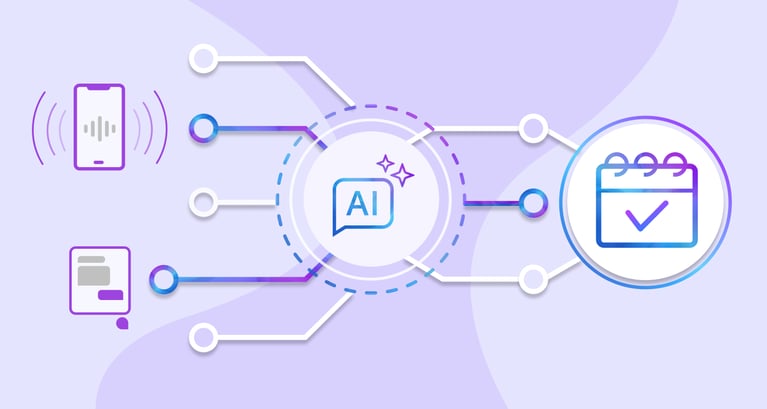
For decades, businesses relied on basic automation, such as IVR (Interactive Voice Response) phone trees and structured chatbots. These systems were initially created for a single, necessary purpose: to route high volumes of simple calls and chats and reduce the burden on human staff.
But for the customer, the reality often feels much different.
Picture this: You call a company contact line. You press "1" for sales, "4" for support, and "0" to speak to a human. Then, you wait on hold for twenty minutes, only to get disconnected.
Now, imagine a different scenario. You call, speak naturally, and the system understands you instantly. It checks the calendar and books your meeting in under two minutes, without a human ever picking up.
This is the promise of conversing with artificial intelligence. It isn't just about answering questions anymore; it's about getting things done.
In this guide, we’ll break down exactly what conversational AI is, how it works, and how businesses are using it to turn casual chats into confirmed appointments - all while keeping your business data secure.
What does a Conversation with Artificial Intelligence Actually Mean?
At its core, conversational AI is technology that enables computers to understand, process, and respond to human language naturally. You can speak or type just like you would to a friend, and the system “gets it.”
To understand this better, let’s compare it to the old way of doing things:
You might be wondering, "How does the computer actually know what to say?" This is where the technology gets interesting, but it also introduces a challenge every business needs to manage: control.
How Conversational AI Works?
You don’t need a PhD to grasp the engine behind conversational AI, which heavily relies on machine learning. At a high level, it relies on two main components working together to understand and respond naturally:
1. The Input: Understanding with Natural Language Processing (NLP) When you provide input, the system relies on Natural Language Processing (NLP). This is the broad field of technology dedicated to enabling computers to understand and generate human language.
The initial step is a simple understanding. The AI uses NLP techniques to parse your speech or text to correctly identify two things:
-
Your Intent: What you actually want to do (e.g., "book a meeting" vs. "cancel a subscription").
-
The Context: The key details involved (names, dates, times, etc.).
2. The Output: Generating with Large Language Models (LLMs) To deliver sophisticated and human-like answers, modern systems primarily rely on a Large Language Model (LLM).
The LLM is a highly advanced type of model within the broader NLP field. Because it is trained on vast amounts of data, it cannot only understand but also generate coherent, grammatically correct, and contextually relevant responses.
3. The Partnership: This combination is what allows today’s conversational AI to feel so natural and versatile. NLP provides the fundamental structure for understanding what you said, while the LLM provides the advanced capacity for generating the perfect response.
From Talking to Doing: Agentic AI
This is where AI becomes truly useful for businesses. Unlike a standard bot that passively waits to answer questions, agentic AI takes action:
-
Passive AI: “Here’s a link to our calendar.”
-
Agentic AI: “I see you’re free next Tuesday at 10 AM. I’ve booked that slot and sent the invite.”
This ability to act - booking meetings, updating records, routing calls - turns a conversation into a completed task, not just an exchange of words.
Control vs. Complexity: Keeping the AI in Check
Business owners’ biggest fear is AI going "off-script." To keep it safe, you need specific controls - not just connecting it to your data (RAG), but also setting strict rules on behavior (system prompts) and blocking unsafe topics (guardrails).
Here lies the trade-off: Implementing these controls adds significant complexity.
When choosing software, you generally face two options:
-
Open Platforms: These give you access to every technical lever. You have total control, but you often need technical skills or engineers to configure the safety rules correctly.
-
Managed Solutions: These handle the complex safety measures in the background. You get a safe, on-brand AI agent without needing to understand its underlying engineering.
Now that we understand the mechanics and how to control them, let’s look at the specific reasons why this matters for your bottom line.
Why Conversational AI Matters for Businesses?
“Live chat and digital customers often expect a reply within 10 minutes or less.” - SynthicAI
Adopting this technology isn't just about chasing a shiny new trend. It is about fixing the biggest killer of business growth: friction.
These days, customers are impatient. They want answers now, not just during your business hours. Every second they spend searching your website, waiting on hold, or filling out a long contact form is a chance for them to give up and go to a competitor.
Here is why this shift matters for your bottom line:
1. Improves Engagement by Removing Friction
Modern customers expect near-instant responses - even at 2 AM. Conversational AI meets that demand, answering questions, qualifying leads, and resolving issues instantly. By cutting wait times, it significantly improves the customer experience, keeping customers happy, engaged, and less likely to look elsewhere.
2. Increases Efficiency Across All Customer Interactions
Your human team has limits; they can only handle one conversation at a time. If your best people are tied up answering routine questions - whether it's a sales lead, a support ticket, or a scheduling request they aren't focusing on high-value work. Conversational AI handles these repetitive interactions instantly, freeing your staff to tackle complex problems and build relationships.
3. Scales Operations Without Increasing Headcount
Growth usually comes with a cost: hiring more staff. If your lead volume doubles overnight, you can’t instantly onboard a new team. AI, however, handles hundreds of conversations simultaneously, letting you scale up or down without the overhead.
We know why it is valuable, but where does it actually fit into your daily operations? Let’s look at the specific business applications where this technology shines, from text chats to voice calls.
Text-Based AI Interactions
Text is often the first place businesses deploy AI, and for good reason. It is low-friction and high-impact.
-
Live Chat & FAQ Automation: Instead of a static "Contact Us" form, an AI agent lives on your website. It handles the repetitive questions- "What are your hours?", "Do you ship to Canada?" "How do I reset my password?" - instantly. This clears the queue for your human support team to handle the tricky, emotional, or complex issues that actually need empathy.
-
Smart Ticketing Systems: In IT or internal support, AI doesn't just log a ticket; it tries to solve it. If an employee types "my printer won't work," the AI can guide them through basic troubleshooting steps before ever alerting a technician. This drastically reduces the human workload.
Also read: How to Create a Booking Link
Voice Conversations and AI Phone Booking
“AI-based voice/chat systems report that they drastically reduce call abandonment and missed‑call loss compared with traditional phone/IVR systems.” - Retell AI
Text is convenient, but sometimes voice is faster and more human. Forget the frustrating old menus (“Press 1 for Sales”). With AI-powered Phone Booking from OnceHub, every call becomes an opportunity.
.png?width=1540&height=700&name=features_of_phone_booking%20(1).png)
Here’s how a modern AI-driven phone workflow works:
-
Capture Intent: A customer calls your number. The AI answers immediately- no hold music. It asks naturally, “How can I help you today?”
-
Collect Information: The caller says, “I need to book a demo.” The AI gathers all the details it needs - name, company, email- just like a professional receptionist would.
-
Instant Scheduling: The AI checks your team’s live calendar, offers available slots (“Tuesday at 2 PM or Wednesday at 10 AM”), and locks in the meeting on the spot.
Why it matters:
-
24/7 Availability: Calls at 8 PM or over the weekend? No problem. Every lead has a chance to convert.
-
Voicemail Transcription: Missed calls still turn into actionable opportunities. The AI transcribes messages and delivers them straight to your inbox for quick follow-up.
-
Scalability: Whether it’s 5 calls or 500, the AI handles them all seamlessly. Peak hours no longer mean missed opportunities.
-
Smart, Multi-Location Scheduling: Need to offer multiple office locations or time zones? The AI automatically adjusts and routes the caller to the right option.
-
Controlled Conversations: Every interaction stays focused and on-brand, with guardrails that ensure a smooth, secure, and professional experience.
Scheduling and Action-Oriented Conversations
The true power of conversational AI isn’t just chatting - it’s driving real business actions. Every conversation can become a conversion if designed properly.
“Did you know, according to a study by agentiveaiq, automated scheduling + AI‑powered booking systems can reduce no‑shows by up to 30%.”
Automated Appointment Booking:
Whether it’s via text or voice, AI can qualify a lead and instantly place a meeting on your team’s calendar. No manual back-and-forth, no missed opportunities - just seamless scheduling.
Routing Inquiries:
Think of AI as a traffic controller. It listens, understands, and sends the customer to the right person. Technical questions go to engineering, pricing inquiries to sales - all automatically, without human intervention.
Real-World Implementation: OnceHub’s AI-powered Phone Booking, along with advancements in AI chatbots, captures intent during the conversation and instantly schedules appointments. It turns what used to be a passive interaction (leaving a voicemail) into a measurable business outcome (a booked meeting).
We have seen the applications, but how do you actually build these conversations so they don't sound like a robot? Let's dive into the design principles that make AI effective.
Designing Effective AI Conversations
.png?width=1140&height=920&name=AI-Powered%20Tools%20for%20Optimized%20Scheduling%20and%20Conversions%20(3).png)
You wouldn't hire a receptionist who forgets your name ten seconds after you introduce yourself. You shouldn't accept that from your AI, either.
Building a good conversation with artificial intelligence isn't just about plugging in a bot and hoping for the best. It requires design. You have to teach the system how to be helpful, how to remember details, and most importantly, how to get the job done without annoying your customer.
What Makes AI Conversations Effective?
The difference between a frustrating bot and a helpful AI comes down to two things: Context and Intent.
-
Context is King: Effective AI remembers what you just said. If a customer asks, "Do you have appointments next week?" and then follows up with, "How about Tuesday?", the AI must understand that "Tuesday" refers to "next week's appointments." If it asks, "Tuesday of which week?", the conversation feels broken.
-
Intent Over Keywords: Bad bots scan for keywords. Good AI looks for meaning. If a customer types "my bill is wrong" or "I was overcharged," the AI should recognize both as a "Billing Issue" and route them to the same solution.
Avoid the common pitfalls to keep the conversation moving; you need to avoid the "Dead End." Never let a conversation stop with "I don't understand." Always offer a path forward, like "I didn't catch that, but I can help you book a meeting or check pricing. Which would you like?"
Also read: The Best Voicemail Alternative in 2025: Phone Booking
How to Make AI Conversations Actionable?
This is the biggest missed opportunity for most businesses. They set up AI to talk, but not to do.
To get a real return on your investment, you need to connect your AI to your actual business tools. This is where "Agentic AI" shines. It moves the customer from a passive chat to a completed task.
-
Connect to Your Calendar: Don't just have the bot send a link. Let the AI find the slot and book it directly. For example, OnceHub's Phone Booking doesn't just tell a caller your hours. It checks your live availability, agrees on a time with the caller, and puts the meeting on your calendar instantly.
-
Qualify, Then Route: Use the conversation to filter leads. If the AI asks, "How large is your company?" and the answer meets your criteria, the AI should automatically transfer that chat to a live sales rep. If they are too small, it might point them to a self-serve checkout page.
Making the AI useful is critical, but you also need to ensure it doesn't feel creepy or cold. Let’s look at how to build trust with the right tone.
Ensuring a Human-Like, Trustworthy Experience
There’s a fine line between being helpful and feeling creepy. Your AI should feel natural, but it doesn’t need to pretend to be human - pretending can actually backfire. Here’s how to strike the right balance:
Risks and Limitations of Conversational AI
While powerful, this technology isn't magic. It has risks, and smart business leaders manage them upfront.
-
Misinterpreted Intent: Sometimes the AI gets it wrong. A customer might say, “I want to change my appointment,” and the AI thinks they want to cancel. Always provide a clear “human escape hatch” so users can reach a real person if needed.
-
Hallucinations (Making Things Up): Standard AI can invent answers. Using methods like Retrieval-Augmented Generation (RAG) ensures the AI only accesses your verified business data, preventing mistakes or false promises.
-
Data Privacy: Be careful with sensitive information. Avoid asking for passwords, credit card numbers, or other private details unless your tool is fully secured for that purpose.
You have built a smart, actionable AI. But is it actually working? Let's look at the numbers you need to track to prove it is worth the investment.
Measuring Success of Conversational AI
You can’t improve what you don’t measure. Implementing conversational AI is an investment, and to know if it’s paying off, you need the right metrics.
Metrics That Matter:
-
Response Time: How quickly does the AI answer? Near-instant replies keep customers engaged and satisfied.
-
First-Contact Resolution: Did the AI solve the issue the first time, or did the customer need to follow up? High numbers here show your AI is smart and effective.
-
CSAT (Customer Satisfaction Score): Simple feedback, like thumbs up/down, provides immediate insight into the user experience.
Phone Booking-Specific Metrics:
-
Call-to-Appointment Conversion: Out of 100 callers, how many actually booked a meeting?
-
No-Show Reduction: Are automated reminders and confirmations helping clients show up?
ROI of Action-Oriented AI:
-
Reduced Admin Work: Every appointment the AI books is time your team doesn’t spend on repetitive tasks.
-
Increased Lead Capture: AI works 24/7, capturing leads outside business hours.
-
Scalability: AI handles high volumes without additional staff, turning growth into pure profit.
We have covered the what, the how, and the why. Let’s wrap up with the main takeaways you need to remember.
Conclusion
To sum up, the days of clunky, robotic chatbots are fading. A true conversation with artificial intelligence is dynamic, multi-channel, and most importantly, actionable. It isn't just about answering questions; it is about guiding your customers to a solution, whether that is resolving a tech issue or booking a high-value meeting.
We have seen how technologies like NLP and Agentic AI are moving businesses from simply "talking" to actually "doing." Tools like OnceHub's Phone Booking act as the execution layer in this process. They take the customer's intent and turn it into a measurable outcome - a confirmed appointment on your calendar, without you ever lifting a finger.
Ready to turn talk into action? Don't let another lead get lost in voicemail or stuck in a chat loop. Try OnceHub's AI-powered Phone Booking today and see how seamless automation can fill your calendar and grow your business.
FAQ’s
What is the difference between chatbots and conversational AI?
Think of a chatbot as a digital multiple-choice quiz. It follows a strict script and can only answer questions it has been explicitly programmed for. If you stray from the path, it gets stuck. Conversational AI, on the other hand, is like a digital assistant that actually listens. It uses technologies like Natural Language Processing (NLP) to understand the meaning behind your words, not just the keywords. This allows it to handle complex, unscripted conversations and adapt to your preferences in real time.
How does AI phone booking work?
It works by combining three smart technologies. First, Speech Recognition turns your spoken words into text. Then, a Large Language Model (LLM) understands your intent (e.g., "I need a meeting next Tuesday") and checks the live calendar for availability. Finally, Text-to-Speech converts the AI's response back into a natural-sounding voice to confirm the time with you. It happens in milliseconds, creating a fluid conversation.
Can conversational AI handle multi-step scheduling?
Yes. Unlike simple bots that forget what you said a moment ago, conversational AI retains context. If you say, "I'd like to book a demo," and then follow up with, "Actually, can we make that next week?", the AI remembers you are still talking about the demo. It can guide you through multiple steps - collecting your name, company details, and preferred time without losing track of the conversation.
How do I measure the ROI of conversational AI?
You measure it by looking at efficiency and conversion. Track metrics like Call-to-Appointment Conversion Rate (how many callers actually book) and No-Show Reduction (did the AI's reminders work?). Also, consider the Administrative Time Saved if your AI handles 50 calls a week; that’s dozens of hours your team isn't spending on the phone, which is a direct cost saving.
Is AI phone booking safe and secure?
Reputable ai systems, including AI booking systems such as those from OnceHub, prioritize security. They typically use Retrieval-Augmented Generation (RAG), which restricts the AI to only using your approved business data, preventing it from making up answers. Additionally, they often include standard security measures, such as data encryption and compliance with privacy regulations, to protect customer information.